

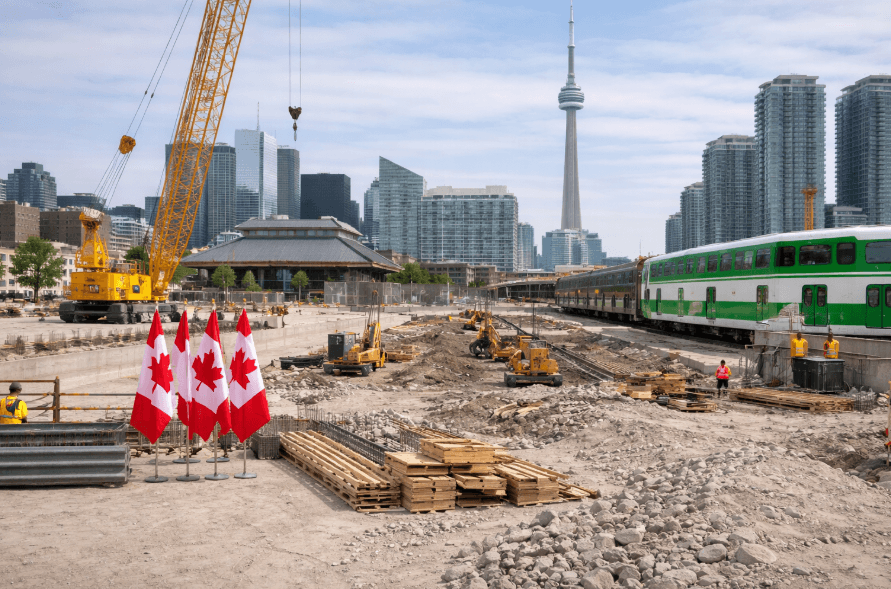
Federal-provincial agreement targets affordability, infrastructure and job creation amid economic uncertainty
By Business Desk Reporter
The governments of Ontario and Canada have signed a sweeping new infrastructure and housing agreement aimed at accelerating home construction, expanding transit networks and supporting economic growth, as policymakers respond to affordability pressures and global economic uncertainty.
Announced Monday in Toronto, the Canada-Ontario Partnership to Build will see $8.8 billion in combined federal and provincial funding over the next decade. The agreement focuses on lowering development costs, advancing major transit projects and unlocking housing supply across the province.
Premier Doug Ford and Prime Minister Mark Carney framed the deal as a cornerstone of efforts to address housing shortages while sustaining economic momentum.
“Today’s agreement will be transformational for Ontario and Canada, delivering new homes, transit and infrastructure and supporting hundreds of thousands of good-paying jobs for Ontario workers,” said Premier Doug Ford. “Our government will continue to deliver on our plan to protect Ontario in partnership with the federal government and municipalities by lowering the cost of building, getting shovels in the ground faster, cutting red tape and investing in workers.”
Focus on lowering housing costs and boosting supply
A central component of the agreement is a commitment to reduce municipal development charges (DCs), which can significantly increase the cost of building new homes. The funding framework will support municipalities in cutting these fees by up to 50 per cent, while offsetting lost revenue through infrastructure investments.
Officials say the approach is designed to remove financial barriers for developers and accelerate construction timelines, ultimately increasing housing supply and improving affordability.
The agreement also introduces a Harmonized Sales Tax (HST) rebate for new homebuyers. Eligible buyers of homes valued up to $1 million will see the full 13 per cent HST removed, while homes priced between $1 million and $1.5 million will qualify for rebates of up to $130,000. The federal government is expected to contribute $875 million toward the initiative, pending legislative approval.
Combined, the tax measures are projected to deliver approximately $2.2 billion in housing-related relief.
“Our new partnership with Ontario is about building more affordable homes, more transit and more careers in the skilled trades,” said Mark Carney, Prime Minister of Canada. “We’re tackling the housing crisis from every angle — so we can build up housing supply and bring down costs for Canadians. We’re building Ontario strong and Canada strong.”
Major transit investments included in deal
Beyond housing, the partnership outlines co-ordinated funding and planning for several high-profile transit initiatives across the Greater Toronto and Hamilton Area (GTHA) and beyond.
These include the Waterfront East Transit line, a jointly funded նախագ linking Toronto’s eastern waterfront communities, as well as expanded GO rail service under the “GO 2.0” initiative, which aims to increase capacity and service frequency along existing and potential new corridors.
The agreement also supports ongoing work on priority transit projects such as the Ontario Line, the Eglinton Crosstown West Extension, the Scarborough Subway Extension, the Yonge North Subway Extension and the Hamilton light rail transit (LRT) system.
In addition, both levels of government committed to advancing planning for the Alto high-speed rail corridor, which would connect major population centres between Toronto and Quebec City.
Municipal role and local impact
Municipal governments are expected to play a key role in implementing the agreement, particularly in supporting development charge reductions and identifying priority infrastructure projects.
Toronto Mayor Olivia Chow welcomed the announcement, highlighting the city’s existing efforts to accelerate housing development.
“I’m pleased to join with the federal and provincial governments in this partnership to build more housing, transit and support good jobs,” said Olivia Chow, Mayor of Toronto. “The City of Toronto has taken bold steps to cut development charges on new homes, speeding up our development timeline and investing in affordable housing. Further, we have invested in the design of the Waterfront East Transit line. Today’s historic announcement takes our work further and will deliver thousands more affordable homes and better transit, benefiting our city for generations.”
Economic context and next steps
The agreement comes as governments face mounting pressure to address housing affordability while navigating external risks, including U.S. tariffs and broader global economic uncertainty.
Officials say the partnership provides a framework to keep major infrastructure projects moving while strengthening domestic supply chains. Projects funded under the agreement will be subject to Ontario’s “Buy Ontario” policy, prioritizing local suppliers and labour.
Ontario is already investing heavily in infrastructure, including a $70-billion transit expansion plan and billions in housing-enabling programs. The new federal partnership is expected to accelerate those efforts and enhance coordination across all levels of government.
The Canada-Ontario Partnership to Build is positioned as a long-term strategy to increase competitiveness, stimulate job creation and ensure that both housing and infrastructure development keep pace with population growth in the years ahead.