

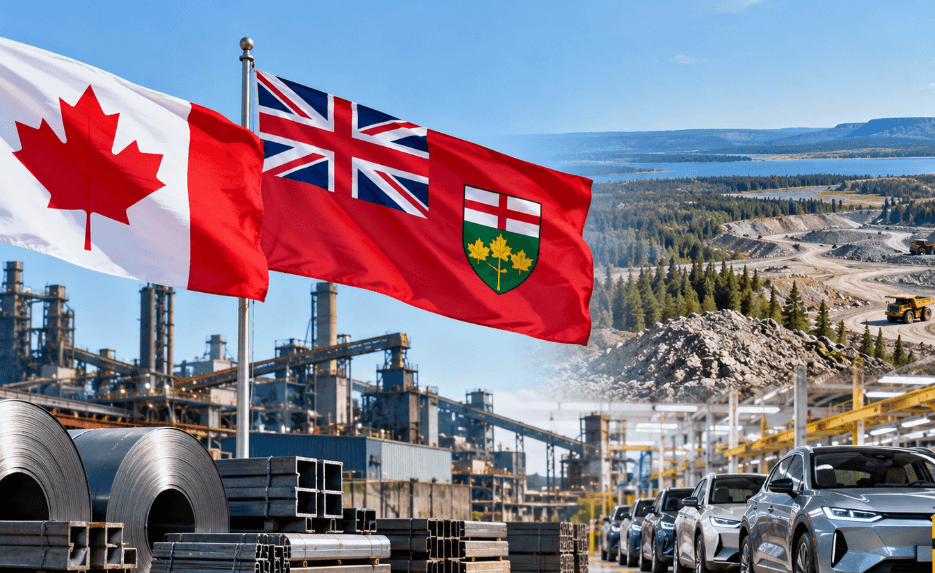
OTTAWA, Ontario Premier Doug Ford and Prime Minister Mark Carney have announced a joint $8.7 billion action plan aimed at protecting Canadian workers from U.S. tariffs, strengthening domestic manufacturing and accelerating investment in the steel, automotive and critical minerals sectors.
The federal-provincial agreement introduces new funding commitments, procurement measures and regulatory coordination intended to improve industrial competitiveness while reducing Canada’s exposure to international trade uncertainty.
The initiative focuses on supporting tariff-affected businesses, modernizing production facilities and developing infrastructure needed for long-term economic growth.
Canada and Ontario Commit Billions to Industrial Development
The agreement reflects growing cooperation between Ottawa and Queen’s Park as Canadian manufacturers face trade barriers, changing supply chains and increased international competition.
“Working in partnership to protect Canadian workers, Ontario and Canada are fortifying our industrial base and securing the good-paying jobs of the future,” said the Hon. Doug Ford, Premier of Ontario. “The agreement we are announcing today is the next step in our ongoing partnership to provide tariff-impacted workers the certainty and stability they deserve, while unlocking Ontario’s vast supply of critical minerals and building a more competitive and resilient economy that can stand up to anything that comes our way.”
Prime Minister Carney emphasized the importance of coordinated government investment.
“From mine to mill to assembly line, Canada and Ontario are protecting jobs today and making bold investments that will build a stronger, more resilient, more independent Canadian economy for tomorrow,” said the Rt. Hon. Mark Carney, Prime Minister of Canada. “Today’s action plan is cooperative federalism in action. Canada is strong. Canada is united. Canada is working.”
Steel Industry to Receive $5.22 Billion in Joint Funding
A central component of the agreement is the establishment of a Joint Steel Action Fund, supported by $3.55 billion from the federal government and $1.67 billion from Ontario over five years.
The fund will help steel manufacturers diversify production, pursue international markets and supply emerging industries, including defence, advanced manufacturing and energy infrastructure.
Both governments will also use their respective Buy Canadian and Buy Ontario procurement policies to increase demand for domestically produced steel.
Additional measures include stronger enforcement against unfairly subsidized steel imports and the creation of a Canada-Ontario Steel Task Force.
Reducing Transportation Costs and Improving Competitiveness
The task force will initially examine opportunities to reduce steel shipping costs while assessing import trends and existing trade protections.
Canada’s steel industry supports more than 23,000 direct jobs and contributes to employment across the fabricated metals sector, which accounts for approximately 172,000 jobs.
Automotive Manufacturers to Benefit from $2.5 Billion Investment
The federal and provincial governments will allocate an additional $2.5 billion over two years to automotive manufacturing projects.
Ottawa will contribute $1.5 billion, while Ontario will provide $1 billion.
The funding will support investments in modern machinery, upgraded assembly lines and production technologies for connected and electric vehicles.
Canada will also maintain greenhouse gas emissions standards for new light-duty vehicles at 2026 levels through the 2029 model year, with annual increases resuming in 2030.
A Canada-Ontario Automotive Task Force will coordinate implementation and support the industry’s transition.
The Canadian automotive sector supports more than 120,000 direct jobs and contributes over $16 billion annually to national GDP.
Ring of Fire Infrastructure Receives Federal Support
The action plan also targets critical minerals development in Northern Ontario’s Ring of Fire region.
The federal government will match Ontario’s initial investment of up to $1 billion over three years to advance essential road infrastructure.
Both governments intend to coordinate permitting processes and identify projects eligible for federal financing, tax credits and other development incentives.
First Nations Engagement and Environmental Considerations
A dedicated working group will support engagement with First Nations and identify economic and community development opportunities.
Its responsibilities will also include examining conservation measures and potential Indigenous protected areas as regional development advances.
Governments Expand Support for Tariff-Affected Businesses
The new agreement builds on previous federal measures supporting Canadian industries affected by U.S. tariffs.
Ottawa has provided more than $25 billion in assistance and announced another $7.5 billion in new and expanded measures in August 2026.
Those initiatives include financing for small businesses, liquidity support, industrial diversification funding and employment assistance.
The latest action plan represents a further effort to strengthen domestic supply chains, preserve industrial employment and position Canadian manufacturers for future investment.
Its long-term impact will depend on how quickly funding reaches businesses, infrastructure projects advance and manufacturers adapt to changing international trade conditions.
Discover more from Wire Service Canada
Subscribe to get the latest posts sent to your email.