

Ontario and Nova Scotia Sign Direct-to-Consumer Alcohol Pact to Boost Interprovincial Trade
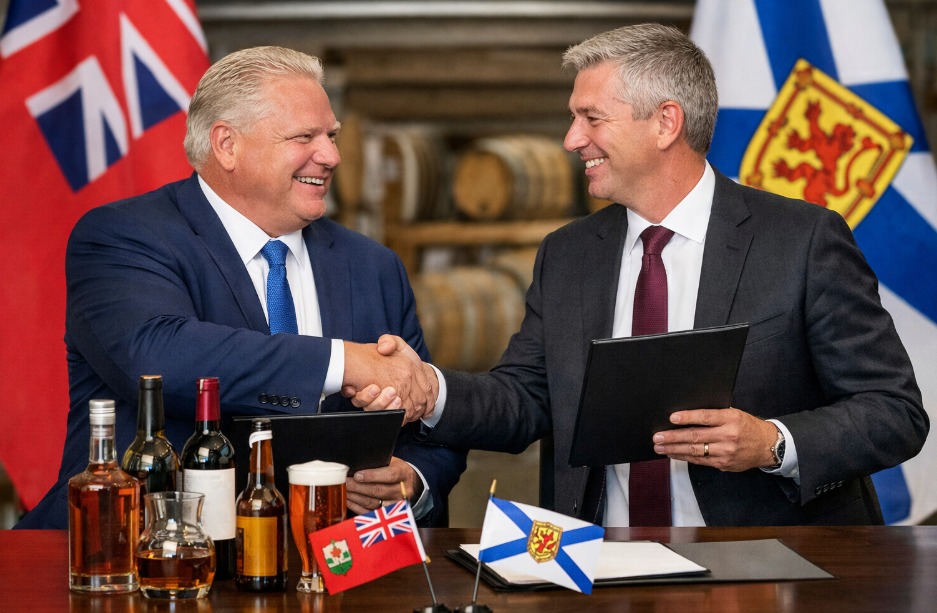
TORONTO — Ontario and Nova Scotia have signed a landmark agreement allowing alcohol producers in each province to sell directly to consumers in the other, marking a significant step toward reducing internal trade barriers and expanding market access for Canadian businesses.
Ontario Premier Doug Ford and Nova Scotia Premier Tim Houston formalized the first-of-its-kind direct-to-consumer (DTC) arrangement on Monday, enabling breweries, wineries and distilleries in both provinces to ship products directly to customers across provincial lines. The deal is positioned as part of a broader effort to strengthen interprovincial trade and stimulate economic growth.
“With President Trump taking direct aim at Ontario companies and workers, it has never been more important to boost interprovincial trade and support local businesses,” said Premier Doug Ford. “Ontario is leading the way to unlock free trade within Canada. Our agreement means Nova Scotia residents can conveniently purchase any of their favourite Ontario craft beers, wines and more, while Ontario residents will be able to buy the very best Nova Scotia has to offer.”
The agreement removes longstanding restrictions that limited consumer access to out-of-province alcohol. Previously, Ontario residents could only purchase alcohol from another province if the product was listed by the LCBO, obtained through its Private Ordering Program, or purchased in person and transported back to Ontario for personal use.
In the coming weeks, Nova Scotia producers will begin receiving authorization to sell directly to Ontario consumers through online platforms, with delivery to customers’ homes. The arrangement is reciprocal, granting Ontario producers access to Nova Scotia buyers under a similar framework.
Starting Tuesday, producers in both provinces can begin applying for the required approvals to participate in cross-border DTC sales.
The Liquor Control Board of Ontario (LCBO) and the Nova Scotia Liquor Corporation (NSLC) will oversee the authorization process. Under the agreement, each regulator will permit producers from the other province to sell directly to consumers for personal consumption.
Both governments said they will implement a mark-up structure designed to maintain fairness and competitiveness for domestic producers, while aligning with existing tax rates.
“Nova Scotia is committed to dismantling internal trade barriers, piece by piece, but my goal is to have free trade, nationwide,” said Premier Tim Houston. “This agreement is a stepping stone that will give our local producers more access to Ontario markets and open a broader customer base. We will continue to work with other provinces and territories to reach agreements so that our companies have more opportunities and customers have more choice.”
The agreement builds on Ontario’s broader push to liberalize internal trade. Last year, the province passed the Protect Ontario Through Free Trade Within Canada Act, 2025, legislation that included measures to enable a DTC alcohol sales framework.
Since July 2025, Ontario and 10 other provinces and territories have signed a memorandum of understanding committing to advance a pan-Canadian DTC alcohol sales system, with an implementation target of May 2026. Ontario has also entered into economic cooperation agreements with seven provinces that include commitments to work toward bilateral DTC frameworks.
Peter Bethlenfalvy, Ontario’s Minister of Finance, said the province’s alcohol producers represent a key segment of the provincial economy and stand to benefit from broader market access.
“Ontario’s vibrant alcohol sector and beverage alcohol manufacturers are an important part of our economy, and we are committed to seeing them grow and thrive while consumers get greater access to their choice of alcohol beverages,” said Peter Bethlenfalvy, Minister of Finance. “I am pleased that Ontario and Nova Scotia are partnering to set a precedent for other provinces to follow by enhancing interprovincial trade of alcoholic beverages in a way that works for consumers and businesses, and is consistent and fair to Ontario producers.”
Industry stakeholders have long argued that internal trade barriers limit growth opportunities for small and medium-sized producers, particularly craft breweries, boutique wineries and independent distilleries seeking to expand beyond their home markets.
By enabling direct online sales and delivery across provincial boundaries, the Ontario–Nova Scotia agreement effectively bypasses traditional listing requirements that have historically constrained market entry.
Ontario officials said the province intends to continue advocating for a national DTC framework that would standardize rules across jurisdictions, reduce administrative complexity and unlock further economic gains. The government estimates that strengthening internal trade could help unlock as much as $200 billion in economic growth.
For consumers, the agreement promises expanded product selection and greater convenience. For producers, it opens new channels to reach customers in two provinces with a combined population of more than 15 million people.
As provinces grapple with global economic uncertainty and renewed trade tensions abroad, the deal signals a renewed focus on reducing barriers within Canada’s own borders — one shipment at a time.