

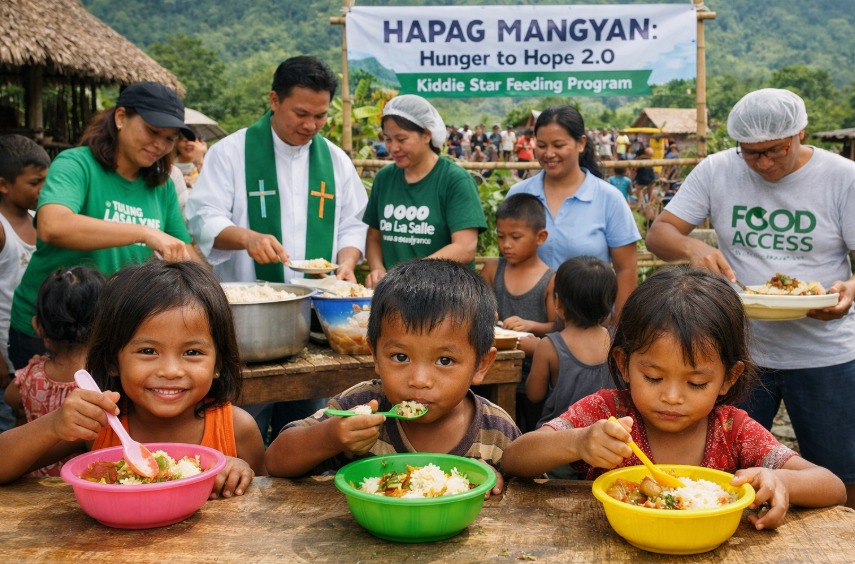
BANSUD, Philippines — A coalition of faith-based organizations, civil society groups and local government units has launched a new multisectoral initiative aimed at addressing child hunger and strengthening early childhood education among Indigenous communities in the Philippines, underscoring how collaborative models are being used to tackle persistent development gaps.
On Feb. 2, partners formally introduced HAPAG MANGYAN: Hunger to Hope 2.0 Project Kiddie Star, a program focused on Mangyan children aged two to five in the province of Oriental Mindoro. The project was inaugurated through the signing of a memorandum of understanding at Sitio Yugo in Barangay Conrazon, within the municipality of Bansud.
The agreement was led by Friends of Saint Mary MacKillop, Inc., alongside key partners De La Salle Brothers, Inc. Social Action Unit Tulong Lasalyano and Food Access Philippines, Inc.. The ceremony was witnessed by representatives of the Local Government Unit of Bansud, signalling formal local government backing for the effort.
Additional community support was evident with the presence of Hope in Me Club, Inc. and barangay officials from Conrazon, reflecting what organizers described as a whole-of-community approach to addressing hunger and education challenges among Indigenous children.
At the heart of the initiative is a daily “share-a-meal” program designed to improve nutrition during a critical stage of early childhood development. Project Kiddie Star sources its food supply from recovered surplus products donated by partner companies—items that are approaching expiration but remain safe for consumption. Organizers say the model not only addresses food insecurity but also contributes to reducing food waste, a growing concern across the region.
“Hunger robs children not only of food, but of their chance to learn, dream, and grow,” said Fr. Dean Klayford Bongat, founder of Friends of Saint Mary MacKillop, Inc. “Through HAPAG MANGYAN: Hunger to Hope 2.0, we are transforming shared responsibility into shared meals, ensuring that food becomes a bridge to education, dignity, and hope for Mangyan children.”
The program responds to broader national concerns about the link between hunger and education outcomes. Findings from EDCOM II have identified hunger as a key factor contributing to school dropout rates, particularly in marginalized and Indigenous communities. In provinces such as Oriental Mindoro, food insecurity continues to undermine children’s physical health, cognitive development and readiness to learn, according to development advocates.
By targeting children before they enter formal schooling, Project Kiddie Star aims to strengthen the foundations for literacy and long-term educational participation. Health professionals involved in the initiative emphasize that consistent access to nutritious food during the early years is closely linked to improved learning outcomes later in life.
The partnership brings together a diverse group of stakeholders, including faith-based organizations, advocacy groups, local government, health practitioners and community leaders. Supporters say this structure allows resources, expertise and networks to be pooled in ways that single organizations could not achieve alone.
For Food Access Philippines, the initiative also highlights the economic and social value of food recovery systems, which redirect surplus goods away from landfills and toward communities in need. Program advocates argue that such models can be scaled to other regions facing similar challenges, particularly where poverty, food insecurity and limited access to early education intersect.
While the project is currently focused on selected Mangyan communities in Bansud, organizers say the long-term vision is to expand the model across other parts of Oriental Mindoro and beyond. They point to the formalized partnership framework as a key factor that could enable replication and sustained impact.
As HAPAG MANGYAN: Hunger to Hope 2.0 begins implementation, local officials and civil society partners say its success will be measured not only by meals served, but by improved health, school readiness and renewed optimism among families in some of the province’s most vulnerable communities.
