

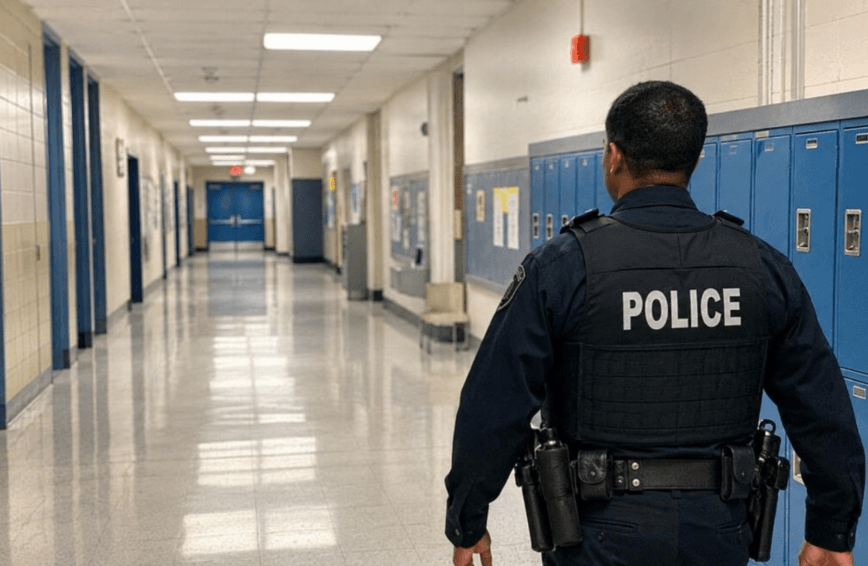
BCCLA and Policing-Free Schools call on provincial government to prohibit police presence in public schools
VANCOUVER — The BC Civil Liberties Association (BCCLA) and advocacy group Policing-Free Schools (Canada) are calling on the British Columbia government to immediately end all police-in-school programs across the province, arguing that the presence of law enforcement in educational settings creates significant risks for students, staff and marginalized communities.
In a letter sent to the BC Minister of Education and Child Care and the Minister of Public Safety and Solicitor General, the organizations urged the province to prevent the reintroduction or expansion of school policing programs, citing recent incidents involving Vancouver Police Department officers and broader concerns about systemic discrimination and accountability.
The groups announced the initiative from the traditional territories of the xʷməθkʷəy̓əm (Musqueam), Sḵwx̱wú7mesh (Squamish) and səlilwətaɬ (Tsleil Waututh) peoples in Vancouver.
The letter comes amid ongoing debate in British Columbia and across Canada about the role of police officers in schools, particularly in relation to vulnerable and marginalized students.
Organizations cite incidents involving Vancouver police officers
Among the examples highlighted by the BCCLA is what the organization described as a serious incident at a Vancouver school involving a School Liaison Officer (SLO). According to the letter, the officer allegedly pointed a firearm at an unarmed school employee, handcuffed the individual and searched their belongings without legal grounds.
The organizations said the incident caused “serious lasting harm” to the employee, who wishes to remain anonymous.
The letter also references a recent report from British Columbia’s Office of the Police Complaint Commissioner (OPCC), which detailed misconduct involving a Vancouver Police Department officer assigned to school-related programming.
According to the OPCC report, the officer delivered a presentation at a high school, exchanged emails with a female student about careers in policing and later entered into an intimate relationship with the student after she graduated. The investigation found the officer lied about his age and engaged in verbally and emotionally abusive behaviour.
The misconduct was classified as discreditable conduct, and the disciplinary outcome was dismissal.
The advocacy groups argue that these incidents are not isolated cases, but instead reflect broader structural concerns associated with policing in schools.
Debate intensifies over safety, accountability and systemic discrimination
The BCCLA and Policing-Free Schools said Indigenous, Black, racialized, disabled and 2SLGBTQIA+ communities have long raised concerns about the disproportionate harms associated with police presence in schools.
The organizations also pointed to criticism from BC’s Human Rights Commissioner, who has previously warned about the impact of school policing on vulnerable students.
Police services and school boards often describe school liaison programs as partnerships intended to support safety, mentorship and positive community relationships. However, the organizations argue that accountability becomes unclear when harm occurs.
According to the letter, there is no conclusive empirical evidence demonstrating that police presence in schools improves safety outcomes in British Columbia or elsewhere in Canada. The groups contend that existing evidence instead points to harmful impacts that are often underreported because some individuals are reluctant or fearful to come forward.
The organizations also criticized recent efforts by the BC government to expand policing in schools, including actions involving the reinstatement of democratically elected members of School District 61’s board.
The debate has intensified following a Vancouver School Board evaluation that found improved perception ratings among staff and students after reforms were introduced to the district’s school liaison program. However, the report did not assess whether police presence reduced harm or improved safety outcomes.
The organizations argue that reforms such as additional officer training or reducing visible markers of policing fail to address deeper systemic concerns.
They contend that combining law enforcement responsibilities with mentorship and student support roles creates blurred boundaries between care and coercion. Instead, they advocate for increased investment in mental health workers, youth counsellors, education assistants and other non-policing support services within schools.
“Police presence in schools is counter-productive to maintaining a safe learning environment for children. Institutional unwillingness to address the known harms compounds the serious power imbalance between police and the students and employees they interact with, and presents a risk to everyone in BC’s schools. It’s time to end the use of police-in-school programs in BC public schools without delay,” said Meghan McDermott, BCCLA Policy Director.
Andrea Vásquez Jiménez, Director of Policing-Free Schools (Canada), said the current approach is fundamentally flawed.
“Policing-in-schools, including police-in-school programs and police-led programming, is non-evidence-based, fiscally irresponsible, and harmful. It cannot be reformed out of the systemic harms it causes. What we need is a properly funded, supported, and well-resourced public education system, and strong community supports and services,” said Vásquez Jiménez.
The organizations said they do not plan to comment further beyond the contents of the public letter.
Discover more from Wire Service Canada
Subscribe to get the latest posts sent to your email.