

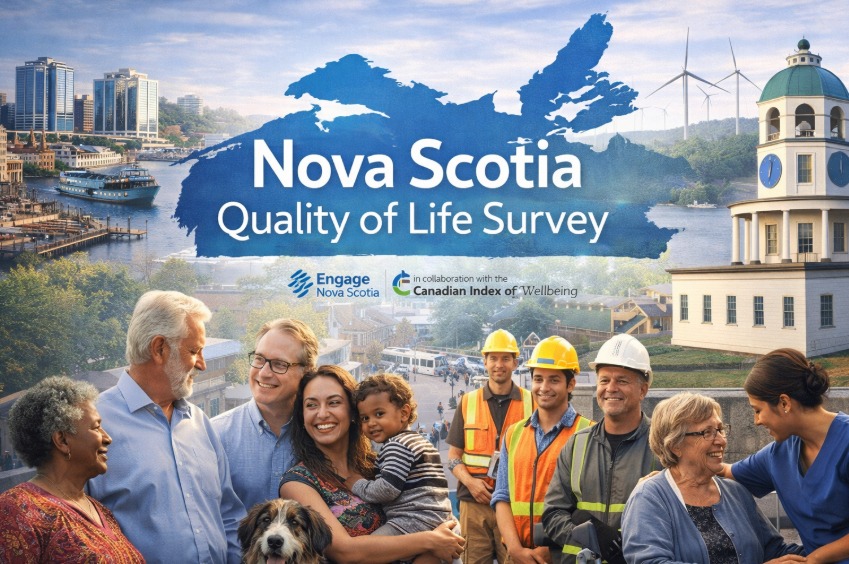
Halifax — Engage Nova Scotia is rolling out a province-wide survey aimed at capturing a comprehensive picture of wellbeing across Nova Scotia, with organizers positioning the initiative as a critical data tool for governments, researchers and community leaders.
Beginning February 23, postcard invitations will arrive in mailboxes across the province, inviting households to participate in the Nova Scotia Quality of Life Survey. The initiative is being delivered in collaboration with the Canadian Index of Wellbeing (CIW), a national research organization based at the University of Waterloo.
The survey is designed to gather detailed insights into how Nova Scotians are faring across eight domains of wellbeing, ranging from affordability and housing to health, equity and climate change. Organizers say the results will build on data collected in 2019, when nearly 13,000 residents responded to the inaugural survey — generating what Engage Nova Scotia describes as the largest dataset of its kind on quality of life in Canada.
The updated 2026 survey will allow researchers and policymakers to assess changes in wellbeing before and after the COVID-19 pandemic, offering a longitudinal view of economic and social conditions in the province.
The survey provides an opportunity to tell a more complete story of wellbeing in Nova Scotia which can help inform decision making, drive impactful change, and improve local communities.
“Learning the stories and lived experiences of Nova Scotians – from all communities and all backgrounds – will have a profound impact in understanding their hopes, dreams and challenges in these times,” says Danny Graham, Chief Engagement Officer at Engage Nova Scotia. “We encourage Nova Scotians to share their stories to help us gain deeper insights into the wellbeing of our communities and create momentum for a stronger Nova Scotia.”
The questionnaire includes more than 200 questions and takes between 30 to 60 minutes to complete. Topics range from time spent with family and experiences with loneliness to the ability to pay bills. Organizers emphasize that the survey is anonymous and does not collect identifying information such as names or addresses.
Engage Nova Scotia says the breadth of the survey is intended to generate actionable data that can inform evidence-based policy and investment decisions at multiple levels of government.
“The dataset is an exceptional opportunity for researchers, decision makers, governments at the provincial, municipal and federal levels to build on an evidence-based foundation to work together to improve quality of life and living standards for everyone,” adds Dr. Gaynor Watson-Creed, Board Chair at Engage Nova Scotia.
Initial findings from the 2026 survey are expected to be released later in the year and will be made publicly available through the organization’s website. In keeping with its mandate to promote transparency and community engagement, Engage Nova Scotia will also make the data accessible through its Wellbeing Mapping tool, enabling municipalities, organizations and residents to explore localized results.
The Canadian Index of Wellbeing provides the conceptual framework underpinning the survey. Since 2011, the CIW has tracked national wellbeing indicators and administered its Community Wellbeing Survey in communities across Canada. The partnership with Engage Nova Scotia in 2019 marked the first province-wide application of the framework in Nova Scotia.
Engage Nova Scotia, a non-profit and independent organization, works with municipalities, community groups and other partners to advance quality of life outcomes across the province. The organization has presented its work on wellbeing measurement at international forums including the United Nations and the Organisation for Economic Co-operation and Development (OECD), and positions data-driven decision making as central to addressing longstanding social and economic challenges.
For business leaders and policymakers, the 2026 survey is expected to provide updated indicators on workforce conditions, housing pressures, affordability concerns and broader social trends that shape economic performance and community resilience.
By expanding and refreshing its dataset, Engage Nova Scotia aims to equip decision makers with what it describes as previously unknowable or overlooked information — helping to guide investments, program development and cross-sector collaboration.
As Nova Scotia continues to navigate post-pandemic recovery and longer-term demographic and economic shifts, organizers say broad public participation will be key to ensuring the survey accurately reflects the lived experiences of residents across urban, rural and coastal communities.
With invitations set to reach households later this month, Engage Nova Scotia is urging residents to take part and contribute to what it hopes will become one of the most comprehensive provincial wellbeing datasets in Canada.