

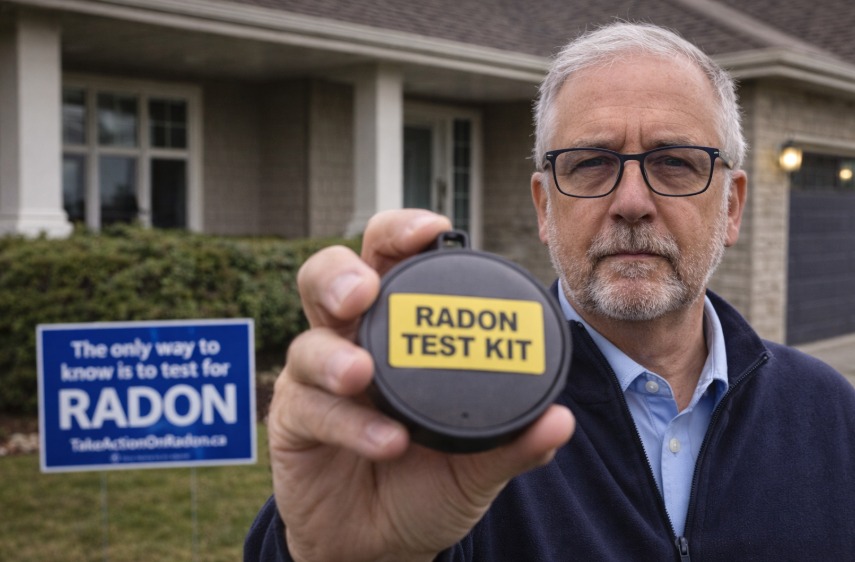
A community-wide radon testing initiative across the Strathcona Regional District has found that the vast majority of participating homes recorded low indoor radon levels, offering reassurance to residents while reinforcing the importance of individual testing to manage long-term health risks.
Results from the winter 2024–2025 program were released on January 28, 2026, following a partnership between the Strathcona Regional District (SRD) and Take Action on Radon. The initiative formed part of the National 100 Radon Test Kit Challenge, a nationwide effort to raise awareness of radon exposure and its link to lung cancer.
A total of 117 households across the region voluntarily participated, requesting long-term radon test kits to measure indoor concentrations of the naturally occurring radioactive gas. Homes in Campbell River, Oyster River, Tahsis and Zeballos took part, providing a snapshot of radon exposure across a diverse range of communities within the district.
According to the findings, 96 per cent of tested homes recorded radon levels below 100 becquerels per cubic metre (Bq/m³), while two per cent measured between 100 and 200 Bq/m³. A further two per cent exceeded Health Canada’s recommended guideline of 200 Bq/m³, with the highest reading recorded at 214 Bq/m³.
A more detailed breakdown by postal code showed similarly low averages across the region. In the V0P area, which includes parts of the west coast of Vancouver Island, 23 homes were tested. Of those, two per cent exceeded the federal guideline, with an average reading of 39 Bq/m³ and a maximum of 214 Bq/m³. In the V9H area, covering portions of Campbell River and Oyster River, 43 homes participated, none of which exceeded the guideline. The average radon level there was 37 Bq/m³, with a high of 131 Bq/m³. In the V9W area, 41 homes were tested, also with no readings above 200 Bq/m³, an average of 30 Bq/m³ and a highest result of 70 Bq/m³.
While the overall results were described as encouraging, the SRD cautioned against complacency, noting that radon levels can vary significantly from one building to another, even within the same neighbourhood.
“These results are reassuring overall, but they also confirm an important message: the only way to know your home’s radon level is to test,” said Mark Baker, chair of the SRD board. “Even in areas where average levels are low, some homes can still have elevated radon. Testing is simple, affordable, and one of the best steps residents can take to protect their family’s long-term health.”
Radon is a colourless and odourless gas produced by the natural breakdown of uranium in soil and rock. While it disperses harmlessly outdoors, it can accumulate inside buildings, particularly in basements and ground-level spaces. Long-term exposure to elevated radon levels is the second leading cause of lung cancer after smoking, and the leading cause among non-smokers.
Health experts say residential exposure represents the most significant source of radon risk for Canadians. “Radon is a well-established human carcinogen, and testing and reducing radon levels is an important method of lung cancer prevention,” said Anne-Marie Nicol, a researcher at Simon Fraser University. “Residential radon represents Canadians’ primary exposure to radon, and preventing that exposure will reduce the number of Canadians dying from lung cancer.”
The Canadian Association of Radon Scientists and Technologists recommends that homeowners test their properties every three to five years, or following major renovations, to ensure radon levels remain within safe limits. Long-term testing, typically conducted over a minimum of three months during the heating season, is considered the most reliable method.
Funding for the SRD initiative was provided by Health Canada, which has increasingly supported community-level testing programs as part of broader cancer prevention strategies. Local officials say the program has helped build awareness of an often-overlooked health risk and provided residents with practical information to make informed decisions.
Although only a small number of homes exceeded federal guidelines, the SRD said it will continue to encourage testing across the region, emphasizing that radon exposure is preventable. With testing kits widely available and mitigation measures proven to be effective, officials say early detection remains one of the simplest ways to reduce the long-term health impacts associated with radon in Canadian homes.
