

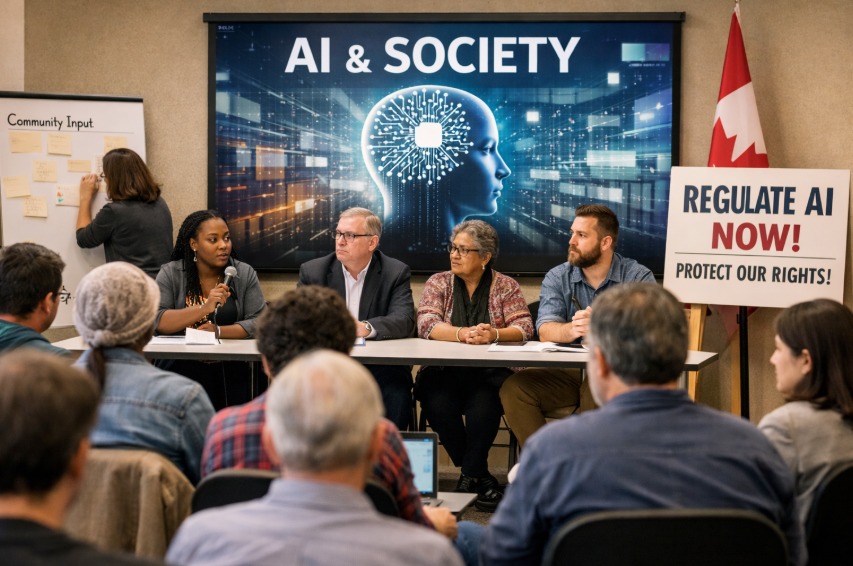
VANCOUVER — A coalition of civil society groups, academics and community organizations launched the People’s Consultation on AI today, positioning the initiative as an alternative to what organizers describe as a rushed and industry-driven federal process to shape Canada’s national artificial intelligence strategy.
The consultation, based in Vancouver on the traditional territories of the xʷməθkʷəy̓əm (Musqueam), Sḵwx̱wú7mesh (Squamish) and səlilwətaɬ (Tsleil-Waututh) Nations, is designed to gather submissions from across the country on whether — and how — AI should be adopted and governed in Canada.
Organizers say the effort is a direct response to the federal government’s development of a national AI strategy in October 2025, arguing that Ottawa failed to provide a meaningful consultation process while moving quickly to establish its policy direction.
In 2025, the government assembled a task force to develop its national strategy. Critics say the group was heavily weighted toward industry voices, with few participants positioned to speak to the broader ethical, social and political implications of AI technologies.
An accompanying public consultation allowed 30 days for feedback, which civil society groups argue limited the ability of communities most affected by AI systems to participate effectively. Organizers also contend that the consultation survey emphasized economic benefits over risks and harms, and that responses are now being assessed by AI rather than public officials.
Those concerns were raised in an open letter signed by more than 160 civil society organizations and experts in October 2025. The letter protested what it called the government’s “national sprint” on AI and pointed to negative impacts already emerging as AI becomes embedded in more areas of Canadian life.
“The federal government’s approach to a national AI “strategy” has resembled a parody of AI boosterism, with their purported consultation a thin veneer for manufacturing consent where they know there is none. It is a slap in the face to every historically marginalized community and vulnerable person who has already been harmed by the carelessness and arrogance of robber tech barons prioritizing profits over people and ego over ethics. If we have learned one thing repeatedly from the cascading and discriminatory harms of so many cycles of tech hype—whether big data, social media, algorithmic decision-making, or genAI—it’s that those hardest hit often see the future first, but are the last to be heard. This collective initiative is an attempt to steer Canada away from making that profound mistake yet again,” said Cynthia Khoo, Senior Fellow, Citizen Lab; technology & human rights lawyer.
The People’s Consultation on AI is structured to support broad participation, with organizers welcoming submissions ranging from neighbourhood discussions about everyday impacts to detailed expert analyses. The consultation website includes resources describing current implications of AI, as well as guidance and community facilitation tools intended to help groups craft submissions collaboratively.
Submissions will be published on the consultation website, shared with the federal government, and used to support civil society efforts aimed at responding to what organizers describe as threats posed by AI.
The consultation will accept submissions until March 15, 2026.
Civil liberties groups and legal advocates involved in the initiative argue that Canada’s approach to AI policy requires stronger regulation and a rights-based framework, particularly as governments and businesses deploy AI systems more widely.
“Proponents of novel technologies celebrate speed in embracing change without regard to consequences, but this is a catastrophic approach to legislation. The government puts our fundamental rights at risk — including the equality and privacy rights that are essential to a free and democratic society — when they allow the development of AI regulation to be rushed or dominated by industry interests,” said Aislin Jackson, Policy Staff Counsel, BC Civil Liberties Association.
Tamir Israel, Director, Privacy, Surveillance & Technology Program, Canadian Civil Liberties Association, said, “AI is being adopted with a concerning disregard for the negative impacts it is having on our lives–impacts that fall most heavily on groups that are already precarious. As AI reshapes how we work, how we learn, how we interact with each other, and how we are policed by the state, it is imperative that Canada adopt an informed strategy for dealing with this technology.”
Other participants emphasized risks they say are already materializing, including job displacement, misinformation campaigns, harassment enabled by deepfakes, and gaps in accountability for technology platforms.
“The collateral damage around the intoxicated rush to embrace AI can be measured in laid-off workers, psyop campaigns in the service of corrupt oligarchs and autocrats, women and vulnerable minorities bullied into silence by swarms of deep fakes, and teen suicides. It is entirely unacceptable to allow tech platforms to experiment on billions of people for private gain with no meaningful restraints. We urgently need mandated transparency requirements, independent auditing of AI platforms, and stronger privacy and consumer protection laws,” said Ronald J. Deibert, O.C., O.O., Professor of Political Science and Director of the CitizenLab, The Munk School, University of Toronto.
Labour organizations also framed the debate around worker protections and the distribution of benefits from automation.
“We need workers and the public to have a real say in shaping a public vision for AI in Canada. It’s the only way to make sure AI serves workers and ordinary folks, not just big tech corporations. CUPE is calling for strong laws and regulations to protect workers, the public and the environment,” said Mark Hancock, CUPE National President.
Advocates working with immigrants and refugees warned that automated decision-making in government services could deepen inequities without safeguards.
“The government’s rush to automate services with unregulated AI could cement systemic biases, disproportionately harming vulnerable Canadians. Refugees and immigrants face the gravest risk of being left behind, potentially thrust into deeper precarity by algorithmic systems,” said Debbie Douglas, Executive Director, OCASI – Ontario Council of Agencies Serving Immigrants.
Supporters of the consultation say the initiative aims to provide Ottawa with a clearer picture of public concerns and priorities, and to demonstrate that broader participation can strengthen AI governance rather than slow it down.
“We hope that this consultation exercise will demonstrate that social innovation in AI is also compatible with values of inclusion and social justice. Including citizens’ perspectives and, more broadly, civil society in AI governance is essential to ensure that we develop in Canada AI systems that meet the needs of the population as a whole and in all its diversity,” said Karine Gentelet, Full Professor, Université du Québec en Outaouais & scientific director Collaboration with Civil Society Obvia.
Andrew Clement, Professor emeritus, University of Toronto, said, “The Canadian government is pushing AI hard as a boon to our economy. It seeks our trust but fails to make a good case for AI’s benefits. It avoids addressing the many serious pitfalls, especially of generative AI, and makes only token efforts to engage Canadians broadly in this important policy debate. The People’s Consultation on AI, in providing Canadians with a more open, inclusive and informed basis for expressing their views, offers a powerful corrective. Government should heed the coming results.”
Participation details, including English and French submission portals, are available through the consultation website.
