

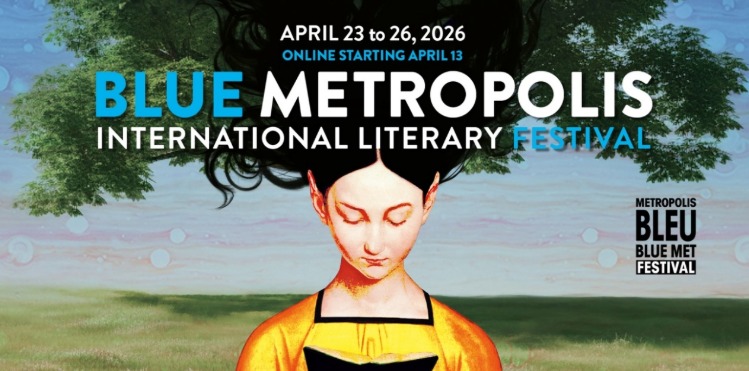
Montreal literary festival returns with 150+ participants and a focus on connection
Montreal will once again host one of North America’s largest multilingual literary gatherings this spring, as the Blue Metropolis International Literary Festival returns for its 28th edition with a timely theme centred on communication and understanding.
Running from April 23 to April 26, 2026, with online programming beginning April 13, the festival will bring together more than 150 authors, journalists, translators and cultural figures from Quebec, across Canada and around the world. Organizers say the event will feature 110 sessions spanning nine languages, reinforcing its role as a major cultural and intellectual hub.
“In such a noisy world—a world marked by wars, conflicts and divisions; dominated by speed; dizzied by overconsumption; assaulted by petty rumors circulating on social media; submerged in the constant flow of fact and falsehood—how can we come to understand each other?” organizers said in a statement announcing the event.
Theme centres on dialogue in a fragmented world
This year’s theme, Words for Understanding One Another, reflects growing concern about global polarization and the erosion of meaningful dialogue. Programming will be delivered primarily in English, French and Spanish, with additional languages broadening the festival’s international reach.
The event will take place בעיקר at Hotel 10 in Montreal, alongside partner bookstores and cultural venues. Many sessions will be offered free of charge, with ticketed events starting at $8.
Blue Metropolis Director of Programming Marie-Andrée Lamontagne emphasized the importance of firsthand perspectives in today’s geopolitical climate.
“At a time when all eyes are turned towards the courageous and tenacious people of Iran and Ukraine, it is more necessary than ever to hear first-hand accounts from Iranian essayist Azar Nafisi and Ukrainian poet Lyuba Yakimchuk, both of whom will be present at the Festival,” noted Lamontagne.
Festival Executive and Artistic Director William St-Hilaire added that the theme speaks directly to modern communication challenges.
“Social networks are overflowing and information is circulating abundantly, but are we still able to hear what someone is really trying to tell us? In today’s world, we must find the words to finally get along,” said St-Hilaire.
Diverse programming spans literature, society and performance
The 2026 edition will feature a broad mix of programming, including panels on novels, poetry and graphic literature, as well as discussions on ecology, mental health, history and film. Popular series such as Eleanor Wachtel at Blue Metropolis will return, alongside new and evolving formats.
The festival will officially open April 24 with its Blue Met Talks and cocktail reception, showcasing prominent participants. Additional programming highlights include Spanish and Portuguese-language events under the “Azul” banner, mystery and detective fiction sessions, and a dedicated professional space for industry participants.
Organizers are also expanding experiential formats. Events include Indigenous-focused programming curated by Tara McGowan-Ross, a “literary speed dating” concept led by Curtis McRae, and a queer storytelling series curated by Christopher DiRaddo. Two documentary screenings—Rule of Stone (2024) and Sewâtisiwin/They are Sacred (2025)—will complement the literary lineup.
International prize winners highlight global literary impact
A key feature of the festival remains its prestigious literary awards, which recognize contributions from both Canadian and international writers.
This year’s recipients include Cuban novelist Leonardo Padura, Iranian-American author Azar Nafisi, and Swedish Sámi writer Ann-Helén Laestadius. British writer Wyl Menmuir, Canadian author Shani Mootoo, and Quebec graphic novelist Guy Delisle are also among those honoured.
The festival will also present the Blue Metropolis/Conseil des arts et de Montréal New Contribution Prize, recognizing emerging voices from immigrant communities in Montreal.
Canadian voices and local perspectives take centre stage
Alongside its international roster, the festival maintains a strong domestic focus, showcasing authors from Quebec and across Canada.
Featured participants include Claire Cameron, Ayelet Tsabari, Miriam Toews (virtually), and Heather O’Neill, among others. Programming will also explore questions of identity and belonging in Quebec, including a panel examining what it means to be Québécois in a diverse society.
Youth programming and accessibility remain priorities
The TD-Blue Metropolis Children’s Festival will return with programming aimed at young readers across Quebec, while the organization’s fundraising gala on April 23 will support literacy and educational initiatives.
Festival passes are priced at $35 until March 31, increasing to $50 thereafter, and include a discount on books purchased at the on-site bookstore.
With participants representing countries from Ukraine to Brazil and languages ranging from Cree to Japanese, organizers say the 2026 edition underscores the festival’s longstanding mission: fostering dialogue across cultures through literature.
As global tensions and digital noise continue to shape public discourse, Blue Metropolis is positioning itself as a space for reflection, exchange and, above all, understanding.