

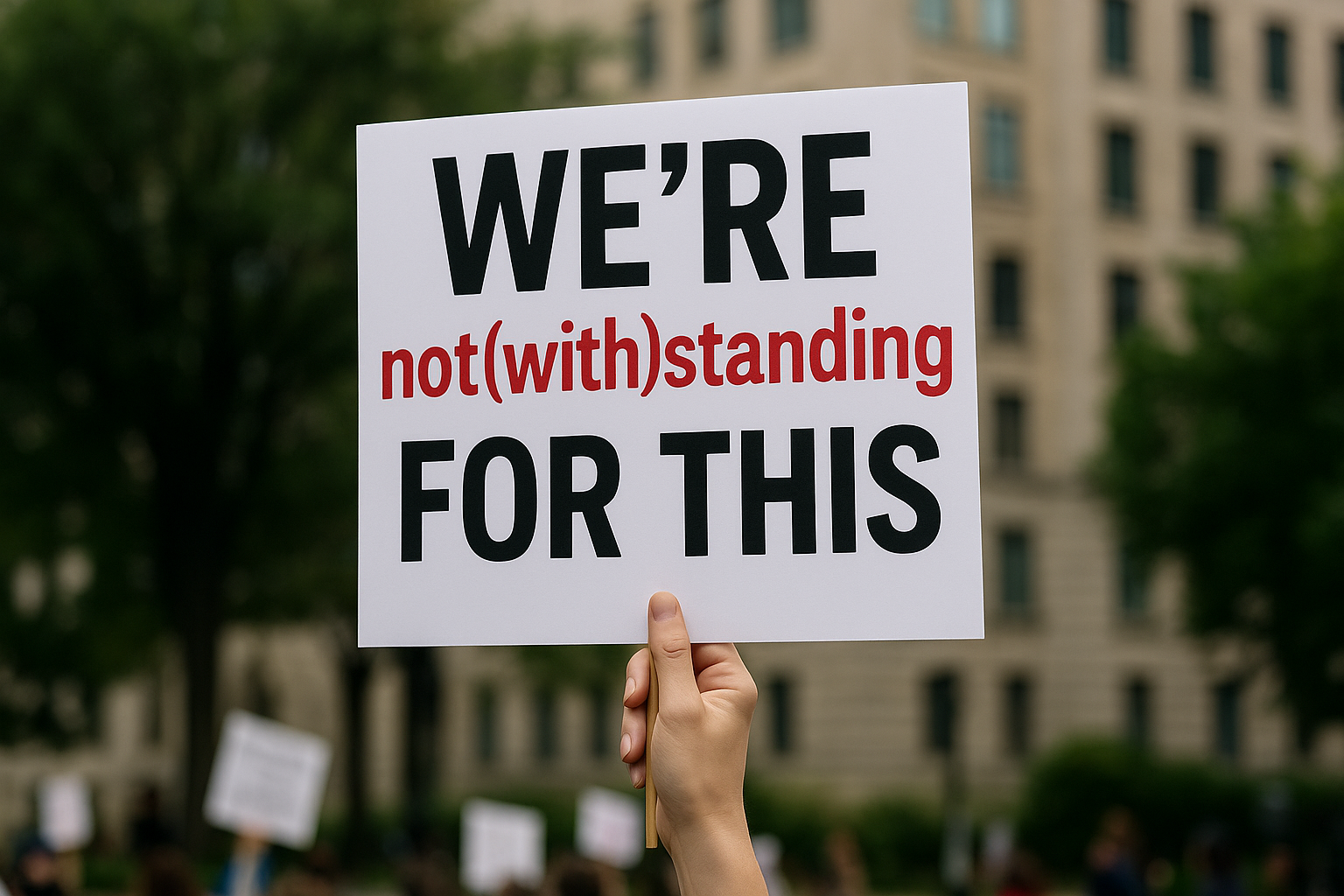
VANCOUVER — The BC Civil Liberties Association (BCCLA) has launched a campaign to push back against the growing use of Canada’s notwithstanding clause, calling it a “dangerous tool” that undermines fundamental rights guaranteed in the Charter of Rights and Freedoms.
The campaign, branded We’re not(with)standing for this: Charter Rights are ours to protect!, includes a nine-minute educational video titled What the heck is the notwithstanding clause? and a public pledge asking Canadians to oppose the clause’s use in provincial legislation.
Raising Awareness Through Education
The notwithstanding clause, formally known as section 33 of the Charter of Rights and Freedoms, grants governments the authority to enact laws even when those laws are acknowledged to violate Charter rights. While included in the Charter as a political compromise during constitutional negotiations in 1982, its use has long been controversial.
BCCLA’s campaign frames the clause as fundamentally incompatible with the notion that Charter rights are “inalienable.” The association says governments’ increasing reliance on section 33 has created a troubling trend of eroding protections for equality, religious freedom, freedom of expression, and labour rights.
A Broader Campaign
According to the organization, the video launch is only one part of a broader initiative designed to mobilize Canadians against what it sees as a dangerous precedent. By signing the People’s Pledge, citizens are invited to express their opposition to any use of the clause and to reaffirm their support for Charter rights.
“In a world where political dissent is increasingly suppressed, democratic principles are diluted or cast aside, and civil liberties are under direct attack, Canada is no exception. With the notwithstanding clause, Canadian politicians wield a dangerous tool,” said Liza Hughes, BCCLA Executive Director.
Hughes added: “Right now, provincial leaders are using the notwithstanding clause to override Charter rights that they find inconvenient. Increasing polarization, fearmongering, and scapegoating of marginalized groups has led to a political climate that enables them to do this. But the rights under attack – equality rights, religious freedom, freedom of expression, and labour rights – belong to all of us.
“BCCLA’s not here to ask for concessions or negotiate around the use of the clause. It’s time to show politicians that Charter rights are ours to protect. When we stand for rights and freedoms, we stand together.”
Context: A Growing Political Flashpoint
The notwithstanding clause has drawn heightened attention in recent years, with several provincial governments invoking or threatening to invoke it in areas ranging from labour disputes to education policy. Advocates of the clause argue it provides elected legislatures with a democratic check on judicial power. Critics counter that its use effectively weakens constitutional protections for minority rights and civil liberties.
Legal scholars have noted that while the clause was originally envisioned as an “extraordinary” measure to be used sparingly, it has become a more routine political tactic. BCCLA argues this normalization threatens to erode public confidence in the Charter’s ability to protect Canadians.
Mobilizing Public Support
Through its campaign, BCCLA is urging Canadians to take a more active role in defending their rights. The association believes public engagement is essential to counterbalance political incentives for governments to bypass Charter protections.
The initiative reflects a growing trend among advocacy organizations to use digital tools and storytelling to mobilize public support. By producing accessible content such as explainer videos, BCCLA is seeking to broaden awareness beyond legal circles to the general public.
The campaign is also expected to resonate with business leaders and organizations concerned about the stability of democratic institutions and the predictability of Canada’s legal framework. For investors and employers, Charter protections provide an important backdrop of legal certainty that underpins labour rights, anti-discrimination protections, and freedom of expression.
Support From Legal Community
The project was made possible with financial support from the Canadian Bar Association’s Law for the Future Fund, a program that backs initiatives aimed at advancing public understanding of legal rights and the justice system.
The partnership reflects the legal profession’s concern with preserving constitutional protections. By aligning with the campaign, the Canadian Bar Association is lending weight to the call for vigilance against the erosion of rights.
Looking Ahead
As governments across Canada continue to weigh the use of section 33 in contentious policy areas, the BCCLA’s campaign is positioned to become a focal point for public debate. Its emphasis on education and mobilization signals a long-term effort to reframe how Canadians understand the clause and its implications for democracy.
Whether the campaign succeeds in shifting political calculations remains to be seen. For now, BCCLA’s message is clear: the organization intends to challenge any attempt to normalize the use of the notwithstanding clause and to remind Canadians that Charter rights are not optional.
