

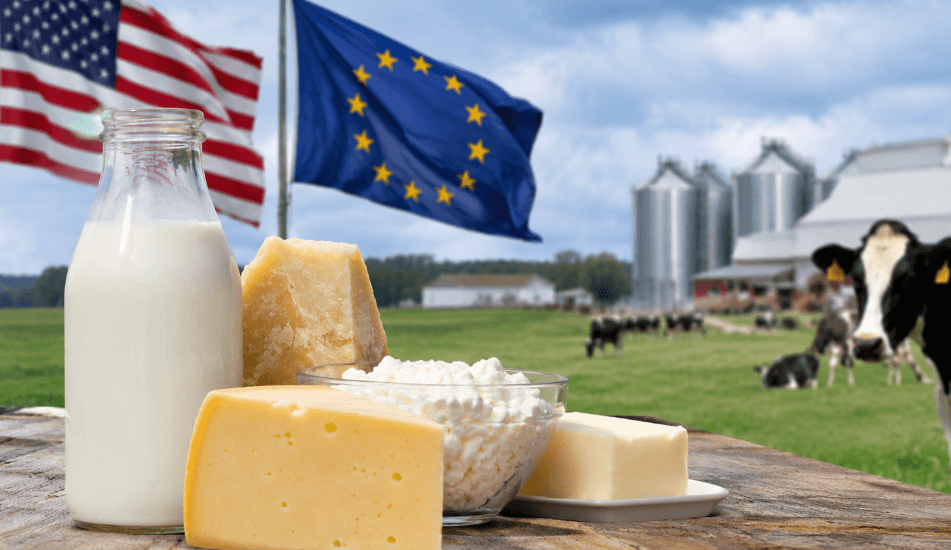
Longstanding European Union trade barriers are costing American dairy farmers up to US$2.6 billion annually, according to a new study highlighting significant disparities in agricultural market access and growing concerns over transatlantic dairy trade.
The report, released on November 23, 2026, by Texas A&M University’s Agricultural and Food Policy Center, was commissioned by the National Milk Producers Federation (NMPF) and the U.S. Dairy Export Council (USDEC).
The findings underscore the economic consequences of unequal market access, with researchers identifying tariffs, regulatory requirements and restrictions on common cheese names as significant obstacles to American dairy exports.
U.S.-EU Dairy Trade Imbalance Raises Economic Concerns
According to the report, the European Union exported US$2.4 billion worth of dairy products to the United States in 2025, while American dairy exports to the European market totalled just US$269 million.
The figures represent a nearly nine-to-one trade imbalance, highlighting the challenges facing American dairy producers seeking to expand their presence in European markets.
The study identifies several structural barriers that contribute to the disparity, including high over-quota tariffs, changing certification requirements and restrictions associated with geographical indications policies.
European regulations governing product names such as feta and parmesan have also emerged as a significant point of contention, with American producers facing restrictions on their use in European and certain international markets.
Regulatory Requirements Create Additional Challenges
Researchers also identified emerging regulatory measures, including the EU’s Corporate Sustainability Due Diligence Directive, as potential sources of additional complexity for transatlantic dairy trade.
Meanwhile, the report says European exporters benefit from generous country-specific quotas for cheese and butter, alongside relatively consistent documentation requirements when accessing the American market.
Despite the international competitiveness of American dairy products, the study concludes that regulatory and market access restrictions continue to limit commercial opportunities for U.S. manufacturers and farmers.
Dairy Farmers Face Significant Revenue Losses
The economic analysis estimates that existing trade disparities could cost American dairy farmers as much as US$2.56 billion annually through displaced demand and reduced export opportunities.
The report also estimates that farm-gate milk prices are reduced by between 55 cents and US$1.10 per hundredweight as a result of the trade imbalance.
“Our analysis shows the cost of one-way dairy trade with the EU is substantial and recurring,” Bart L. Fischer, co-director of the Texas A&M Agricultural and Food Policy Center, said. “Reaching parity in cheese and butter access alone would add nearly $2 billion a year to U.S. dairy farm revenue.”
According to researchers, achieving equal market access for cheese and butter could reduce the bilateral dairy trade deficit by more than one-third, with potential annual gains equivalent to approximately US$78,000 per average American dairy farm.
U.S.-EU Trade Framework Offers Opportunity for Reform
The report identifies the August 2025 U.S.-EU framework agreement as an important starting point for addressing longstanding agricultural trade disputes.
The Trump administration has pursued negotiations aimed at reducing tariffs, addressing technical and sanitary trade barriers, and protecting American producers’ ability to use common food names.
Industry representatives argue that implementing and expanding the framework could create more balanced trading conditions.
“The administration has been working day and night to open doors for U.S. dairy around the world, and the U.S.-EU framework is a strong start with one of our toughest trading partners,” Gregg Doud, president and CEO of NMPF, said. “This report shows what’s at stake in finishing the job.”
Industry Groups Call for Reciprocal Market Access
American dairy industry organizations are urging policymakers to secure enforceable commitments that address remaining tariff disparities, quota restrictions and regulatory obstacles.
“This report puts a price on decades of European protectionism, and it comes straight out of farmers’ paychecks,” Krysta Harden, president and CEO of USDEC, said. “USTR has made real progress, and we look forward to building on the framework to secure truly reciprocal EU dairy commitments.”
Both organizations intend to continue working with the administration and Congress to advance negotiations and protect American dairy export opportunities in international markets.
Broader Implications for Global Agricultural Trade
The findings highlight wider challenges surrounding agricultural market access, regulatory standards and international competitiveness, issues that remain relevant to dairy-producing economies, including Canada.
As negotiations continue, the American dairy industry is seeking more predictable trading conditions and expanded export opportunities. Whether those efforts deliver measurable economic benefits will depend on the implementation of the existing framework and the outcome of further negotiations between Washington and Brussels.
Discover more from Wire Service Canada
Subscribe to get the latest posts sent to your email.