

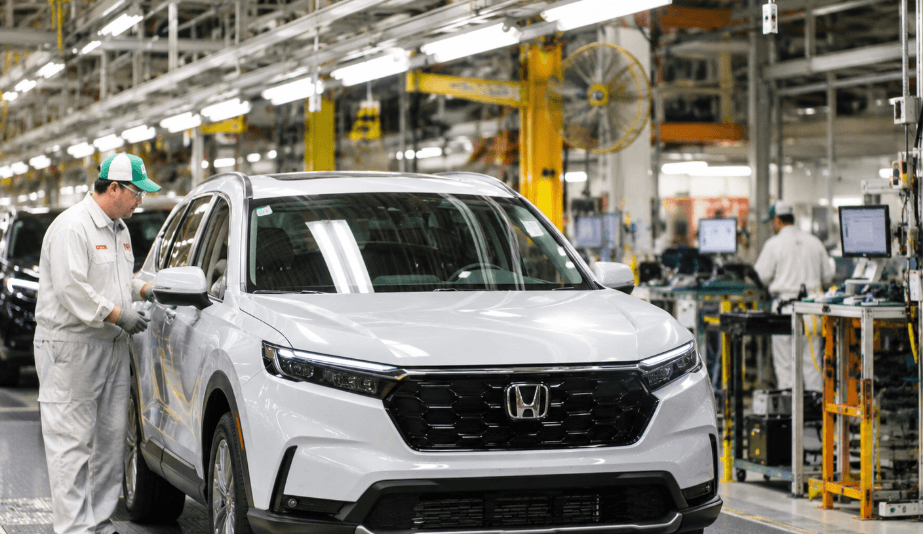
WOODBRIDGE, Ontario —The Ontario and federal governments are advancing an $8.7 billion trade action plan designed to protect automotive workers, strengthen domestic manufacturing and attract investment as U.S. tariffs and global trade uncertainty continue to pressure Canada’s industrial economy.
The joint initiative includes financial support for manufacturers, investments in production facilities and measures to improve the competitiveness of Ontario’s automotive supply chain.
The announcement follows Honda Canada’s commitment to invest $867 million in its Alliston manufacturing operations, supported by funding from both levels of government.
Honda Canada Announces $867 Million Investment in Alliston Manufacturing
Honda Canada’s latest investment will modernize its Alliston facilities to support growing North American demand for hybrid-electric and gasoline-powered vehicles.
The project includes bringing engine production back to Ontario, strengthening domestic manufacturing capabilities and reducing reliance on international supply chains.
Ontario will contribute up to $156 million, while the federal government will provide $313 million through its Strategic Response Fund.
The investment is expected to support approximately 400,000 vehicles annually while protecting more than 4,000 direct manufacturing jobs, over 30,000 indirect jobs and relationships with more than 50 local suppliers.
Government Emphasizes Job Protection and Supply Chain Stability
“Ontario has long stood at the forefront of global auto manufacturing and in the face of uncertainty, our government is taking dedicated actions to protect our world-class workers and sustain this vital industry,” said Vic Fedeli, Minister of Economic Development, Job Creation and Trade. “By bolstering our supply chains and fostering the conditions for investment, we’re ensuring that our strategic industries can withstand the pressures of present day and remain resilient for generations to come. Honda’s investment is integral to this effort and we look forward to seeing this retooling enhance their Alliston’s operations, while further anchoring our workers at the heart of their North American supply chain.”
Canada-Ontario Trade Action Plan Targets Automotive Competitiveness
A central component of the $8.7 billion initiative is a combined $2.5 billion commitment over two years to support capital projects across tariff-affected industries.
The funding will help manufacturers purchase modern equipment, upgrade production lines and improve operational efficiency.
Both governments will also establish a Canada-Ontario Automotive Task Force to coordinate industry support and oversee the implementation of measures addressing economic and technological changes.
Vehicle Emissions Standards and Electric Vehicle Transition
Under the agreement, Canada’s greenhouse gas emissions standards for new light-duty vehicles will remain at 2026 levels through the 2029 model year.
Annual increases will resume in 2030, consistent with the federal government’s 2035 electric vehicle target.
The approach is intended to provide manufacturers with greater regulatory predictability while allowing additional time to adjust production strategies and investment plans.
Federal Government Reinforces Commitment to Canadian Auto Manufacturing
Federal Industry Minister Mélanie Joly highlighted the importance of maintaining Canada’s automotive manufacturing capabilities.
“Canada is an auto nation, now and into the future. By investing $313 million in this project, the federal government is supporting the talent, technology and industrial strength that make Canada a global destination for vehicle manufacturing. Building on the Canada-Ontario Action Plan, we are working together to strengthen two industries at the heart of our economy: investing in the future of auto manufacturing and transforming our steel sector. This investment will strengthen our automotive supply chains, support thousands of well-paying jobs in Ontario and across the country and help build a strong Canadian auto sector where workers build the cars of the future.”
The investment also reinforces Honda’s longstanding presence in Ontario.
Since opening its Alliston facility in 1986, Honda has manufactured more than 11 million cars and light trucks in the province. The facility remains the global lead production plant for the Honda CR-V.
Ontario Automotive Industry Remains Central to Economic Growth
Ontario produced more than 1.2 million vehicles in 2025 and remains one of North America’s major automotive manufacturing regions.
Since 2020, the province has attracted tens of billions of dollars in investments across vehicle assembly, battery manufacturing and related supply chains.
Existing provincial support programs, including the Protect Ontario Financing Program, Ontario Together Trade Fund and Trade-Impacted Communities Program, will complement the joint trade action initiative.
The provincial government also plans to pursue regulatory reforms, lower business costs and expand export opportunities to strengthen industrial competitiveness.
As trade tensions continue to reshape North American manufacturing, the Ontario-Canada partnership aims to preserve existing employment, secure future production mandates and reinforce the province’s position as a major automotive investment destination.
Discover more from Wire Service Canada
Subscribe to get the latest posts sent to your email.