

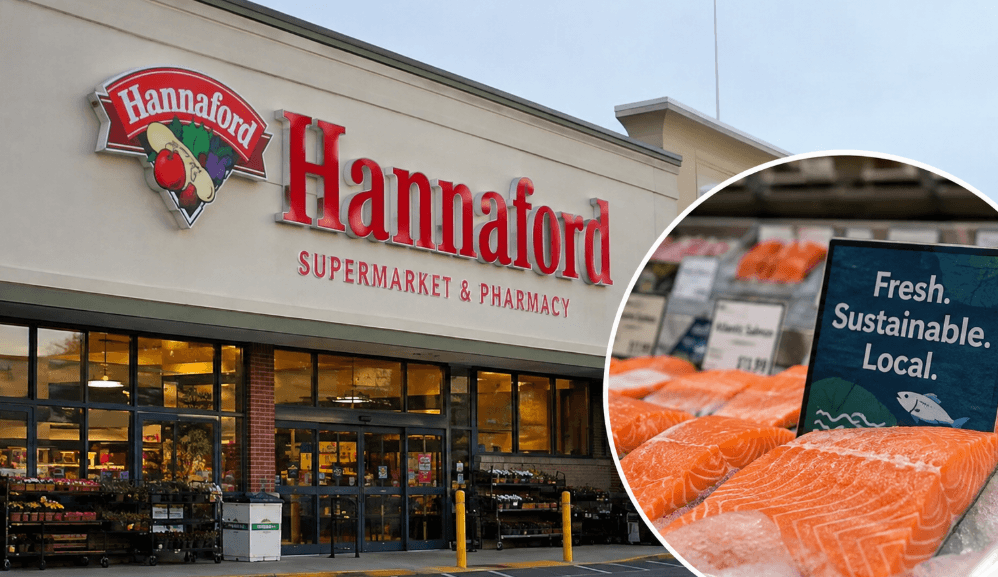
A proposed class-action lawsuit filed in federal court in New York accuses U.S. grocery chain Hannaford and its parent company, Ahold Delhaize USA, of misleading consumers by marketing farmed salmon as sustainable despite alleged environmental damage associated with industrial aquaculture operations.
The lawsuit challenges Hannaford’s seafood advertising, including claims that its products are “harvested with sustainability in mind” and “Fresh. Sustainable. Local.” Plaintiffs argue that these representations create a misleading impression about the environmental practices of the company’s salmon suppliers.
The complaint identifies Cooke Aquaculture, a major salmon producer with operations in Maine and Eastern Canada, as one of Hannaford’s suppliers.
Lawsuit Challenges Hannaford’s Seafood Sustainability Advertising
According to the complaint, Hannaford uses prominent in-store signage to emphasize sustainability and consumer trust. One advertisement states, “Every fish has a tale. Ours you can trust”.
The plaintiffs allege that these statements conflict with the environmental consequences of open-net-pen salmon farming, including nutrient pollution, chemical discharge and mass fish mortality events.
The lawsuit claims that salmon farming operations can release waste and nutrients into surrounding waters, potentially contributing to oxygen depletion and harming marine ecosystems.
It also raises concerns about the use of pesticides, medications and other chemical substances in aquaculture facilities.
The allegations have not been established in court.
Cooke Aquaculture Operations Face Environmental Criticism
Cooke Aquaculture, a Canadian aquaculture company, is a central focus of the complaint because of its role in supplying farmed salmon sold by Hannaford.
The company operates salmon farms in the Gulf of Maine, where its products are marketed using geographical descriptions such as “Gulf of Maine” and “local Gulf of Maine”.
Environmental advocates contend that industrial salmon farming threatens marine habitats and traditional fishing communities through waste accumulation, pollution and intensive production practices.
The complaint also references salmon sourced from Chile, where industrial aquaculture has faced similar environmental concerns.
Crystal Canney, Executive Director of Protect Maine’s Fishing Heritage Foundation, said consumers should receive accurate information about seafood production.
“Maine people deserve to know what they are eating and how the food they put on their tables is produced,” said Crystal Canney, Executive Director of Protect Maine’s Fishing Heritage Foundation. “We trust that the lawsuit against Hannaford over alleged deceptive marketing will encourage Hannaford to take a hard look at all of the claims it makes about its open net-pen farmed salmon products and to do its due diligence in understanding and accurately communicating the true environmental, animal welfare, and food system impacts of Cooke’s practices to their customers. Consumers deserve accurate information so they can make informed choices about the food they buy and eat.”
Consumer Protection Claims Could Affect Seafood Retail Marketing
The proposed class action seeks to represent New York consumers who purchased farmed salmon from Hannaford during the applicable legal period.
Plaintiffs allege that the retailer’s marketing violates New York consumer protection laws by encouraging shoppers to purchase products based on sustainability representations they consider misleading.
The complaint also argues that consumers may pay premium prices for seafood advertised as environmentally responsible.
A survey cited by advocates found that 88% of respondents were willing to pay more for sustainable and responsibly sourced products.
Kelsey Eberly, FarmSTAND Senior Attorney and counsel for the proposed class, criticized the retailer’s marketing practices.
“Hannaford made an explicit promise to its customers that it was selling them sustainably-produced salmon. In reality, customers were getting the products of a pernicious industrial aquaculture system that pollutes waters, harms wild fish and marine mammals, and destroys ways of life for fishing communities in Maine and around the world,” said Kelsey Eberly, FarmSTAND Senior Attorney and counsel for the class. “When retailers like Hannaford falsely tell customers that industrially farmed products from seafood conglomerates are equally sustainable to local catch from independent fishers, they help maintain corporate seafood giants’ stranglehold over the market.”
Canadian Aquaculture Industry Faces Broader Sustainability Questions
The litigation highlights continuing debate surrounding industrial salmon farming, an economically significant industry in Atlantic Canada and other seafood-producing regions.
Supporters of aquaculture emphasize its contribution to seafood supply and employment, while critics question the environmental consequences of intensive open-net-pen production.
Amy van Saun, Center for Food Safety Managing Attorney and class counsel, said the dispute concerns industrial production methods rather than fish farming generally.
“Just like farming on land, fish farming from time immemorial is not the problem; it’s the industrialization to churn out mass product without regard for the health of the animals, ecosystems, or people that makes industrial net-pen salmon unsustainable, like Cooke Aquaculture’s Maine operations,” said Amy van Saun, Center for Food Safety Managing Attorney and class counsel. “The public relies on accurate food labeling and advertising to know how that food was produced, and when companies cynically slap ‘sustainable’ on products that are anything but, it erodes trust and violates the law.”
The case could bring further scrutiny to environmental marketing claims across North American seafood supply chains. Its outcome will depend on whether the plaintiffs can establish that Hannaford’s representations violated applicable consumer protection laws.
Discover more from Wire Service Canada
Subscribe to get the latest posts sent to your email.