

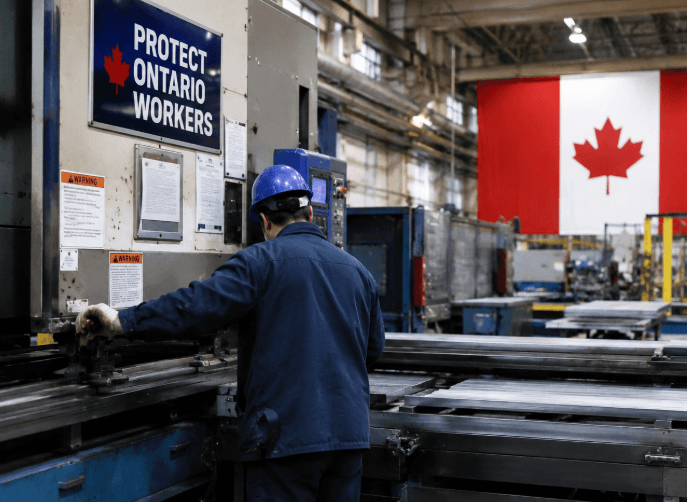
Ontario is expanding access to a $1-billion financing program for businesses affected by U.S. tariffs, broadening provincial support after Washington imposed new 50 per cent duties on a range of Canadian goods. The move is aimed at helping companies manage cash-flow pressures, protect jobs and maintain operations amid heightened Canada-U.S. trade uncertainty.
The province announced the changes in Hamilton on August 24, saying eligibility for the Protect Ontario Financing Program, or POFP, will immediately expand to businesses affected by the new U.S. Section 338 tariffs. Companies facing existing Section 232 tariffs on steel, aluminum, copper and automotive products will also remain eligible for support.
Ontario Responds to New 50 Per Cent U.S. Tariffs
The latest U.S. tariffs took effect at 12:01 a.m. Eastern time on August 22. Section 338 of the U.S. Tariff Act of 1930 permits the U.S. president to impose additional duties of up to 50 per cent on imports from countries deemed to discriminate against American commerce.
Ontario said this marks the first time the United States has imposed tariffs under Section 338.
“Our government will do whatever it takes to stand up for Ontario workers and protect their jobs and paycheques as we face down this latest economic attack from President Trump,” said Premier Doug Ford. “Now more than ever, Team Canada needs to deliver on our shared commitment to build the most competitive and resilient economy in the G7, so we can attract investment, create jobs and protect workers and their families for decades to come.”
The province argues that tariffs could disrupt highly integrated North American supply chains, weaken investor confidence and raise costs for businesses and consumers on both sides of the border.
Protect Ontario Financing Program Offers Up to $1 Billion
First launched in August 2025, the POFP provides up to $1 billion in loans to qualifying Ontario businesses experiencing tariff-related working-capital pressures.
Financing can help companies meet expenses such as payroll, lease payments and utility bills when trade disruptions reduce sales, margins or available cash.
Support Targets Industries Facing Trade Pressure
Ontario’s manufacturing sector is particularly exposed to changes in U.S. trade policy. The province is Canada’s steel-making hub and is home to three large producers supported by a supply chain employing about 16,500 workers.
Its automotive industry is also deeply integrated with U.S. manufacturing operations, meaning tariffs can affect suppliers and workers on both sides of the border.
“As President Trump’s tariffs continue to target our province’s key industries and the world-class workers behind them, our government remains unwavering in its commitment to protect Ontario,” said Vic Fedeli, Minister of Economic Development, Job Creation and Trade. “By broadening eligibility for the Protect Ontario Financing Program and advocating for a fair deal, we will ensure Ontario’s economy can remain competitive and resilient for generations to come, while advancing meaningful, immediate relief for our businesses and their workers today.”
Province Points to $30 Billion Tariff-Relief Strategy
The financing program forms part of Ontario’s broader $30-billion tariff relief and support plan.
That strategy includes the $150-million Ontario Together Trade Fund, which helps small and medium-sized businesses pursue international and interprovincial markets, strengthen competitiveness and re-shore critical supply chains.
The province said the fund has supported 89 companies whose projects represent nearly $1 billion in investment and are expected to protect or create more than 10,000 jobs.
Ontario has also established the $40-million Trade-Impacted Communities Program. Seven announced projects valued at $5.6 million have created or protected 1,605 jobs, according to the province.
Manufacturing Tax Credit Provides Additional Support
Another component is the Ontario Made Manufacturing Investment Tax Credit, which provides tax relief for qualifying capital investments in buildings, machinery and equipment used for manufacturing or processing.
The province estimates the credit will deliver approximately $2.7 billion in income-tax support over five years.
“Our government is taking decisive action to protect Ontario workers, businesses and communities from U.S. tariffs taking direct aim at our economy,” said Peter Bethlenfalvy, Minister of Finance. “Our government will continue to provide targeted support for our trade-impacted sectors and invest in strategic priorities to ensure Ontario remains resilient and well-positioned to navigate global uncertainty and seize new opportunities for long-term growth.”
Ontario Seeks Greater Trade Diversification
The province said it will continue advocating for Ontario industries while emphasizing the economic importance of the Canada-U.S. relationship. At the same time, the government is encouraging businesses to diversify export markets and reduce dependence on U.S. customers.
Ontario also warned that tariffs on Canadian cement and concrete could have consequences south of the border, particularly along the U.S. East Coast, where Canadian suppliers help address gaps between domestic production and demand.
By expanding the POFP, Ontario is seeking to provide businesses with additional liquidity while the trade dispute continues. The broader challenge will be protecting manufacturing employment and investment while helping Ontario companies develop more diversified markets and supply chains.
Discover more from Wire Service Canada
Subscribe to get the latest posts sent to your email.