

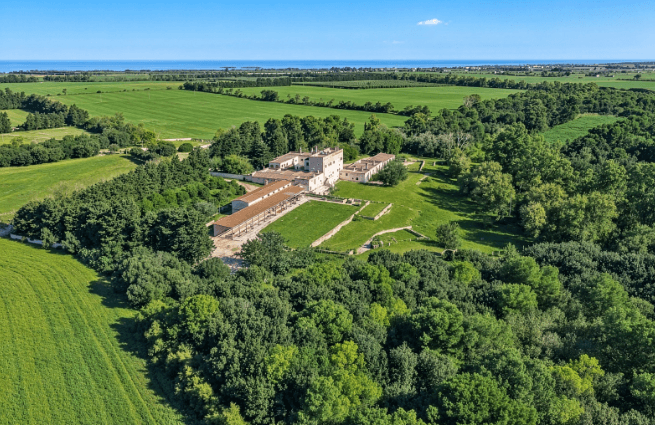
A centuries-old fortified masseria in Italy’s Puglia region has been placed on the market, offering prospective buyers the chance to acquire one of the region’s largest and most historically significant rural estates. Located near the Adriatic coast and the Torre Guaceto Nature Reserve, the property combines nearly 900 years of history with development potential in the luxury hospitality and heritage real estate sectors.
The estate, represented by Lionard Luxury Real Estate, spans more than 2,400 square metres of built space across an approximately 50-hectare property, with the option to expand the estate to around 100 hectares.
A Landmark Property with Nearly Nine Centuries of History
Situated approximately one kilometre from the sea near Torre Guaceto, the fortified residence traces its origins to the early 12th century and is regarded as one of the oldest surviving fortified masserie in Puglia.
Historical records indicate that in 1107, Norman duchess Sichelgaita donated the estate to the Monastery of the Benedictine Nuns of Brindisi. The religious order retained ownership for nearly five centuries, establishing the estate as an important agricultural and defensive centre during the medieval period.
Ownership later transferred to Princess Eleonora Caraccioli before becoming part of the holdings of the Dentice family, a noble lineage with roots in the Maritime Republic of Amalfi. For generations, the family governed the surrounding territory from castles in Carovigno and San Vito dei Normanni, further strengthening the property’s historical significance.
Royal Connections Add to the Estate’s Legacy
Historic Residence Hosted European Royalty
Beyond its architectural importance, the masseria has played a role in modern European history through its association with the Dentice di Frasso family.
In 1943, during one of the most turbulent periods of Italy’s Second World War experience, the family welcomed King Victor Emmanuel III and Queen Elena to the estate.
In subsequent decades, the residence also hosted distinguished European guests, including Queen Paola of Belgium and King Albert II, along with members of Italian and international noble families.
These royal connections have contributed to the property’s reputation as one of southern Italy’s notable historic residences.
Architecture Reflects Puglia’s Medieval Heritage
The estate comprises more than 2,400 square metres of interior space distributed across the principal residence, a Renaissance tower and an additional dépendance.
Several preserved architectural features highlight the property’s medieval origins and centuries of continuous occupation. These include a white-stone façade, a crenellated defensive tower, centuries-old cypress trees, an internal courtyard framed by rounded arches, and a small deconsecrated church featuring a traditional bell gable.
From the rooftop terrace of the Renaissance tower, panoramic views extend across the surrounding countryside toward the Adriatic Sea and the protected Torre Guaceto Nature Reserve, reinforcing the property’s close relationship with both the coastal and agricultural landscapes.
The combination of preserved historical elements and expansive grounds makes the estate a rare example of fortified Apulian rural architecture.
Investment Potential Extends Beyond Heritage Preservation
Opportunity for Luxury Hospitality Development
The transaction includes approximately 50 hectares of land that provide privacy and preserve the estate’s rural setting. Buyers also have the option to acquire an additional 50 hectares, increasing the overall property to roughly 100 hectares.
Its scale, proximity to the Adriatic coastline and accessibility via Brindisi International Airport position the estate as a potential candidate for luxury hospitality or heritage tourism projects, subject to preserving its architectural integrity and environmental setting.
Industry observers note that demand for historically significant properties has continued to attract international investors seeking unique assets that combine cultural heritage with long-term commercial potential.
The property’s location near one of southern Italy’s protected coastal areas further enhances its appeal for high-end tourism developments that emphasize sustainability and heritage conservation.
Growing Interest in Heritage Real Estate
Across Europe, interest in landmark properties with historical significance has remained resilient as investors increasingly seek assets distinguished by architectural character, cultural value and limited market availability.
As one of the largest fortified masserie currently available in Puglia, the estate represents a rare opportunity to acquire a property that has evolved through nearly nine centuries of Italian history while retaining much of its original identity.
With its combination of medieval architecture, royal heritage, extensive land holdings and proximity to both the Adriatic coast and modern transportation links, the masseria stands as an exceptional heritage asset. As it enters the market, the estate is poised to begin a new chapter, balancing preservation of its historic legacy with opportunities for carefully managed future development.