

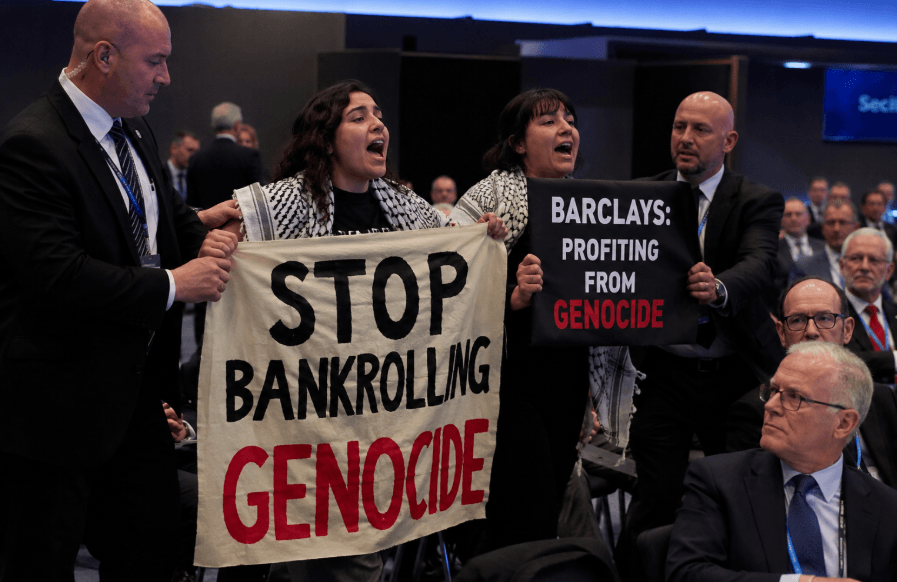
Protesters Call on Bank to End Ties to Israeli Government Bonds and Arms Companies
LONDON — Pro-Palestinian activists disrupted the annual general meeting of Barclays in London on Thursday, accusing the bank of financially supporting Israel’s military operations in Gaza through investments, loans and its role in selling Israeli government bonds.
The disruption took place during the bank’s AGM as demonstrators interrupted proceedings with chants urging Barclays to “stop bankrolling genocide.” Several groups of protesters were eventually escorted from the meeting by security personnel after repeated interruptions.
The protest was organized by the Palestine Solidarity Campaign alongside the Campaign Against Arms Trade and War on Want, which have intensified pressure on financial institutions linked to Israel amid the ongoing conflict in Gaza.
According to research cited by the campaign groups, Barclays holds more than £2 billion in shares and provides approximately £6.1 billion in loans and underwriting to nine companies allegedly supplying weapons, military technology and components used by Israel in military operations against Palestinians.
Campaigners Target Barclays’ Role in Israeli Bond Sales
Activists also focused on Barclays’ position as a “primary dealer” for Israeli government bonds, a role that allows the bank to participate directly in the sale and distribution of Israeli sovereign debt.
Campaigners argue that the arrangement enables Israel to raise funds that support its military operations and policies toward Palestinians. The groups say Barclays is currently the only UK-headquartered bank serving in that capacity.
The protest reflects growing scrutiny from activist organizations toward multinational banks and institutional investors with financial exposure to companies connected to defence and military sectors operating in the Middle East.
Barclays has become the subject of a broader boycott campaign in the United Kingdom, with organizers encouraging customers to close accounts and urging cultural and sporting organizations to cut commercial ties with the bank.
Campaigners have compared the movement to international anti-apartheid campaigns targeting South Africa during the 1980s, arguing that sustained economic pressure can influence corporate behaviour.
Activists Escalate Public Pressure Campaign
Demonstrations outside Barclays branches have become increasingly common in recent months, with campaign groups organizing pickets and public awareness events across Britain.
The latest disruption at the AGM represents an escalation in tactics designed to draw attention to the bank’s business relationships and financial activities tied to Israel.
PSC Deputy Director Calls for Account Closures
Ryvka Barnard, Deputy Director of the Palestine Solidarity Campaign, accused Barclays of profiting from the conflict and urged the public to intensify pressure on the bank.
“There can be no business as usual for Barclays while it bankrolls Israel’s genocide against Palestinians in in the Gaza Strip, and wider regime of military occupation and apartheid.
Rather than heeding voices of conscience, which includes thousands of former customers, it seeks to make more money from the misery, pain and death of Palestinians. We call on everyone to join our campaign – to close their accounts with Barclays, pledge not to bank there until it ends its complicity in Israel’s crimes , and picket branches across Britain. The only way to get Barclays to do the right thing is by drawing public attention to their role in facilitating Israel’s genocide and hitting their profits. Just as South African anti-apartheid campaigners did, we too will force Barclays to withdraw in shame from Israel’s arms supply chain.”
The activist groups claim that more than 72,000 Palestinians have been killed in Gaza since October 2023, while violence and displacement in the West Bank have also intensified.
Financial Institutions Face Increasing ESG and Political Scrutiny
The Barclays protest highlights the growing challenges facing major financial institutions navigating environmental, social and governance (ESG) expectations alongside geopolitical controversies.
Banks and asset managers globally have faced mounting pressure from activist shareholders, civil society groups and consumers over investments connected to defence contractors, fossil fuels and governments accused of human rights violations.
While campaign groups continue to pressure Barclays publicly, the bank has not yet announced any changes to its investment activities or its role in Israeli government bond markets.
Photographs and video footage of Thursday’s protest were made available by organizers following the disruption.