

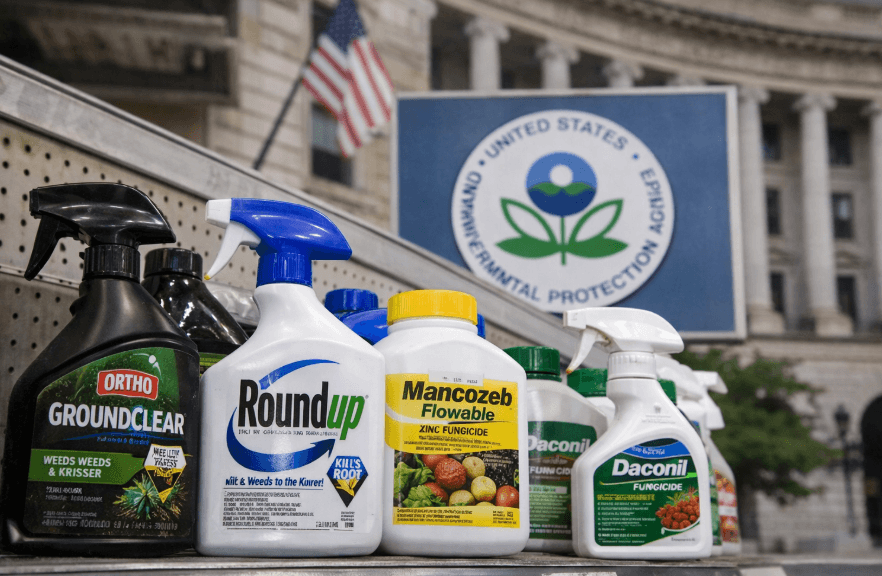
Advocacy groups raise concerns over regulatory gaps as Supreme Court case looms
WASHINGTON — The Environmental Protection Agency has repeatedly failed to require cancer warnings on pesticide products despite internal assessments identifying significant cancer risks, according to two new analyses released Tuesday by the Center for Food Safety and the Center for Biological Diversity.
The findings highlight what the groups describe as a systemic disconnect between the agency’s scientific evaluations and its public-facing safety requirements, raising broader questions about regulatory oversight in the pesticide industry.
High cancer risk thresholds flagged
The Center for Food Safety analysis examined both currently approved and legacy pesticide ingredients and found that the EPA has allowed products on the market with cancer risks far exceeding its own safety benchmark.
According to the report, some pesticides carry a cancer risk as high as one in every 100 people exposed — significantly higher than the agency’s stated threshold of one in a million. Over the past four decades, the EPA has approved 200 pesticide active ingredients classified as either “likely” or “possible” carcinogens.
“It’s bad enough that the EPA approves cancer-causing pesticides,” said Bill Freese, science director at the Center for Food Safety. “But if the agency is going to allow such chemicals to be freely sold at Home Depot, Wal-Mart and farm-supply stores, the very least the EPA must do is require a clear cancer warning on the label. Warnings save lives by incentivizing users to wear protective equipment that reduces risk.”
The analysis further found that of 570 pesticide chemicals reviewed by the EPA since 1985, 35% were categorized as either “likely” or “possible” human carcinogens.
Limited use of warning labels
A separate analysis by the Center for Biological Diversity reviewed more than 93,000 pesticide labels and found that cancer warnings are rarely applied, even when the EPA has identified potential carcinogenic risks.
The study reported that only 69 of 4,919 pesticide labels (1.4%) containing “likely” carcinogens include cancer warnings. For products with “possible” carcinogens, just 242 of 22,147 labels (1.1%) carry such warnings.
“It’s dumbfounding that the EPA has failed to require any cancer warning on thousands of pesticide products sold to the public that the agency itself has linked to cancer,” said Lori Ann Burd, environmental health program director at the Center for Biological Diversity. “Why should anyone have confidence in the EPA’s ability to keep tabs on the pesticide industry and protect us all from harmful poisons when it won’t even compel companies to put long-term health warnings on pesticides it knows are really dangerous?”
The report also noted inconsistencies in how warnings are applied. In some cases, products containing identical active ingredients carry different labeling requirements, creating confusion for users.
State-level rules fill federal gaps
Both analyses found that most cancer warnings currently seen on pesticide products stem from California’s Proposition 65 regulations, rather than federal requirements. The state law mandates warnings for products containing chemicals linked to cancer or reproductive harm.
However, the groups argue that reliance on state-level rules leaves most Americans without adequate information. For example, pesticides containing mancozeb, diuron and chlorothalonil — all classified by the EPA as “likely” carcinogens — are only required to carry warnings in California, despite widespread agricultural use across the United States.
Legal backdrop adds urgency
The reports come ahead of oral arguments scheduled for April 27 in the U.S. Supreme Court case Monsanto Company v. John L. Durnell. The case involves Monsanto, now owned by Bayer, which is seeking immunity from future lawsuits tied to its glyphosate-based herbicide products, including Roundup.
At issue is whether the EPA holds sole authority over pesticide labeling, a decision that could significantly affect the ability of individuals to pursue legal claims related to alleged health harms.
Broader implications for public trust
The findings underscore ongoing tensions between regulatory agencies and advocacy groups over pesticide safety standards and transparency. Critics argue that inconsistent labeling and elevated risk thresholds may undermine public confidence in federal oversight.
The EPA has not publicly responded to the analyses at the time of publication.
For Canadian observers, the issue may resonate as regulators and policymakers continue to evaluate pesticide safety frameworks and cross-border agricultural practices. While Canada maintains its own regulatory regime, developments in the U.S. — particularly those involving multinational companies and widely used chemicals — often carry implications for domestic policy discussions.
As the Supreme Court case proceeds, the spotlight on pesticide labeling practices is expected to intensify, with potential consequences for both industry accountability and public health protections.
Discover more from Wire Service Canada
Subscribe to get the latest posts sent to your email.