

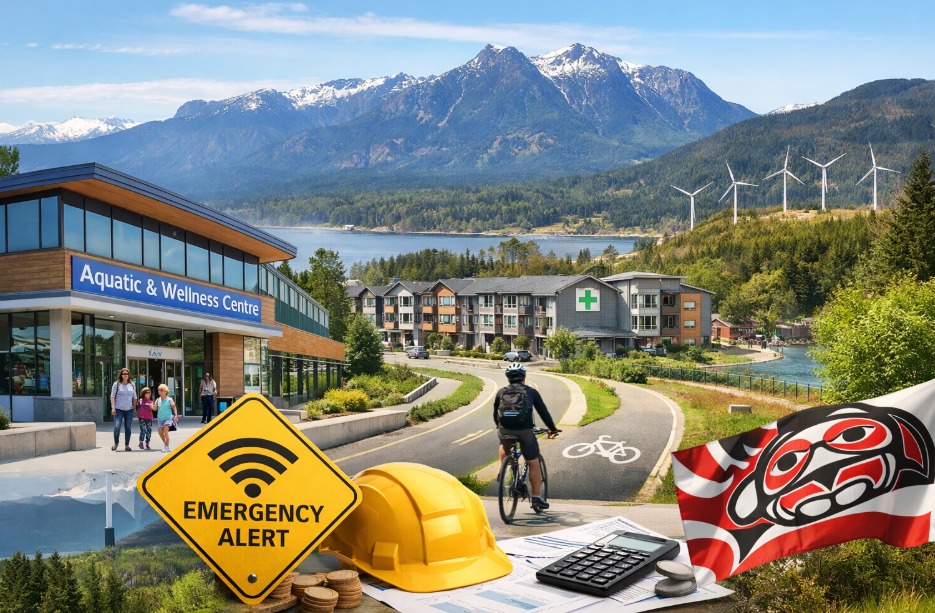
The Strathcona Regional District has approved its 2026–2030 financial plan, shifting its fiscal focus from major capital construction to operating new facilities while continuing to invest in housing, infrastructure and climate resilience across the Vancouver Island region.
The plan, approved Feb. 27, positions the regional government to support new community assets coming online in 2026 while balancing affordability concerns amid ongoing inflationary pressures.
Among the most significant developments is the opening of the new Aquatic and Wellness Centre at Strathcona Gardens, along with the Just Like Home Lodge and Health Professionals Housing project. Regional officials say these projects mark a transition point, with recent construction investments now moving into operational phases aimed at delivering long-term community benefits.
The five-year financial roadmap outlines spending priorities tied to community well-being, environmental sustainability and governance. It was developed through internal staff reviews and board workshops and is designed to maintain transparency in how services are funded across the district’s electoral areas and member municipalities, including Campbell River and several smaller communities.
In addition to supporting new recreational and health facilities, the plan advances several strategic initiatives, including housing and health programs, rehabilitation and recreation services, and improvements to broadband connectivity and emergency alert systems. Investments are also earmarked for active transportation projects, environmental infrastructure and First Nations reconciliation and governance initiatives.
Regional officials say these priorities reflect both immediate service needs and longer-term economic and social objectives.
The financial plan reflects a shift in spending patterns compared with previous years, when the district undertook large-scale capital builds. With major construction projects nearing completion, operating costs for new facilities will become a larger part of the district’s budget.
Despite broader economic challenges, including rising costs for labour, materials and services, the district says the plan seeks to balance fiscal responsibility with service sustainability.
The average residential property assessment change across the region is projected at 2.4 per cent, though tax impacts vary by community.
Homeowners in Area A (Kyuquot/Nootka-Sayward) will see an increase of $5 annually, while those in Area B (Cortes Island and surrounding archipelago) will see a decrease of $34. Area C (Discovery Islands and Mainland Inlets) residents will see a $1 decrease, and Area D (Oyster Bay – Buttle Lake) will experience no change.
In Campbell River, the district’s largest municipality, the average household will see an annual increase of $65. Smaller increases are expected in other communities, including $1 in Gold River, Tahsis and Zeballos, and $9 in Sayward. Taxes will remain unchanged for Ka:’yu:’k’t’h’/Che:k’tles7et’h’ First Nations.
The regional district said the modest changes reflect efforts to distribute costs fairly while ensuring stable service delivery.
The plan also underscores the growing role of regional governments in addressing housing shortages and supporting health-care access, particularly in smaller or rural communities where attracting professionals can be difficult. The Just Like Home Lodge and Health Professionals Housing project is intended to help address those challenges by improving accommodation availability tied to health services.
At the same time, investments in broadband and emergency communications aim to strengthen connectivity and safety in remote areas, while environmental spending reflects increasing attention to climate resilience and infrastructure durability.
Regional district chair Mark Baker said the financial plan represents a significant effort to align spending with community priorities and long-term sustainability.
“Significant work has gone into ensuring this plan meets residents’ needs while supporting long-term sustainability and regional prosperity,” said SRD Chair Mark Baker. “Our investments in recreation, housing, environmental resilience, and governance will benefit the region for generations to come.”
The Strathcona Regional District serves a diverse geographic area that includes urban centres, remote coastal communities and island populations, each with different service needs and tax bases.
Officials say the approved plan provides financial stability and predictability while enabling the district to transition from building infrastructure to operating and maintaining it — a shift they describe as essential for delivering lasting value from recent investments.
The 2026 budget will take effect as the district begins operating its newest facilities, marking what regional leaders say is a new phase focused on service delivery, community health and long-term resilience.
Discover more from Wire Service Canada
Subscribe to get the latest posts sent to your email.