

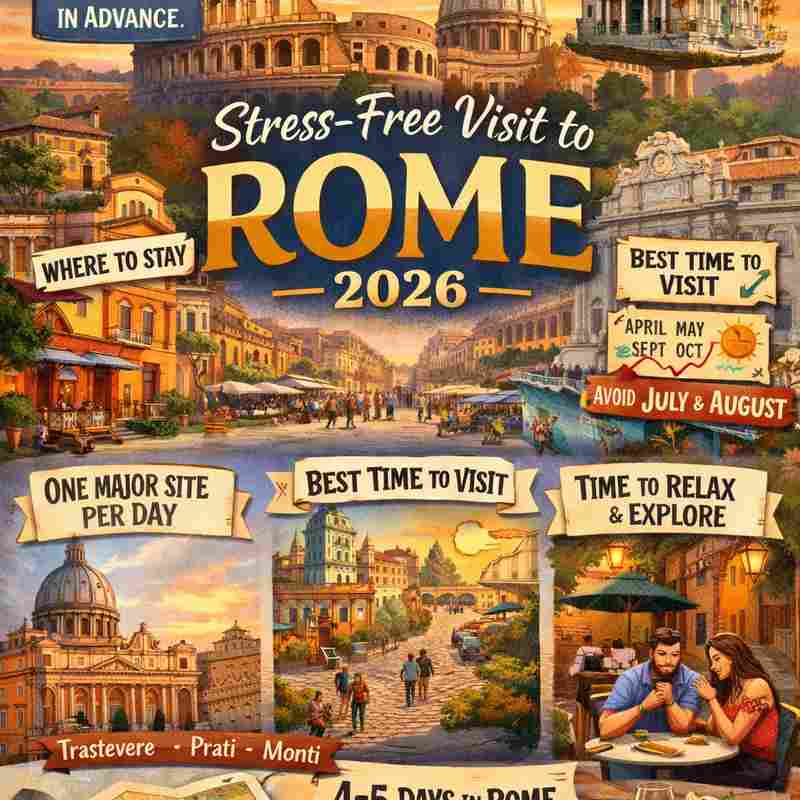
Rome remains one of the most visited cities in the world, yet many travelers still underestimate how much planning is required to enjoy it comfortably. In recent years, timed-entry systems, visitor caps, and high seasonal demand have changed the way major attractions operate. A stress-free visit in 2026 depends less on spontaneity and more on strategic organization.
The good news is that Rome is entirely manageable with the right approach.
Understand How Timed Entry Works
Most of Rome’s major landmarks now operate with pre-booked time slots. The Colosseum, Roman Forum, Vatican Museums, and even smaller sites frequently sell out days in advance during peak months. Visitors who assume they can purchase tickets on arrival often face long waits or limited availability.
Booking in advance allows you to structure your days logically. Instead of moving across the city reactively, you can build your itinerary around confirmed time slots. This reduces unnecessary backtracking and eliminates the stress of uncertainty.
For travelers who want clarity on access types and booking systems, a detailed ticket overview is available at https://www.justroma.it/en/tickets/.
Build Your Itinerary Around Geography
Rome rewards those who think in terms of neighborhoods rather than isolated monuments. The historic center is compact, but inefficient planning can easily double your walking time.
A practical strategy is to group attractions by area:
- Colosseum, Roman Forum, and Palatine Hill in one block of time
- Pantheon, Trevi Fountain, and Piazza Navona within another
- Vatican Museums and St. Peter’s Basilica as a separate half-day
By organizing your visit geographically, you reduce physical fatigue and preserve time for slower moments — coffee stops, side streets, and unexpected discoveries.
Choose the Right Accommodation Zone
Where you stay significantly affects your experience. Hotels near major landmarks reduce transportation time but often come at higher prices. Staying slightly outside the most central areas can provide better value while remaining well connected by Metro Line A or B.
Areas such as Campo de’ Fiori, the Pantheon district, or near Piazza Navona offer walkability. Prati and Monti provide balance between access and atmosphere. For a structured neighborhood overview and practical accommodation guidance, see https://www.justroma.it/en/where-to-sleep-in-rome/.
Understanding the trade-offs between location, price, and transport access makes a noticeable difference in overall comfort.
Avoid Overloading Each Day
Rome is visually dense. Even short walks expose layers of history spanning over two millennia. Trying to visit too many landmarks in one day often leads to fatigue and reduced enjoyment.
A realistic daily structure includes:
- One major ticketed attraction
- Two to three nearby landmarks
- Open time for wandering
Leaving unstructured time in your schedule allows Rome to unfold naturally. Many of the city’s most memorable moments occur between destinations rather than inside them.
Final Considerations for 2026
Tourism trends suggest that advanced booking will remain essential. Digital ticketing systems are expanding, and flexible cancellation options are increasingly common. Travelers who confirm key entries early can approach the city with confidence rather than urgency.
Rome does not require rushing. It requires structure.
When logistics are handled in advance — accommodation selected carefully, time slots secured, routes organized logically — the city becomes far more accessible. Instead of navigating crowds and uncertainty, visitors can focus on architecture, atmosphere, and the rhythm of everyday Roman life.
With thoughtful preparation, Rome transforms from overwhelming to intuitive.
Discover more from Wire Service Canada
Subscribe to get the latest posts sent to your email.