

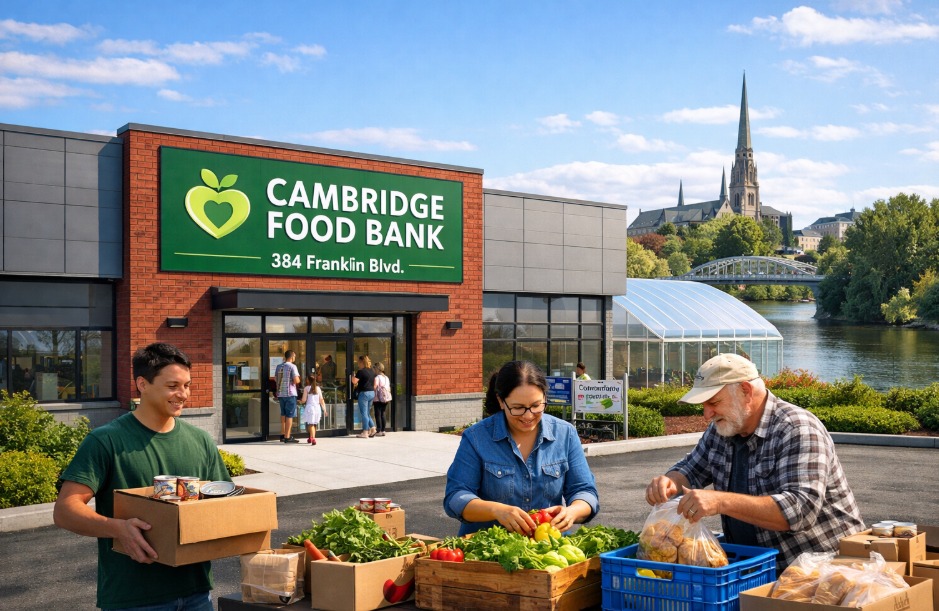
CAMBRIDGE, Ont. — The City of Cambridge is investing $1.5 million to support the Cambridge Food Bank’s planned move to a larger facility, as rising food insecurity drives increased demand for its services.
City officials announced the funding Wednesday, describing the contribution as a strategic investment to help the organization relocate to 384 Franklin Boulevard and expand its capacity to serve residents across Cambridge and nearby North Dumfries.
“With the current location having reached its limits, the City is proud to support the Cambridge Food Bank’s move and help ensure all those living in Cambridge have access to the food they need,” said Jan Liggett, mayor of Cambridge. “This investment will strengthen the food bank’s capacity to meet the growing needs of our community. The Cambridge Food Bank is a vital asset to our community, supporting thousands of residents each year—and that number continues to grow as more families experience food insecurity. This investment is an investment in the people of Cambridge, especially our children. Ensuring that young people have access to nutritious food and regular meals is essential to their success. When children are nourished, they are better able to focus, learn, and thrive in school. This expansion will help make that possible.”
The move comes as demand for food bank services continues to surge. In 2025 alone, the Cambridge Food Bank supported more than 10,000 individuals across more than 4,500 households. Of those, 1,334 households accessed services for the first time, underscoring the widening impact of affordability pressures on the community.
“We are deeply grateful to the City of Cambridge for this transformational investment,” said Dianne McLeod, CEO of The Cambridge Food Bank. “Today, 1 in 8 people in our community are impacted by food insecurity, and many of those turning to us are employed full-time. Food insecurity no longer fits a stereotype. This new space will allow us to expand our reach and serve our neighbours with dignity.”
The new Franklin Boulevard location is expected to open in 2027 and will replace the food bank’s current facility at 54 Ainslie Street, where it has operated for 25 years under a lease agreement with the city. Once the relocation is complete, that lease will end, allowing the municipality to repurpose the downtown space for other community uses.
City officials said the investment will help fund the transition and enable the organization to broaden its programming and services. The expanded facility will include a larger and more accessible emergency food pantry, expanded warehouse capacity, and additional refrigeration to store perishable goods more efficiently.
Plans also call for a larger commercial kitchen to support meal programs and food skills training, along with dedicated program rooms and gathering spaces designed to better serve children, youth and adults. A greenhouse is also included in the design, aimed at increasing access to fresh, locally grown produce for clients.
The expansion reflects broader trends affecting food banks across Canada, where rising housing costs, inflation and wage pressures have pushed more working households to seek assistance. Local officials said the new space will help the Cambridge Food Bank respond more effectively to these pressures while improving the overall client experience.
Municipal leaders framed the funding as part of the city’s long-term strategic priorities, including its Cambridge Connected plan, which focuses on improving access to social supports and strengthening community well-being.
The city’s financial commitment also signals a shift in how municipalities are supporting front-line social service organizations, particularly as demand grows faster than charitable funding alone can sustain.
For the Cambridge Food Bank, the new facility represents both a practical solution to capacity constraints and an opportunity to modernize its operations. With more space, improved infrastructure and expanded programming, the organization aims to serve more residents while maintaining what it describes as a welcoming and dignified environment.
Construction timelines and additional fundraising efforts are expected to continue over the next year, with the goal of completing the move and beginning operations at the new site in 2027.
City officials and food bank leaders say the investment is intended not only to meet current needs but to position the organization to respond to future demand, as economic uncertainty continues to affect households across the region.