

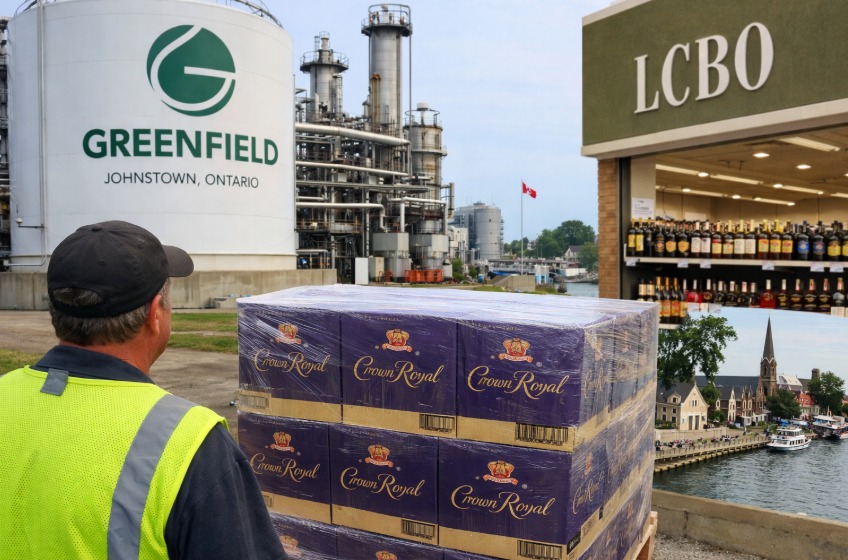
TORONTO — The Ontario government has reached an agreement with global spirits maker Diageo that will see nearly $23 million in new investments directed into the province’s agri-food, manufacturing and beverage alcohol supply chains, while safeguarding jobs and ensuring continued market access for its flagship brands.
The deal follows months of discussions between Queen’s Park and the producer of Crown Royal after concerns were raised last year about the planned closure of the company’s facility in Amherstburg, near Windsor. Provincial officials had signalled that companies benefiting from Ontario’s marketplace would be expected to maintain local commitments.
Premier Doug Ford said the agreement delivers new capital that otherwise would not have flowed into the province.
“By standing firm in our plan to protect Ontario workers, we’ve secured nearly $23 million in investments that Ontario would not otherwise have seen,” said Premier Doug Ford. “These investments will help keep Ontario workers on the job, strengthen provincial supply chains and support the local community in Amherstburg and the surrounding area.”
As part of the arrangement, Diageo has committed to a series of targeted investments spanning economic development, manufacturing inputs, packaging, marketing and agricultural support. In exchange, Crown Royal products produced by Diageo will continue to be available for sale through the Liquor Control Board of Ontario (LCBO), preserving access to one of the company’s key retail channels in Canada.
Supply Chain and Community Investments
The largest single component of the agreement is an $11-million commitment to purchase grain neutral spirits from Greenfield Global’s facility in Johnstown, Ont., strengthening production capacity in eastern Ontario and supporting domestic suppliers.
Diageo will also invest $3 million to expand production of ready-to-drink canned beverages — including Crown Royal, Smirnoff and Captain Morgan — through a Toronto-based co-packer serving the Canadian market. An additional $2 million will go toward new packaging for pre-mixed beverages via a new co-manufacturer in Scarborough.
The agreement includes $5 million in Ontario-based marketing and promotional spending, reinforcing the company’s commercial presence in the province.
On the community front, Diageo has pledged $500,000 to Invest WindsorEssex for regional economic development initiatives focused on Amherstburg and surrounding communities. Another $500,000 will support additional local community projects. The company will also provide $1 million in direct funding to organizations that promote the growth and sustainability of Ontario’s agricultural sector.
The company has further committed to exploring options to establish a new canning facility in Ontario, a move that could deepen local manufacturing capacity if realized.
Taken together, the investments aim to strengthen Ontario’s end-to-end beverage alcohol supply chain — from farm inputs and manufacturing through packaging, marketing and distribution — while helping offset the economic impact associated with the Amherstburg closure.
Broader Alcohol Sector Strategy
The agreement aligns with the province’s broader push to modernize and expand Ontario’s alcohol marketplace.
In its 2025 budget, the government earmarked approximately $100 million in 2025–26 and $155 million in 2026–27 to foster a more competitive and dynamic alcohol sector. Since 2021, Ontario has introduced a range of financial supports for wineries, cideries and distilleries, including up to $35 million annually under the Ontario Grape Support Program over five years beginning in 2025–26, totalling $175 million.
The province has also extended the VQA Wine Support Program through 2029–30, expanded eligibility to provide up to an additional $31 million annually, committed up to $16.7 million over five years to support capital costs for winery retail stores relocating into grocery stores, and granted $10 million to wineries and cideries with on-site retail operations.
Additional measures include nearly $16 million in multi-year supports to wineries, small cideries and distilleries, a $1.2-million increase to the Small Distillery Program, and the elimination of the 6.1 per cent wine basic tax at on-site winery stores.
Finance Minister Peter Bethlenfalvy said the Diageo agreement underscores the province’s strategy of pairing market access with reinvestment expectations.
“Ontario remains committed to protecting good jobs and ensuring that industries across the province continue to grow and thrive. This agreement with Diageo reflects the strength of our agri food and manufacturing sectors, and the value of standing up for workers. By working collaboratively with industry, we are building a stronger, more resilient supply chain while ensuring that companies benefiting from Ontario’s marketplace invest back into our people and our communities.”
For Ontario, the deal signals a more assertive approach to managing relationships with multinational firms operating in regulated sectors. For Diageo, it preserves access to a key provincial retail system while reinforcing its supply chain footprint in Canada.
As competition intensifies in the beverage alcohol market, provincial officials say they will continue to use “every available tool” to ensure companies that benefit from Ontario consumers also invest in local workers, producers and communities.
Discover more from Wire Service Canada
Subscribe to get the latest posts sent to your email.