

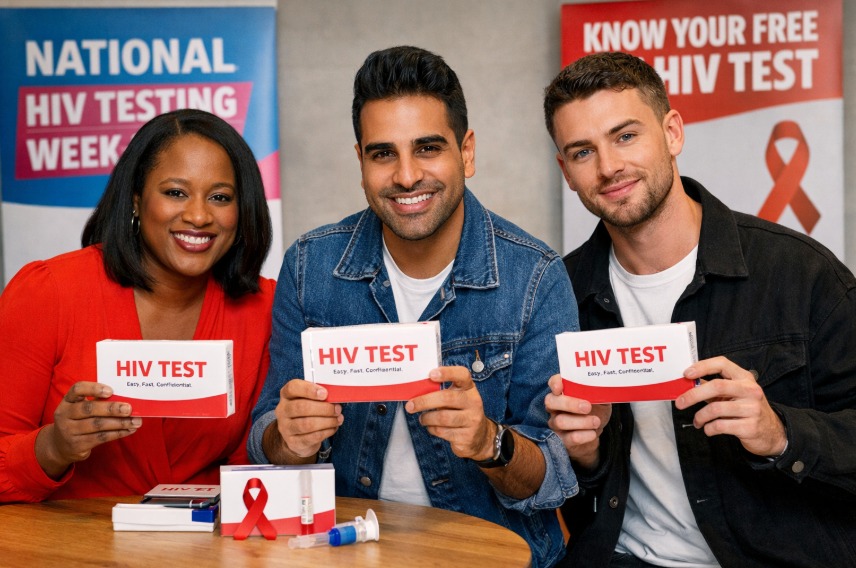
Television personalities from across the UK have united behind a renewed public health campaign urging people to test for HIV, as new polling data reveals that just 20 per cent of adults in England say they have ever taken an HIV test. The campaign coincides with the start of National HIV Testing Week, which runs from Feb. 9 to Feb. 15, and comes amid fresh government commitments to eliminate new HIV transmissions by the end of the decade.
The awareness drive is being supported by a number of well-known TV figures, including broadcaster Charlene White, TV doctor Dr Ranj, and Adam Williams from BBC Three’s I Kissed a Boy. The group is encouraging people across England to order a free HIV home testing kit and to learn their HIV status, a step health experts say remains critical to early diagnosis and effective treatment.
According to new polling conducted by YouGov, misconceptions and gaps in access remain significant barriers to testing. One in five women surveyed said they had never been tested because they had not been offered a test, while nearly three in ten men said they had not tested because they believed their sexual partners could not have HIV, despite having had condomless sex.
HIV charity Terrence Higgins Trust said these assumptions continue to delay testing and contribute to later diagnoses, when the virus may already have compromised the immune system. An estimated 4,700 people are currently living with undiagnosed HIV in England. In 2024, half of new diagnoses were among heterosexuals, while 29 per cent were among gay, bisexual and other men who have sex with men.
During National HIV Testing Week, anyone in England can order a free and confidential HIV test online to complete at home. The self-testing kits can deliver results in as little as 15 minutes, while self-sampling kits can be returned to a laboratory and also test for syphilis.
The push for higher testing rates aligns with the UK government’s goal of ending new HIV transmissions in England by 2030. In December, the government published a new HIV Action Plan backed by more than £170 million in funding. Increasing HIV testing is one of five key priorities outlined in the plan, alongside prevention, treatment access, and tackling stigma.
Charlene White said her own experience demonstrated how straightforward testing can be.
“Five years ago, I took an HIV test live on ITV because I wanted to show it’s easy, quick and something everyone should consider. Today, we have too many people who do not know they need to get a test and are getting diagnosed far later than they could. This National HIV Testing Week, I want to encourage people to get a test, especially if you have never tested or last tested a long time ago. Incredible medication and support are available for anyone who tests positive. Most people will test negative, but either way it’s always better to know. Ordering a test is such a simple step you can take to look after yourself and your health.”
Dr Ranj highlighted the medical progress made over recent decades, while stressing that awareness has not kept pace. “We need to make sure that everyone who needs a test, gets one. From a medical perspective, the progress around HIV has been truly incredible. Treatment is extremely effective, meaning people can live long and healthy lives, and cannot pass on HIV. Now the biggest challenge is people not realising they might need a test. HIV can affect anyone. This week is a great chance for us all to take charge of our sexual health and anyone in England can order free HIV test.”
Adam Williams, who has spoken publicly about living with HIV, said testing was a form of self-care.
“Testing for HIV really is self-care. If it’s a negative result, you can take steps to stay negative. If, like me, it’s positive, you get access to treatment that lets you live a very long, healthy and meaningful life. I take one pill a day and HIV doesn’t hold me back.
“I was diagnosed because of an HIV test I took at home. Afterwards, I did a lot of looking-inward and self-discovery – connecting with other people living with HIV through HIV charities was such an important part of that. I went on I Kissed A Boy to show the world that life for people living with HIV can be very normal: I still go on dates, have sex and do everything I was doing before. The only difference is my one pill a day, which means I can’t pass it on during sex.”
Health and Social Care Secretary Wes Streeting said testing remains central to meeting national targets.
“Thanks to incredible advances in treatment, people with HIV today can live full, healthy lives – and can’t pass the virus on. We’ve come so far.
“But there are still thousands of people in the UK who don’t know they’re living with HIV. That’s why testing matters. It’s quick, free and convenient.
“This government is determined to end new HIV transmissions by 2030. Our new HIV Action Plan, backed by £170 million, sets out how we’ll get there – by tackling stigma, improving access to testing and prevention, and reaching every community that needs support.
“It’s never been easier to get an HIV test and get a result quickly. I’d encourage everyone to test, so you can know your status and keep healthy.”
Richard Angell OBE, chief executive of Terrence Higgins Trust, said National HIV Testing Week remains a pivotal moment in the public health calendar.
“This is the one time of the year when anyone in England can order a free HIV test kit directly to their home. As this new polling shows, it can be easy to put off testing for HIV, or to assume it’s not for you. HIV can affect anyone – it’s always best to know your status. England could become the first country in the world to end new HIV cases – but to get there we need to get a test when they need one. That’s why National HIV Testing Week is a gamechanger – order a test now.”
Discover more from Wire Service Canada
Subscribe to get the latest posts sent to your email.
