

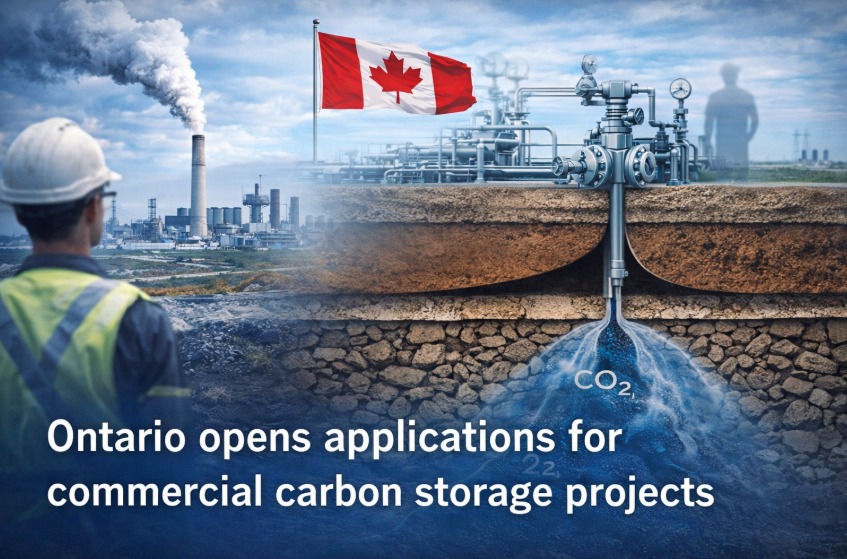
Ontario has formally opened applications for commercial-scale geologic carbon storage projects, marking a significant step in the province’s strategy to reduce industrial emissions while attracting new investment and supporting job creation.
Beginning Monday, developers can submit proposals under a newly established regulatory framework designed to enable the safe, long-term underground storage of carbon dioxide. The province estimates the initiative could help energy-intensive industries cut greenhouse gas emissions by five to seven million tonnes annually, create more than 4,000 jobs and reduce costs for Ontario businesses by nearly $1 billion.
The move is part of the government’s broader economic and environmental agenda, which aims to position Ontario as a competitive jurisdiction for industrial investment while advancing emissions reduction efforts.
“Carbon storage is a tried and trusted technology in Canada and around the world and Ontario is ready to take a safe and responsible approach to unlocking this new opportunity for workers and businesses,” said Mike Harris, Minister of Natural Resources. “Our government is moving forward with strong environmental protections and clear rules that protect our environment while also protecting our economic advantage, supporting good-paying jobs and ensuring Ontario remains competitive around the world.”
Carbon capture and storage (CCS) technology involves capturing carbon dioxide produced by industrial activity before it enters the atmosphere and injecting it deep underground into stable geological formations for permanent storage. The approach has been used for decades in parts of Canada and internationally, particularly in energy-producing regions.
Ontario officials say the new application process follows several years of research, consultation and regulatory development. Since 2022, the province has released three discussion papers, conducted seven public consultations through the Environmental Registry of Ontario and held 11 stakeholder engagement sessions with industry, municipalities and other interested parties.
The result is a regulatory framework intended to provide clarity and certainty for project developers while maintaining environmental safeguards. According to the Ministry of Natural Resources, the framework establishes clear rules for site selection, monitoring and long-term stewardship of carbon storage projects, reducing regulatory uncertainty for businesses considering investment in the province.
Those interested in submitting proposals are encouraged to contact the ministry directly for guidance as applications open.
“The passing of Ontario’s Geologic Carbon Storage Act is a major milestone in building a cleaner, stronger economy,” said Dawn Gallagher Murphy, Parliamentary Assistant to the Minister of Natural Resources. “By regulating carbon storage, we are taking the necessary steps to help ensure its safe implementation while also attracting new investments, creating good-paying jobs and positioning Ontario as a leader in the transition to a global low-carbon economy.”
The Geologic Carbon Storage Act, 2025 provides the legislative foundation for the new framework. The government says the legislation is designed to balance environmental protection with economic development, supporting industries as they work to lower emissions while remaining competitive in global markets.
Geographically, much of Ontario’s carbon storage potential is expected to be concentrated in Southwestern Ontario, where suitable deep rock formations align with many of the province’s largest industrial emitters. That proximity could help lower transportation costs and improve the economic feasibility of CCS projects for manufacturers, cement producers and other energy-intensive sectors.
Globally, carbon capture and storage has been gaining momentum as governments and industries search for scalable solutions to meet climate targets. According to the Global Carbon Capture and Storage Institute, nearly 400 CCS projects were at various stages of development worldwide in 2023, with close to 300 million tonnes of carbon dioxide injected underground.
Ontario officials argue that establishing a clear regulatory pathway now positions the province to compete for future investment as carbon pricing, emissions regulations and corporate climate commitments increasingly shape industrial decision-making.
The government has emphasized that engagement with Indigenous communities, municipalities, landowners and the public will continue as projects are proposed and assessed. Officials say ongoing collaboration will be critical to ensuring that carbon storage development proceeds responsibly and maintains public confidence.
As applications open, Ontario is signaling that carbon storage will play a role in its long-term economic and environmental strategy—one aimed at supporting industrial growth, reducing emissions and strengthening the province’s position in a rapidly evolving low-carbon economy.
