

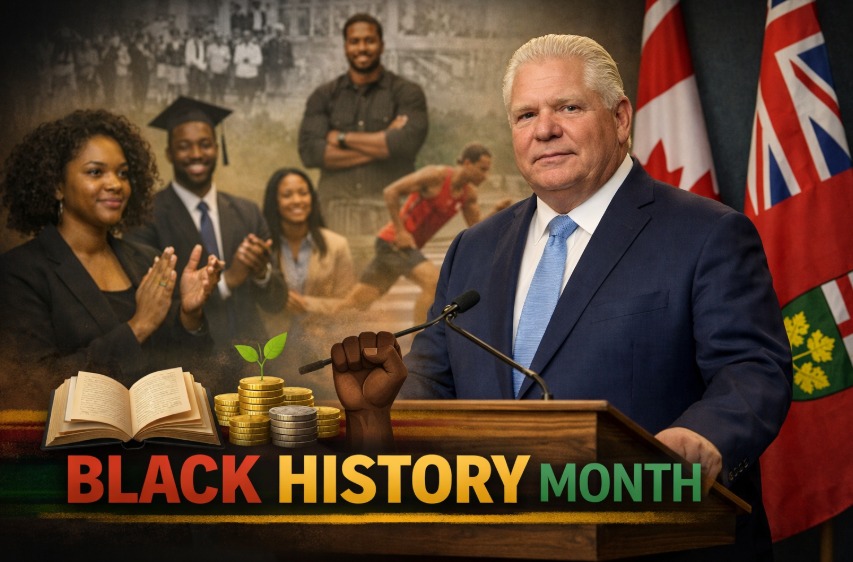
TORONTO — Ontario Premier Doug Ford marked the start of Black History Month on Monday with a statement highlighting the longstanding contributions of Black communities to the province and outlining new and ongoing government efforts aimed at education, economic opportunity and inclusion.
In a statement issued by the Premier’s Office, Ford framed Black History Month as both a time for reflection and a call to action, emphasizing the role Black Ontarians have played across multiple sectors and the importance of addressing systemic barriers that persist today.
“Black History Month is an opportunity to reflect on the many ways Ontario’s Black community has helped strengthen our province and our country,” Ford said.
The premier pointed to the breadth of Black contributions, noting their impact in areas ranging from arts and culture to business, public service and sports. He described the community’s history as one marked by determination in the face of adversity.
“From arts and culture to business, public service, sports and community leadership, the Black community’s legacy of perseverance and resilience is integral to the fabric of Ontario,” he said.
Ford also underscored the educational role of Black History Month, positioning it as a time for Ontarians to deepen their understanding of Black Canadian history while recommitting to the fight against discrimination and racism.
“Black History Month is also a chance to learn about the history and experiences of Black Canadians and stand together against discrimination and racism in all its forms,” the statement said.
The premier’s remarks come amid broader conversations across Canada about equity, representation and the role of public institutions in addressing historical and ongoing inequalities. In Ontario, these discussions have increasingly focused on education and economic participation, particularly for youth and newcomers.
As part of his statement, Ford highlighted provincial investments aimed at expanding opportunities for Black Ontarians, especially young people and entrepreneurs. While the statement did not provide new funding figures, it reaffirmed the government’s commitment to programs designed to reduce barriers and foster inclusion.
“To support this work, our government is proud to invest in innovative programs that expand opportunities for Black youth, entrepreneurs and newcomers, as we build a stronger province for all of us,” Ford said.
Education emerged as a central theme of the premier’s message, with a specific reference to changes coming to Ontario’s school curriculum. Beginning in September 2026, students in Grades 7, 8 and 10 will be required to learn about the history and contributions of Black Canadians as part of the provincial curriculum.
“Starting in September 2026, Ontario’s curriculum for Grades 7, 8 and 10 will also require students to learn about the exceptional contributions and history of Black Canadians who helped build Canada,” Ford said.
The curriculum update is intended to ensure that students gain a more comprehensive understanding of Canadian history, including narratives that have often been overlooked or underrepresented. Education stakeholders have long argued that such changes can help foster greater awareness, empathy and social cohesion among students.
Ford concluded his statement by encouraging Ontarians to actively participate in Black History Month, not only in February but throughout the year.
“This month and every month, I encourage everyone in our province to take time to learn about and celebrate the lasting contributions of Ontario’s Black community,” he said.
Black History Month is observed annually in February across Canada, with events, educational initiatives and community celebrations taking place throughout the province. The month provides an opportunity for governments, businesses and institutions to reflect on progress made while acknowledging the work that remains in advancing equity and inclusion.
The premier’s statement aligns with a broader effort by provincial leaders to publicly recognize Black History Month and signal continued support for policies aimed at addressing systemic challenges. As Ontario prepares to implement curriculum changes and sustain targeted programs, the coming years are expected to test how effectively these commitments translate into long-term outcomes for Black communities across the province.
Discover more from Wire Service Canada
Subscribe to get the latest posts sent to your email.
