

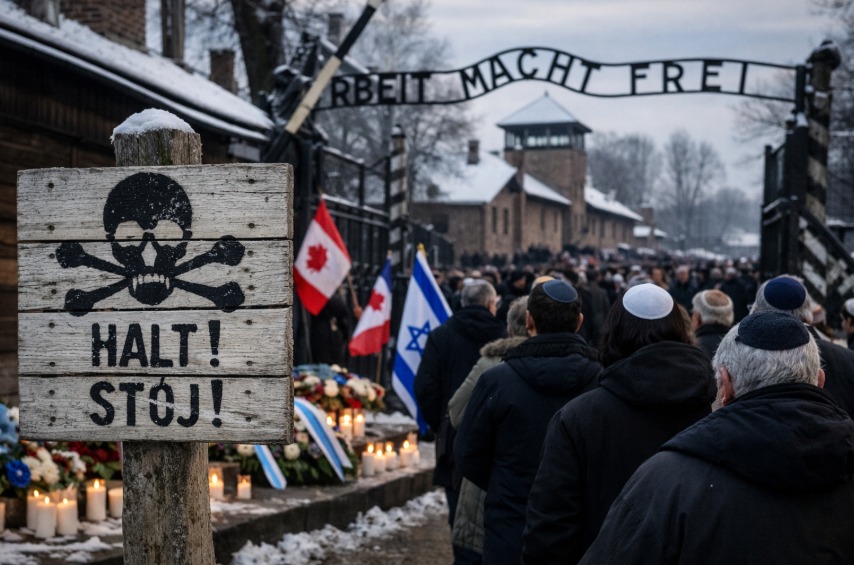
On Jan. 27, communities across Canada and around the world paused to mark International Holocaust Remembrance Day, commemorating the liberation of the Auschwitz concentration camp in 1945 and reflecting on the enduring lessons of one of history’s darkest chapters.
The annual observance serves as a reminder of the consequences of unchecked hatred and antisemitism, as well as a call to renewed vigilance in contemporary society. In a statement issued Tuesday, Rev. Dr. Andrew Bennett, Director of Faith Community Engagement at Cardus, emphasized the significance of the day for Canadians and for faith leaders in particular.
“Each year on January 27, we mark the anniversary of the liberation of the Auschwitz concentration camp in 1945. This commemoration as International Holocaust Remembrance Day stands as an annual recollection of what happens when antisemitism and hatred in a civilised society expands unchecked. Those of us involved in the Simeon Initiative take this day as a reminder of our duty as Christian leaders to stand resolutely with our Jewish fellow citizens against the scourge of antisemitism wherever it is found. We do this not just as Christians but as Canadians dedicated to the upholding of peace, order, and good government for all who call this dominion home.”
— Rev. Dr. Andrew Bennett, Director of Faith Community Engagement at Cardus
International Holocaust Remembrance Day is observed on the anniversary of the liberation of Auschwitz concentration camp, the largest Nazi death camp, where more than one million Jews were murdered alongside Roma, Poles, Soviet prisoners of war, and others targeted by the Nazi regime. The United Nations designated Jan. 27 as an international day of remembrance in 2005, urging member states to honour the victims of the Holocaust and promote education to prevent future genocides.
In Canada, the day is marked by ceremonies, educational programs, and statements from government, civil society, and faith-based organizations. Jewish groups have repeatedly warned of rising antisemitism in recent years, pointing to increases in hate crimes, online harassment, and acts of vandalism targeting synagogues and community institutions. According to Statistics Canada, police-reported hate crimes against Jewish Canadians have remained among the highest of any religious group.
Bennett’s statement situates the observance within a broader civic and moral framework, linking historical remembrance to present-day responsibilities. His remarks underscore the role of Christian leaders in speaking out against antisemitism and standing in solidarity with Jewish communities, not only as a matter of faith but as part of Canada’s democratic tradition.
The reference to the Simeon Initiative highlights an ongoing effort among Christian leaders to engage more deeply with issues affecting Jewish Canadians. The initiative, which brings together clergy and faith-based advocates, seeks to address antisemitism through education, dialogue, and public witness. While Bennett did not outline specific policy proposals, his statement frames remembrance as a catalyst for sustained action rather than symbolic reflection alone.
Cardus, a non-partisan think tank focused on the intersection of faith, culture, and public policy, has increasingly addressed issues related to social cohesion and religious freedom. Bennett’s role as Director of Faith Community Engagement involves working with diverse faith communities on questions of public life, citizenship, and mutual responsibility.
The emphasis on “peace, order, and good government,” a phrase drawn from Canada’s constitutional tradition, reflects an appeal to shared national values. By invoking this language, the statement places the fight against antisemitism within the broader context of Canadian public order and democratic stability, suggesting that hatred directed at one community ultimately undermines society as a whole.
As survivors of the Holocaust continue to age and firsthand testimony becomes rarer, many educators and community leaders have stressed the urgency of remembrance efforts. International Holocaust Remembrance Day, they argue, is not only about honouring the past but about confronting contemporary forms of hate before they escalate.
Bennett’s message aligns with that perspective, framing Jan. 27 as both a solemn anniversary and a reminder of ongoing duty. For Canadian faith leaders and institutions, the observance serves as a moment to reaffirm commitments to solidarity, historical truth, and the protection of vulnerable communities in an increasingly polarized world.
Discover more from Wire Service Canada
Subscribe to get the latest posts sent to your email.
