

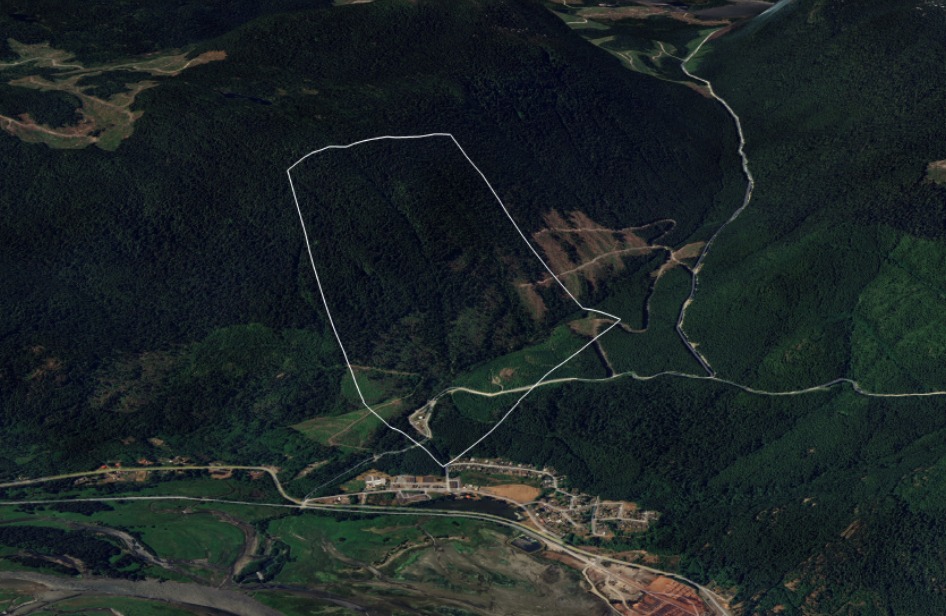
SAYWARD, B.C. — The Village of Sayward and the Strathcona Regional District (SRD) are moving forward with a detailed hazard evaluation of the Newcastle Creek landslide after securing emergency funding from the provincial Ministry of Emergency Management & Climate Readiness (EMCR), as local officials continue to monitor drinking water conditions following prolonged rainfall.
In an update issued Friday, the Village and SRD said the evaluation will focus on the current condition of the slope within and surrounding the landslide area, which is located entirely on Crown land. The work is intended to provide a clearer picture of potential risks to the community and identify possible mitigation measures, while residents are asked to continue conserving water as crews maintain operations at the local water treatment system.
The SRD said data collected through LiDAR drone flights will be used to characterize the landslide and develop cross-sections of the slide area and adjacent slopes. That information will feed into a risk analysis and help guide the development of mitigation strategies.
The evaluation will also include a review of historical watershed information, expected to cover geotechnical assessments, hydrological data, harvesting records and significant event records. Officials said the work will also focus on reducing short-term risks linked to water impoundment and debris, key concerns that can arise after slope failures and heavy rainfall.
The SRD said the hazard evaluation is expected to be completed by early May. Once finalized, the findings will be made publicly available and emergency management personnel will provide the community with an update on next steps.
While the emergency funding allows the evaluation to proceed, Sayward Mayor and SRD Board Chair Mark Baker raised concerns about the province’s position on future risk reduction efforts.
“While the Sayward community is appreciative of this funding to undertake a hazard evaluation, we are deeply concerned about the statement from EMCR that the Province of British Columbia has no intentions to undertake or fund any risk reduction (mitigation) measures on their Crown land,” said Village of Sayward Mayor and SRD Board Chair Mark Baker. “We have been instructed by EMCR that even if this hazard evaluation indicates further risk to the community the Province will not take any immediate action. Their recommendation was for the Village and Regional District to apply for (rare and highly competitive) grants to fund mitigation measures. We are asking EMCR to please reconsider this unfortunate statement and we hope to work with the Province in a collaborative manner to ensure that if any ongoing threats are determined that they are immediately addressed”.
The Newcastle Creek landslide has become a key issue for the community because of its proximity to local infrastructure and its potential impact on water supply conditions, particularly during periods of heavy precipitation.
As part of the update, local officials also thanked residents for continuing to conserve drinking water while Sayward’s Public Works staff carry out ongoing work at the Water Treatment Plant and the Newcastle Creek water intake.
At the time of the release, the Village and SRD said the Water Treatment Plant, water intake and reservoir were operating well, and there were no new operational issues to report. However, officials noted that turbidity levels in Newcastle Creek remain elevated following prolonged rainfall.
Higher turbidity—an indicator of cloudiness in water caused by suspended particles—can pose challenges for water treatment operations, particularly in smaller systems that rely on surface water sources. Officials did not indicate whether any new restrictions or advisories were being introduced, but reiterated the importance of conservation while monitoring continues.
The hazard evaluation is expected to provide the first comprehensive technical assessment of current conditions in and around the landslide area since recent impacts were observed. By combining LiDAR mapping, slope analysis and historical watershed data, the SRD said it aims to better understand both the immediate stability of the area and the potential for further movement or debris-related impacts.
Local governments across British Columbia have increasingly turned to hazard mapping and slope stability assessments as extreme weather events and prolonged rainfall raise the risk of landslides, flooding and debris flows—especially in areas where communities and infrastructure intersect with steep terrain.
For Sayward, the completion of the evaluation in early May is expected to be a key milestone in determining whether further protective measures are needed and what role different levels of government may play in funding and executing them.
Until then, officials said residents will continue to receive updates as information becomes available, with the final report expected to outline risk findings and potential mitigation options for consideration.
