

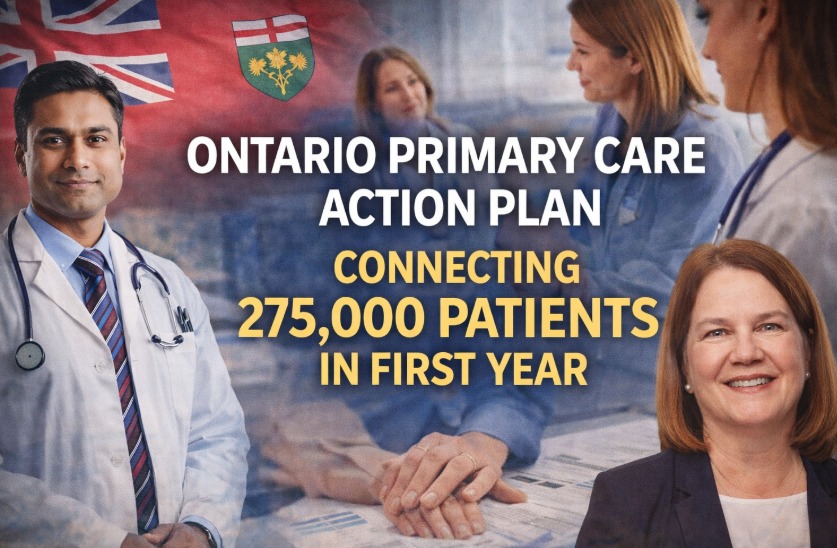
Ontario is marking the first year of its $2.1-billion Primary Care Action Plan, reporting early progress in connecting residents to family doctors, nurse practitioners and team-based primary care as the province works toward its goal of ensuring every Ontarian has a regular provider by 2029.
In a news release issued Monday, the Ministry of Health said the initiative has already attached more than 275,000 new patients to a primary care provider since launch, putting Ontario “on track to meet or exceed” its 2025-26 target of connecting 300,000 new people to care.
The plan is a central part of the government’s broader health system strategy, which has emphasized increasing capacity in community-based care while expanding the health workforce through recruitment and training.
“Our government is protecting Ontario’s health-care system and leading the country with investments that give Ontarians the highest rate of access to a regular health-care provider in Canada,” said Sylvia Jones, Deputy Premier and Minister of Health. “I’m incredibly proud of the progress we’ve made in the first year of our plan as we continue to take bold action to connect every Ontarian to care and help more people live fuller, more active lives.”
Ontario’s approach includes both new funding and structural changes to how primary care is delivered, with an emphasis on interprofessional teams that combine physicians, nurse practitioners and other regulated health professionals.
The government established the Primary Care Action Team (PCAT), led by Dr. Jane Philpott, on Dec. 1, 2024. The ministry said PCAT was given a mandate to connect every Ontarian to primary care by 2029, a timeline that aligns with growing concerns across the country about access to family doctors and increasing pressure on hospital emergency departments.
Ontario launched the Primary Care Action Plan on Jan. 27, 2025, backed by what it described as a historic $2.1-billion provincial investment.
A key early focus has been reducing the Health Care Connect waitlist, the provincial registry that helps match residents without a family doctor to available providers. The ministry said clearing the waitlist as of Jan. 1, 2025 was an initial goal under the plan, and as of this week the waitlist has been reduced by more than 75 per cent.
While the government says Ontario continues to lead the country in access to care, it has framed the action plan as necessary to close the remaining gap and ensure more consistent access across regions and communities.
“Together we are building a primary care system that is comprehensive, convenient and connected for every person in Ontario,” said Dr. Jane Philpott, Chair of Ontario’s Primary Care Action Team. “With historic investments and strong collaboration, Ontario is making real progress toward ensuring that everyone has timely access to a family doctor, nurse practitioner or primary care team close to home.”
From a business and workforce perspective, the plan also represents a major multi-year investment in health human resources, with Ontario linking primary care expansion to recruitment, retention and training initiatives aimed at growing the supply of clinicians.
Among the most significant recent measures, the province said it invested $110 million in 2024-25 to expand interprofessional primary care teams, which has already connected more than 490,000 people to care. It also committed $235 million to fund more than 130 new and expanded primary care teams, designed to connect 300,000 people, with approximately 55,300 already attached.
Looking ahead, the government said it will invest $250 million to add roughly 75 new and expanded teams, with the goal of helping 500,000 Ontarians connect to primary care in 2026-27. That expansion will prioritize people currently on the Health Care Connect waitlist, the province said.
Ontario is also leaning on scope-of-practice reforms to expand access to services. The ministry said broader scopes for regulated health professionals, including pharmacists, have helped improve access to health services.
At the same time, the province is accelerating licensure for qualified out-of-province and U.S.-licensed health professionals, a policy lever that has become increasingly common among provinces facing staffing shortages. Ontario said these efforts have already attracted more than 1,700 new nurses and more than 450 doctors to the province this year alone.
The government is also moving ahead with a medical education expansion, including two new medical schools and an increased number of training seats. The province said that expansion will result in 340 undergraduate and more than 550 postgraduate positions to train future physicians.
The primary care plan is being delivered under the province’s broader Your Health: A Plan for Connected and Convenient Care strategy, which aims to expand the health workforce and improve access to services closer to home.
The ministry also highlighted several broader system benchmarks, noting that the Primary Care Action Team is drawing on “best-in-class models of care” and that the government’s investment of more than $2.1 billion is intended to connect approximately two million more people to primary care by 2029.
Ontario’s Primary Care Act, the ministry added, establishes primary care as the foundation of the province’s publicly funded health-care system and sets out six objectives intended to define what residents can expect when connecting to primary care.
The province cited the Canadian Institute for Health Information in stating that Ontario leads the country in access to a regular health-care provider. It also said that since 2018 Ontario has added nearly 20,000 physicians to its workforce, including an increase of more than 14 per cent in family doctors.
Under the current Physician Services Agreement, Ontario spends more than $20 billion to connect people to doctors across primary care, specialist care and other services, the ministry said.
Discover more from Wire Service Canada
Subscribe to get the latest posts sent to your email.