

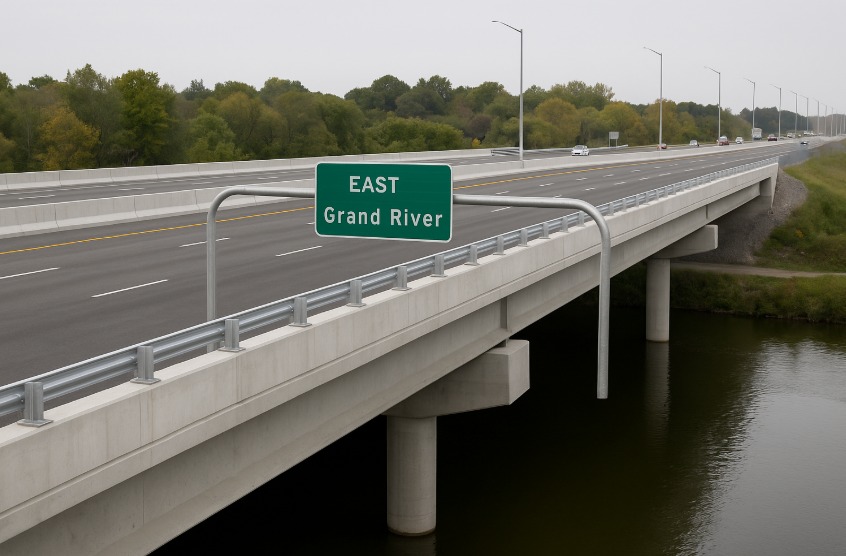
The Ontario government has finished construction of the new Grand River bridges on Highway 401 in Kitchener, a milestone officials say will ease congestion along one of the province’s busiest trade corridors and prepare the route for a major expansion. The project, which also includes rehabilitation of the King Street overpass between Kitchener and Cambridge, forms part of a nearly $30-billion provincial plan to upgrade highways, roads and bridges amid ongoing economic uncertainty.
In a statement announcing the completion, Transportation Minister Prabmeet Sarkaria said the work will improve travel times and bolster the movement of goods across southwestern Ontario. “Our government is protecting Ontario with historic investments in highway infrastructure to help families spend less time in traffic and ensure businesses can move goods more reliably,” Sarkaria said. “Replacing the Grand River bridges will help strengthen the economy across southwestern Ontario and shorten commute times in Kitchener and Cambridge as the region continues to grow.”
The new structures sit between the Homer Watson Boulevard and King Street interchanges, carrying east-west traffic for tens of thousands of daily drivers, including significant commercial truck volumes. Their completion marks one of the final steps needed before the province can widen the stretch of Highway 401 through Kitchener from six to 10 lanes—an expansion viewed by local leaders as essential for managing rapid population and employment growth in Waterloo Region.
Kitchener Mayor Berry Vrbanovic said the upgrades will support the city’s role within Ontario’s Innovation Corridor. “Investments like the replacement of the Grand River bridges on Highway 401 and the ongoing work to build a new Highway 7 between Kitchener and Guelph are investments for residents and businesses in Kitchener and our broader region,” he said. “We are grateful to the province for their efforts to reduce gridlock, improve safety and ensure that commuters and goods can move more efficiently across Ontario’s Innovation Corridor.”
The bridges and overpass improvements build on recent 401 work in the region, including the opening of a new interchange at Highway 6 (Hanlon Expressway) near Guelph, as well as the 2023 widening of eight kilometres of Highway 401 in Cambridge from Highway 8 to Townline Road. The province is also advancing construction of the Frederick Street bridge as part of the planned Highway 7 expansion between Kitchener and Guelph.
Local MPPs welcomed the completion, emphasizing its role in preparing the transportation network for future demand. “Replacing the Grand River bridge structures ensures this stretch of the 401 is ready for the growth and future projects coming to our region,” said Kitchener South–Hespeler MPP Jess Dixon. “It gives us the modern, reliable infrastructure that a high-volume corridor like this needs to keep people and goods moving.”
Cambridge MPP Brian Riddell called the project “an important step in keeping people and goods moving safely and efficiently through Waterloo Region,” adding that it will better support commuters and job creators. Kitchener-Conestoga MPP Mike Harris echoed this, saying the upgrades will “ease congestion, cut commute times, and support the commercial traffic that drives our local economy.”
Municipal leaders across the region noted the economic benefits of strengthening a corridor that links key manufacturing, technology and logistics hubs. Waterloo Mayor Dorothy McCabe said the work will save commuters time and improve safety, while Cambridge Mayor Jan Liggett credited the upgrades with ensuring the community remains competitive. “The new Grand River bridges will make a real difference for our local businesses, families and commuters in Cambridge,” she said.
Regional Chair Karen Redman called the completion critical for connecting residents to jobs and supporting businesses across Waterloo Region. North Dumfries Mayor Sue Foxton said the improvements will “drastically improve the ability of commuters and business trade to connect east / west through our region.”
Industry associations also weighed in, highlighting the project’s role in supporting construction jobs and long-term economic growth. Organizations including the Ontario Road Builders’ Association, the Residential and Civil Construction Alliance of Ontario, and the Ontario Stone, Sand & Gravel Association said the upgrades will reduce gridlock and enhance competitiveness. Labour groups such as LiUNA praised the work for generating skilled employment and preparing the corridor for future widening.
Gridlock currently costs Ontario as much as $56 billion per year, according to the Canadian Centre for Economic Analysis. With Highway 401 acting as a crucial artery for both commuters and freight carriers, officials say continued investment will be central to the province’s economic strategy.
As Redman put it, “Reliable, modern infrastructure is essential for connecting people to jobs, supporting local businesses, and strengthening our economy.”
