

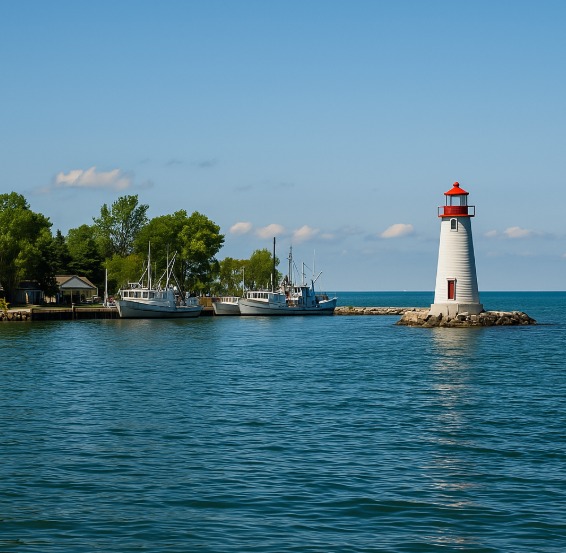
WHEATLEY, Ont. — The Ontario government has announced a $10 million investment to upgrade two key fisheries management facilities along Lake Erie, a move aimed at strengthening the province’s commercial and recreational fishing industries while supporting regional economic growth and job creation.
The investment will fund modernization projects at facilities in Wheatley and Port Dover, with upgrades designed to improve operational efficiency, expand infrastructure, and support long-term ecosystem sustainability. Officials say the improvements will ensure Ontario’s fisheries remain competitive, resilient, and well-positioned to face future economic uncertainty.
“Commercial and recreational fishing in Lake Erie are critical resources to southwestern Ontario’s economy, featuring world-class fisheries that generate millions of dollars and sustain thousands of jobs,” said Mike Harris, Minister of Natural Resources. “As part of our government’s plan to protect Ontario, this investment will help boost our province’s economic growth and agri-food sector by ensuring these fisheries are able to stay competitive and resilient in the face of economic uncertainty.”
Major Facility Upgrades in Wheatley and Port Dover
The planned upgrades include replacing aging infrastructure, expanding workspace, and introducing new technologies to enhance safety and productivity. Construction on both facilities will begin within the next two years, with the Port Dover location expected to open by 2027 and the Wheatley facility by 2029.
The Wheatley and Port Dover operations play a central role in managing Ontario’s freshwater fisheries, particularly across Lake Erie and Lake St. Clair, which together contribute the majority of the province’s commercial fish harvest.
The modernized facilities will include expanded laboratories and storage space for field equipment, improving sample processing and data collection. These investments will help scientists and fisheries managers monitor fish populations, assess water quality, and implement evidence-based conservation measures.
Supporting Food Security and Resilience
The initiative is also aligned with Ontario’s broader goals of building a sustainable agri-food system and enhancing food security across the province.
“With upgraded infrastructure and innovation through new technologies, this investment protects Ontario’s food security and supports the people who work in our fisheries sector against tariffs from the U.S.,” said Trevor Jones, Minister of Agriculture, Food and Agribusiness. “Our government is proud to support the people who work in our agri-food sector and will continue to make the critical investments that ensure a sustainable and resilient food supply for the people in our communities.”
The Ministry of Natural Resources said the upgrades will help ensure Ontario’s fisheries can meet increasing demand for locally sourced fish while maintaining environmental stewardship standards. The government also emphasized that the investment complements its long-term plan to modernize the commercial fishing industry and streamline regulatory processes to reduce red tape.
Industry and Community Response
Industry stakeholders and local officials welcomed the investment, calling it a critical step toward securing the economic future of Lake Erie’s fisheries and the communities that depend on them.
“Upgrades to the Wheatley and Port Dover fisheries are strategic investments in the future of southwestern Ontario’s economy,” said Todd McCarthy, Acting Minister of Infrastructure. “These enhancements will equip the two facilities with the equipment, technology, and resources necessary to safeguard fish populations and promote sustainable ecosystems across Lake Erie.”
Darrin Canniff, Mayor of Chatham-Kent, said the investment marks another milestone in Wheatley’s revitalization efforts.
“Wheatley is undergoing a remarkable transformation, and this investment by the Ontario Ministry of Natural Resources is another exciting step forward for the community,” Canniff said. “This project not only strengthens our vital fishing industry, but also supports the long-term sustainability of our natural resources.”
Vito Figliomeni, Executive Director of the Ontario Commercial Fisheries’ Association, praised the funding as essential for maintaining the industry’s long-term viability.
“These upgrades will not only strengthen our fisheries infrastructure but also ensure the long-term sustainability of Lake Erie’s ecosystem,” he said. “Commercial fisheries are the economic backbone of many small communities across Ontario, supporting jobs, local businesses, and a way of life that has endured for generations.”
Other industry leaders, including Ulysses Pratas, Founder of Presteve Foods Limited, and John Omstead, CEO of John O’s Foods Inc., also endorsed the project, highlighting the role of innovation and science-based management in protecting Ontario’s freshwater ecosystems.
Economic Impact and Broader Context
Lake Erie is home to one of the world’s largest freshwater commercial fisheries, generating an estimated $200 million annually and supporting around 1,000 jobs in fishing and processing sectors. Between 2004 and 2023, it accounted for 82 per cent of all commercial fish harvested from the Great Lakes.
Ontario’s recreational fishing industry is also a major contributor to the provincial economy, generating $1.74 billion in annual economic activity and supporting over 1.15 million anglers.
The new infrastructure investments are part of Ontario’s $191 billion, 10-year infrastructure plan, which includes over $200 billion in capital projects to expand and modernize essential public assets.
The government says the upgrades will help maintain the long-term health of aquatic ecosystems, strengthen cross-border trade competitiveness, and sustain the region’s fishing heritage for future generations.
