

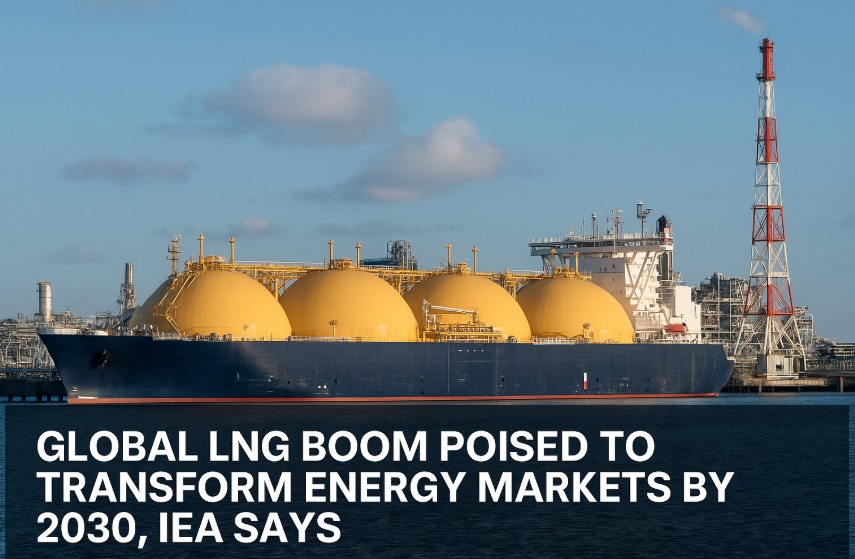
Global natural gas markets are heading for a structural transformation by the end of this decade, driven by an unprecedented surge in liquefied natural gas (LNG) production capacity that could reshape global trade, prices and energy security, according to the International Energy Agency (IEA).
The agency’s latest Gas 2025 report, released Monday, provides a detailed look at medium-term trends in natural gas supply, demand and trade. The analysis suggests that the coming expansion in LNG production—led by the United States and Qatar—will mark one of the most significant shifts in the sector’s modern history.
Record LNG Expansion Underway
According to the IEA, roughly 300 billion cubic metres (bcm) of new LNG export capacity is expected to come online by 2030, the largest increase ever recorded. The majority of this growth will be driven by liquefaction projects in the United States and Qatar, where investment activity has accelerated sharply in recent years.
In the United States alone, more than 80 bcm of annual LNG liquefaction capacity has been sanctioned so far in 2025—an all-time high for the U.S. LNG industry. This global wave of new capacity is expected to bolster supply security, easing some of the market pressures that emerged after Russia’s invasion of Ukraine in 2022.
The report notes that while gas markets have gradually stabilized since that disruption, prices have remained well above pre-crisis levels. Elevated costs have weighed heavily on consumption, particularly in price-sensitive Asian economies, where demand growth has slowed sharply. Global gas demand is projected to decelerate from 2.8% in 2024 to below 1% in 2025.
Prices Set to Ease, Demand to Recover
The IEA expects the expansion of LNG production to translate into a net supply increase of 250 bcm a year by 2030, assuming no major supply disruptions. The added capacity is forecast to push prices lower in the second half of the decade, potentially reviving consumption across key import markets.
“The coming LNG wave is set to offer some respite for global gas markets, which have been tight and volatile for several years. As new supply comes to market, notably from the United States and Qatar, it should apply downward pressure on prices – offering welcome relief for gas importers worldwide,” said IEA Director of Energy Markets and Security Keisuke Sadamori. “But elevated geopolitical tensions and economic uncertainty mean there is no room for complacency. Global cooperation remains essential to ensure supply security – especially with rising electricity consumption set to drive gas demand higher in many regions.”
Regional Shifts and Growth Outlook
In its base-case forecast, the IEA sees global natural gas demand rising by nearly 1.5% annually between 2024 and 2030, amounting to an increase of about 380 bcm. The Asia-Pacific region is expected to account for half of that growth, led by China and emerging South and Southeast Asian economies. The Middle East, where countries such as Saudi Arabia are transitioning from oil to gas for power generation, would contribute nearly 30% of the total increase.
Under a more optimistic scenario—where lower LNG prices stimulate stronger consumption—the agency projects annual demand growth of up to 1.7% through 2030, adding 65 bcm per year beyond the base case. However, a prolonged period of subdued prices could also weaken incentives for new project investment, potentially setting up tighter markets after 2030 if demand continues to climb.
Market Flexibility and Energy Transition
The report highlights ongoing shifts in LNG contracting practices that are making the market more flexible and globally integrated. The IEA expects destination-free contracts—which allow buyers to resell cargoes—to account for just over half of total contracted LNG volumes by 2030, signaling a move toward greater liquidity and responsiveness in global trade flows.
At the same time, the agency’s analysis underscores the importance of cleaner supply chains. The 2025 outlook includes a detailed review of how carbon capture and storage (CCS) technologies could be deployed along LNG value chains to reduce emissions intensity. It also explores the medium-term prospects for biomethane, low-emissions hydrogen, and e-methane, positioning them as emerging complements to conventional gas.
Implications for Canada
For Canada, which continues to advance LNG export projects on the West Coast, the IEA’s findings reinforce both opportunity and risk. Lower global prices could improve access for new entrants but may also squeeze profit margins. At the same time, increased flexibility in global LNG trade could benefit producers able to offer low-emissions or destination-free contracts.
While the IEA sees a decade of relative relief ahead for gas consumers, it cautions that long-term stability will depend on continued investment, technological progress and international cooperation. As global LNG capacity surges, the next five years will be pivotal in determining how securely—and sustainably—the world meets its growing energy needs.
Discover more from Wire Service Canada
Subscribe to get the latest posts sent to your email.
