

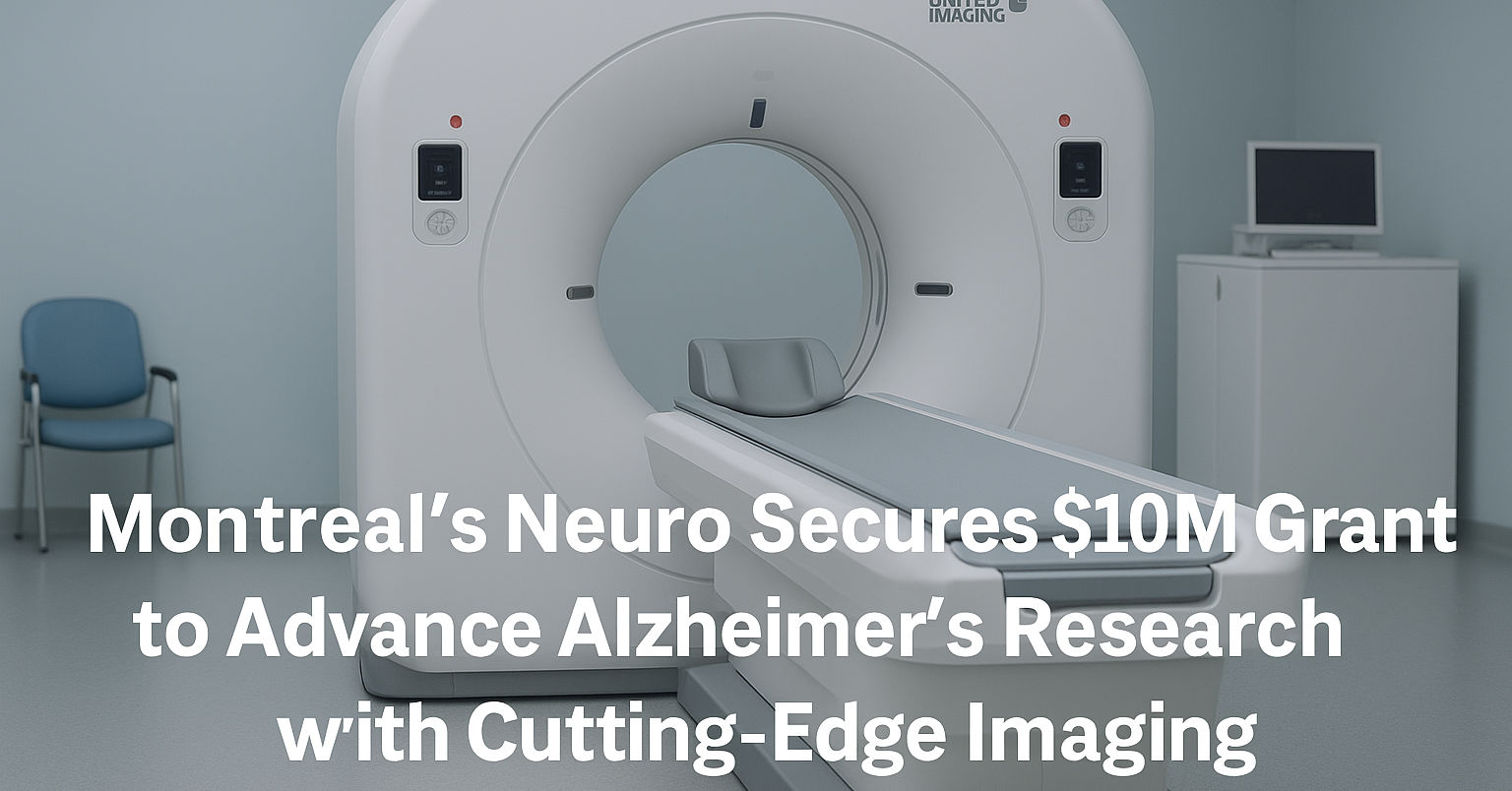
Montreal, A major investment in Canadian brain research is set to bring the country its first ultra-high-sensitivity whole-body PET/CT scanner, a tool that researchers say could transform the fight against Alzheimer’s disease.
The Montreal Neurological Institute-Hospital, known as The Neuro, has received a $10-million grant from the Weston Family Foundation to fund a new project led by Dr. Pedro Rosa-Neto of McGill University. The award marks a significant portion of a $20-million funding initiative under the foundation’s Healthy Aging Strategy, which also includes the Weston Brain Institute and the Weston Family Microbiome Initiative.
Addressing a Growing Health Crisis
Alzheimer’s disease remains the most common form of dementia, affecting more than 750,000 Canadians, according to the Alzheimer Society of Canada. The neurodegenerative condition is marked by progressive memory loss and cognitive decline, placing mounting strain on patients, families, and the healthcare system.
Effective treatment strategies depend heavily on identifying accurate and accessible biomarkers that can diagnose and stage Alzheimer’s, as well as determine which therapies are most effective for individual patients. Currently, such markers are limited, slowing progress in both treatment development and early intervention.
New Technology with National Impact
Dr. Rosa-Neto’s project aims to close that gap by installing Canada’s first Panorama GS tomograph, manufactured by United Imaging. The device will be housed at the McConnell Brain Imaging Centre (BIC) at The Neuro, building on existing infrastructure and expanding research capacity in ways not previously possible in the country.
The scanner’s ultra-high sensitivity is expected to enable the discovery of next-generation biomarkers, with a particular emphasis on neuroinflammation — a process increasingly recognized as a major driver of cognitive decline in Alzheimer’s and other neurodegenerative diseases. By allowing researchers to visualize and track brain changes with unparalleled precision, the technology could accelerate the development of personalized treatments and lead to earlier diagnoses.
“This new technology will allow us to understand better than ever before the mechanisms of disease progression in people with Alzheimer’s,” says Dr. Rosa-Neto. “We can then use this information to develop better treatments to prevent, slow, or reverse the effects of this terrible disease. Thanks to the Weston Family Foundation for this critically important investment.”
A Boost to Montreal’s Global Standing
For The Neuro and the Brain Imaging Centre, the addition of the Panorama reinforces an international reputation for innovation in brain science.
“The Panorama adds to the BIC’s position as a world leader in brain imaging,” says Julien Doyon, PhD, Director of the BIC. “Very few institutes worldwide can provide the level of imaging capacity as The Neuro, and our capabilities continue to grow. I look forward to working with Dr. Rosa-Neto’s on such an exciting research program made possible with this generous donation.”
Strategic Philanthropy
The Weston Family Foundation, one of Canada’s most prominent philanthropic organizations, has a long history of funding ambitious research programs. Its Healthy Aging Strategy is designed to accelerate discoveries that improve the quality of life for aging populations, focusing particularly on neurodegenerative diseases and the human microbiome.
By investing heavily in advanced research tools, the foundation is positioning Canadian institutions to compete globally while responding to urgent domestic healthcare needs. The Neuro’s new scanner is not just a Montreal milestone but a national first, underscoring how targeted philanthropy can drive scientific progress.
About The Neuro
Founded in 1934 by neurosurgeon Dr. Wilder Penfield, The Neuro has grown into Canada’s largest specialized neuroscience research and clinical centre and one of the largest in the world. The institute is recognized for its integration of research, patient care, and education, as well as its pioneering commitment to Open Science, a model that makes scientific data and findings widely accessible to accelerate discovery.
Today, The Neuro operates as both a McGill University teaching institute and a key part of the Neuroscience Mission of the McGill University Health Centre. Its bilingual, international reputation continues to attract top researchers and clinicians while serving patients from across Canada and beyond.
