

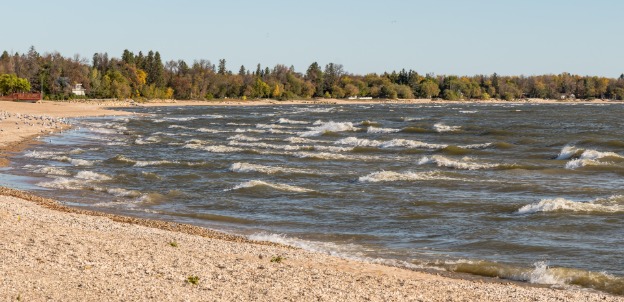
WINNIPEG, Man. — Scientists studying the future of Lake Winnipeg will soon have access to critical new data as a University of Winnipeg researcher embarks on groundbreaking work examining viruses that infect microalgae in the lake.
Dr. Emily Chase, a professor in the Department of Biology at the University of Winnipeg, is the first scientist to investigate algal viruses in Lake Winnipeg. Her research aims to fill a significant knowledge gap in understanding the lake’s ecosystem and improve climate change modelling for one of Canada’s largest freshwater bodies.
“It’s a new frontier,” said Dr. Emily Chase, “so everything that we find will be meaningful.”
Dr. Chase joined UWinnipeg in 2025, bringing years of specialized experience in microbiology and virology, with a focus on micro-algal aquatic viruses. She is part of a small international research community studying how viruses interact with microscopic algae in aquatic environments — a field that remains largely unexplored.
“It feels exciting. Not necessarily because I’m the first, but because it’s such a big question mark,” she said. “There are so many little stories for me to unravel with my trainees, and I’m really excited to see them do that.”
Her previous research has spanned Nova Scotia, France and the United States, and she has worked with lake data from around the world. That global experience, she said, made the opportunity in Manitoba particularly compelling.
“There’s very few people in the world working on this stuff,” she said. “That was one of the reasons I was so excited to come to UWinnipeg. To bring those skills, do something that I think is meaningful, and also pass those skills on to students at UWinnipeg.”
Backed by funding from the Natural Sciences and Engineering Research Council of Canada, Dr. Chase’s research examines the dynamic relationships between microalgae and the viruses that infect them. While microalgae are often mistaken for plants due to their green appearance in surface blooms, they are single-celled organisms vulnerable to viral infections — much like humans.
“A lot of times people see microalgae as plants, just because they look like a bunch of scum on the water and they are quite green,” she explained.
Although the viruses that infect microalgae pose no threat to human health, they can significantly affect aquatic ecosystems. Viral activity can influence algae populations, which in turn affects oxygen levels, nutrient cycling and the broader food web — including fish stocks that support commercial and recreational fisheries.
“It’s under the bigger umbrella of climate change,” Dr. Chase explained. “Understanding the ecology between these microbes will give us more information on what will happen with fish stocks, what will happen with tourism, and what will happen with the health of the lake overall.”
Lake Winnipeg plays a critical economic role in Manitoba, supporting fisheries, tourism and shoreline communities. Improved predictive models of how the lake responds to warming temperatures and nutrient inputs could help policymakers and industry stakeholders better manage long-term environmental and economic risks.
“It’s the same kind of health perspective for humans,” she added. “If we don’t understand the viruses that are infecting us, how can we predict what might happen next flu season or what a pandemic’s impacts might be.”
Over the past year, Dr. Chase and her research team have collected and analyzed water samples from across Lake Winnipeg. While the project remains in its early stages, she expects preliminary findings to be shared in the near future.
Beyond its local implications, the work could have global relevance. Insights gained from Lake Winnipeg may help scientists better understand viral-microalgal interactions in other freshwater systems around the world.
“Even though I’m the first at Lake Winnipeg,” Dr. Chase said, “by understanding our lake system it can help us understand other lake systems too.”
In addition to advancing a niche field of environmental virology, Dr. Chase is also helping to broaden representation within it. As one of the few women working in this specialty, she said persistence has been key to building her career.
“It’s been beneficial for me to be a bit stubborn and opinionated and outspoken,” she said. “And I hope me laying the groundwork and being somebody like this, people after me won’t have to do that as much.”
She emphasized that diversity strengthens scientific inquiry and innovation.
“Science is about curiosity and troubleshooting and exploration,” she added. “Anytime that we have people coming in who have different perspectives, whether that’s women, BIPOC, or otherwise, you end up branching out that curiosity much further.”
As data continues to emerge, Dr. Chase’s work may not only reshape understanding of Lake Winnipeg’s ecosystem but also strengthen Canada’s capacity to anticipate environmental change — one microscopic virus at a time.