

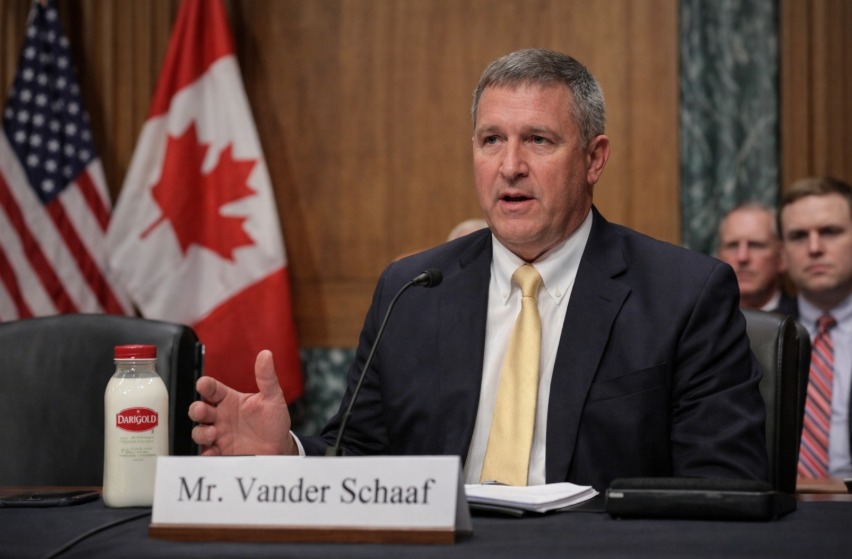
ARLINGTON, Va. — A senior U.S. dairy industry representative is calling on lawmakers to strengthen enforcement of the United States-Mexico-Canada Agreement (USMCA) as the pact heads into a mandatory joint review in 2026, warning that unresolved trade barriers threaten export growth critical to American producers.
Ted Vander Schaaf, an Idaho dairy farmer and board member of the Northwest Dairy Association, testified before the Senate Finance Committee on the importance of the trilateral agreement and the need for reforms to ensure it delivers on its original commitments.
The Northwest Dairy Association owns Darigold and, along with the Idaho Dairymen’s Association, is a member of both the National Milk Producers Federation and the U.S. Dairy Export Council.
“Strong, enforceable trade agreements are critically important to the U.S. dairy industry. The United States exported approximately $9 billion in dairy products in 2025, including a record 559,000 metric tons of cheese last year through November,” said Vander Schaaf at the hearing.
Exports have become a central pillar of the U.S. dairy sector’s economic model, with Mexico and Canada representing its two largest foreign markets. In 2024, the two countries purchased $3.6 billion in American dairy products, accounting for 44 per cent of total U.S. dairy export value. Industry leaders say maintaining open and predictable access to those markets is essential for price stability and farm viability.
USMCA, which replaced the North American Free Trade Agreement in 2020, was designed to modernize trade rules and expand market access, including new dairy quotas in Canada. However, Vander Schaaf told lawmakers that implementation gaps have limited the agreement’s full potential.
He pointed to what he described as Canada’s continued manipulation of its dairy tariff-rate quotas and circumvention of USMCA dairy protein export disciplines. According to the industry, those practices have constrained U.S. producers’ ability to compete both within Canada and in third-country markets.
Mexico, by contrast, has been characterized as a constructive partner in maintaining open dairy trade. However, Vander Schaaf noted that challenges remain, particularly around intellectual property protections for common food names.
While Mexico has cooperated on broader trade issues, its intellectual property office has yet to fully protect widely used cheese names such as “parmesan” and “feta,” a longstanding concern among U.S. dairy exporters who fear restrictions could erode established market share.
The USMCA agreement mandates a formal “joint review” in 2026, creating an opportunity for participating governments to address outstanding concerns and assess the pact’s overall performance. Industry representatives are positioning the review as a critical inflection point.
“For U.S. dairy producers exports are critical not just for growth but for survival, and we all agree it must continue. But a firm base depends on Canada upholding their end of the bargain, and on preserving our fully open trade flows with Mexico,” continued Vander Schaaf. “The U.S. dairy industry is counting on Congress and the Administration to help us fix the issues that I have laid out today, and to secure a better, stronger USMCA for American dairy farmers.”
The testimony comes amid heightened focus on North American trade competitiveness and agricultural market access. Dairy exports have grown steadily over the past decade, with cheese shipments reaching record volumes in 2025. Industry leaders argue that without reliable export outlets, domestic oversupply could depress farmgate prices and strain rural economies.
Vander Schaaf’s appearance before the committee also builds on the Feb. 5 launch of The Agricultural Coalition for USMCA, a multi-sector advocacy initiative co-led by the U.S. Dairy Export Council and the National Milk Producers Federation. The coalition is pressing policymakers to prioritize enforcement and modernization of the agreement to ensure long-term certainty for American farmers and food processors.
For Canadian stakeholders, the upcoming review may attract particular scrutiny given longstanding disputes over dairy quota allocation and market access. Any renegotiation efforts could have ripple effects across supply-managed sectors and broader agri-food trade flows between the two countries.
As lawmakers prepare for the 2026 review process, industry participants on all sides of the border are expected to intensify lobbying efforts aimed at shaping the next phase of North American dairy trade.
A written version of Vander Schaaf’s testimony has been submitted to the Senate Finance Committee for the official record.