

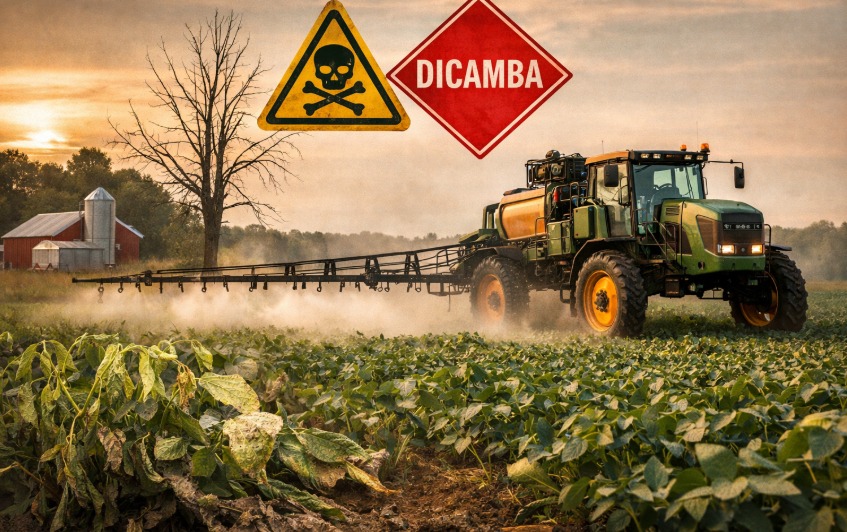
WASHINGTON — Farmers and environmental organizations have launched a fresh legal challenge against the Environmental Protection Agency, accusing the regulator of unlawfully reapproving the controversial herbicide dicamba despite years of court rulings, scientific concerns and documented crop losses.
The lawsuit, filed by groups including the National Family Farm Coalition and the Center for Biological Diversity, targets a recent decision by the EPA under administrator Lee Zeldin to allow continued use of the pesticide on genetically engineered soybeans and cotton. Previous federal court rulings in 2020 and 2024 struck down earlier approvals, finding the agency had failed to properly assess risks.
“EPA’s re-registration of dicamba flies in the face of a decade of damning evidence, real world farming know-how and sound science, and, oh-by-the-way, the law,” said George Kimbrell, legal director of the Center for Food Safety and counsel in the case. “In reality, the Trump administration has once again betrayed farmers and poisoned the environment to pad corporate pesticide profits. We will see them in Court.”
Dicamba is a widely used herbicide designed to kill broadleaf weeds, but it has become one of the most contentious agricultural chemicals in the United States because of its tendency to volatilize and drift beyond target fields. Since its first approval in 2016, dicamba drift has damaged millions of acres of crops, orchards, vegetable farms and natural areas, according to researchers and regulators.
Environmental advocates say the EPA’s latest approval weakens safeguards put in place previously. The agency eliminated a June cutoff date for spraying and removed a 100-foot buffer designed to protect endangered species habitat. The new rules also rely on temperature-based restrictions and volatility-reducing agents, measures critics say have failed in the past.
“Lee Zeldin’s hollow promises that new restrictions on dicamba will prevent damaging drift to nearby farms and backyard gardens is totally unsupported by the facts or common sense,” said Nathan Donley, environmental health science director at the Center for Biological Diversity. “Zeldin insists he’s working closely with the Make American Healthy Again movement to make pesticides safer. But his reckless reapproval of this dangerous, highly toxic pesticide shows his words to be nothing more than an attempt to ‘MAHA-wash’ the facts. No one in the healthy foods movement has been fooled by Zeldin’s pro-industry spin game.”
The renewed approval comes amid scrutiny over industry influence within the EPA. Kyle Kunkler, a former lobbyist for the American Soybean Association, recently joined the agency as deputy assistant administrator for pesticides. Critics say his past support for dicamba raises conflict-of-interest concerns.
Dicamba use expanded dramatically after Monsanto — now owned by Bayer — introduced genetically engineered crops resistant to the chemical, allowing farmers to spray it directly over fields. The U.S. Department of Agriculture estimated that up to 15 million acres of soybeans were damaged by dicamba drift in 2018 alone.
Farm groups involved in the lawsuit say the impact has been severe and ongoing.
“This is déjà vu all over again,” said Jim Goodman, president of the National Family Farm Coalition. “Despite an extensive history of failed weed management in genetically engineered crops, thousands of complaints by farmers about crop damage caused by drift, and two prior court bans, EPA is once again re-registering dicamba. There is no rationale for re-approving this incredibly harmful herbicide other than to line the pockets of the agri-chemical industry. National Family Farm Coalition is standing up for family farmers and rural communities everywhere in urging our courts to block this egregious, irresponsible and unjust reapproval.”
Farmers themselves say the chemical has directly affected their livelihoods.
“Dicamba’s tendency to volatilize and drift is well-documented and when dicamba was registered for over-the-top spraying our vegetable farm, like so many farms, saw a significant decline in marketable produce from damage,” said Rob Faux, an Iowa farmer and communications manager at Pesticide Action & Agroecology Network. “Successful legal challenges removed dicamba’s prior registrations, and because of that we have had successful seasons without dicamba drift. A new dicamba registration will, once again, pit farmer against farmer, and some of us will be forced to exit food production.”
Court rulings over the past five years have repeatedly faulted the EPA’s handling of dicamba approvals, including findings that the agency failed to consider social and economic impacts on farming communities.
The plaintiffs argue the latest decision further loosens already insufficient restrictions, allowing broader use while eliminating protections designed to reduce harm to wildlife and neighbouring farms.
The case adds to ongoing uncertainty around one of modern agriculture’s most divisive chemicals, with significant implications for farmers, agrochemical companies and regulators. A ruling against the EPA could once again remove dicamba from the market, while a decision in favour of the agency would cement its continued use despite years of legal and scientific challenges.