

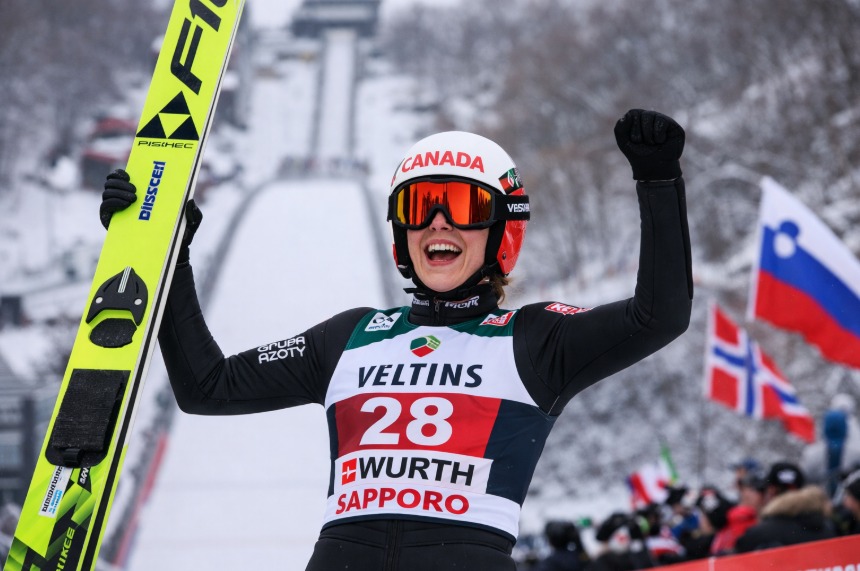
SAPPORO, Japan — Canadian ski jumper Abigail Strate added another key result to her Olympic-season resume on Saturday, capturing silver in the women’s large hill event at the Ski Jumping World Cup in Sapporo, Japan, as she continues to build momentum toward the 2026 Olympic Winter Games.
The 24-year-old Calgarian reached the podium for the second consecutive competition and secured her first large hill medal of the current World Cup season, despite competing while battling a cold. Earlier this week, Strate earned bronze on the normal hill in Zao, Japan, extending a run of strong form that has placed her among the sport’s most consistent performers this winter.
“I’m really happy to get silver in Sapporo because it is a hill that I’ve struggled on for years,” said Strate, who was officially nominated to her second Olympic Winter Games team earlier this week. “In the past, my jumping here has been inconsistent and I’ve gotten a bit lost in my head. This year I came in determined to make friends with the hill, and that made a big difference.”
Strate delivered her best performance when it mattered most, producing the top jump of the final round. She soared 130.0 metres in the second heat and finished with a combined score of 273.9 points, securing her fourth World Cup podium of the season and the ninth of her career.
“Every jump this week was a small improvement,” she added. “It really felt like a training session, and I’m proud of how strong I was mentally. My coaches played a huge role in that.”
Slovenia’s Nika Prevc won gold with 279.4 points, finishing six points ahead of Strate, while Norway’s Anna Odine Strøm claimed bronze at 260.3 points. The results underscored the tight margins at the top of the women’s field, where small differences in execution can shift the standings.
World Cup ski jumping results are calculated using a combination of distance and style points, rewarding both length and technical quality. Strate sat third after the opening round and moved up one position in the final heat among the top 30 competitors who advanced.
The Sapporo silver also highlighted a trend in Strate’s season: her strongest results have largely come on the large hill. Earlier in the Olympic year, she earned silver medals on the big hill in Lillehammer, Norway, and in Poland. The women’s large hill event is also set to take on greater significance as it prepares to make its Olympic debut at the 2026 Winter Games, giving athletes another medal opportunity on the sport’s biggest stage.
“I hope it’s not a normal hill versus large hill thing,” said Strate. “When the jumps are good, they work on both. That’s what I’m aiming for heading into the Olympics, because we’ll need to perform on both hills.”
“This week was a really good start,” she added. “These were my last competitions before the Games, so it’s exciting to finish on a high as we head into the final training period.”
Canada also had another athlete in the field in Sapporo, with Calgary’s Nicole Maurer finishing 37th. Maurer did not qualify for the final round, which is reserved for the top 30 after the opening jumps.
For Strate, the latest podium continues a season of steady progress that has combined athletic performance with a growing public profile. A certified beekeeper and graphic designer, she has been one of Canada’s most recognizable ski jumping athletes this Olympic cycle, competing regularly against the world’s top names while accumulating the distance and style points needed to remain in podium contention.
Her winter success follows what was described as a standout summer on the Grand Prix circuit, where Strate recorded podium finishes in all five events she entered. That stretch included victories in Courchevel, France, and at the 2026 Olympic venue in Val di Fiemme, Italy—results that helped set expectations for her current campaign and reinforced her ability to contend on different hills and in different conditions.
With the World Cup calendar continuing to shape the competitive landscape ahead of 2026, Strate’s back-to-back podium finishes in Japan provide Canada with a strong indicator of readiness, particularly as the women’s program prepares for the expanded Olympic format that will include the large hill event.
Ski Jumping Canada, the sport’s national governing federation, oversees domestic competitions and operates the national team program. The organization has positioned the current season as a key build toward the next Winter Games, where Canadian athletes will aim to translate World Cup form into Olympic results.
