

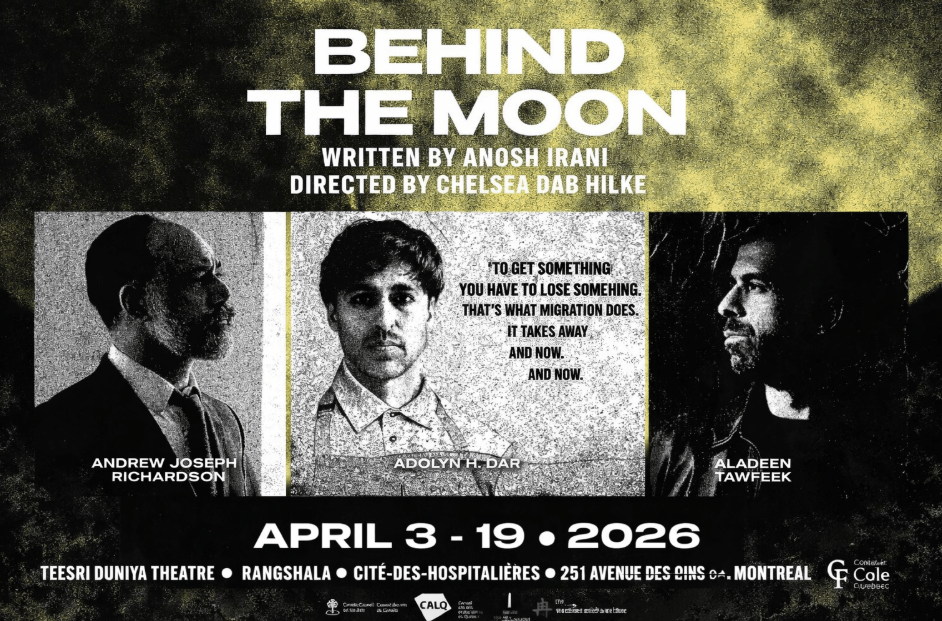
Teesri Duniya Theatre opens milestone season with Anosh Irani’s Behind the Moon
Montreal production examines sacrifice, identity and the elusive promise of a better life
Montreal’s Teesri Duniya Theatre is launching its 45th season with a production that places immigrant experiences at the forefront, blending humour, emotional depth and subtle magical elements to explore the meaning of a “better life.”
Running from April 3 to April 19 at Rangshala in Cité-des-Hospitalières, Behind the Moon is written by award-winning playwright and novelist Anosh Irani and directed by Chelsea Dab Hilke. The production anchors the company’s “Season of the Migrant,” a thematic program aimed at honouring immigrant stories, challenging misinformation and fostering a stronger sense of belonging.
Set in a late-night restaurant environment familiar to many urban Canadians, the play centres on Ayub, a lone worker managing cooking, cleaning and service while waiting for his life to move forward. His routine is disrupted by the arrival of Jalal, a mysterious cab driver, forcing Ayub to confront unresolved decisions and the family he left behind—all under the watch of his employer, Qadir Bhai.
“I don’t live in Canada. I live in a kitchen. But I must thank you for making me clean the tiles. I have seen my face. I have seen who I am.” – Ayub
A timely lens on immigrant labour
The production arrives at a moment when immigration continues to shape Canada’s labour market, particularly in sectors such as food services. According to industry estimates cited by the theatre, more than 25 per cent of workers in the food and beverage sector are immigrants, many from the Global South. The play uses this backdrop to explore the gap between expectation and reality.
Through its three central characters—Ayub, Jalal and Qadir—the story examines how migration can bring both opportunity and hardship. Their narratives highlight long hours, economic pressures and emotional isolation, while also revealing humour, resilience and complex interpersonal bonds.
“Migrant stories are rich, diverse and abundant, but never monolithic—and they remain untold,” said TDT Artistic Director Rahul Varma. “We regularly encounter restaurant workers from other parts of the world. They frequently operate in challenging, high-stress environments, often for low pay, and endure long, physically demanding shifts while navigating toxic workplaces and unpredictable customer behaviour. Our goal is to showcase the humanity and courage of this workforce, which was promised more than what many actually experience. The play captures this struggle beautifully.”
Direction emphasizes nuance and emotional complexity
Director Chelsea Dab Hilke, returning after last season’s Keffiyeh/Made in China, said the production aims to present male characters with emotional depth often missing from mainstream narratives.
“It’s important to show men in their complexity; with care, nuance and love. There is a very real epidemic of loneliness among men, which is addressed in the play—here we see men caring for each other in meaningful ways,” she said.
Hilke also positioned the work within broader political conversations around migration.
“Immigration and migration are hot button topics these last few decades, especially in conservative politics. Immigrants are being scapegoated across the western world to defer blame for larger failing systems by failing governments. It’s crucial to be discerning about how immigration issues are framed.”
Cast draws on personal and cultural resonance
The production features performances by Adolyn H. Dar as Ayub, Andrew Joseph Richardson and Aladeen Tawfeek as Jalal. For Tawfeek, the role offers an opportunity to explore what remains unspoken in immigrant narratives.
“Anosh Irani’s writing is compelling for an actor. It asks you to listen closely to what is not being said; to explore the inner life of a character rather than simply the events of the story. I was moved by the humanity of the piece, and the tenderness with which it observes people who are often invisible,” said Tawfeek. “They carry memories, expectations, family obligations and dreams that don’t always align with their current situation. That tension between hope and reality is deeply understood on a very personal level.”
Dar, meanwhile, connected the play’s themes to broader historical forces.
“Even within our own cultures and ethnicities we are forced to compete with each other just to get ahead. It’s tragic. But also, we are our own salvation,” commented Dar.
Production details and community engagement
The staging incorporates design elements from an award-winning creative team, including set design by Diana Uribe, costumes by Georges Micheal Fanfan, lighting by Jordana Natale and original music and sound by Rehan Lalani. The production also integrates multiple languages—Hindi, Kashmiri, Urdu and Arabic—adding cultural texture and authenticity.
In keeping with its community-focused mandate, Teesri Duniya Theatre will host post-show talkbacks, including sessions featuring the playwright, to encourage dialogue around the issues raised in the play.
The company has also introduced a tiered ticketing system this season, with prices ranging from $15 to $28, aimed at improving accessibility for audiences.
“To get something you have to lose something. That’s what migration does.” – Qadir Bhai
As Canada continues to grapple with questions around immigration, labour and identity, Behind the Moon offers a timely, human-centred perspective—one that reflects both the promise and the cost of seeking a new life.