

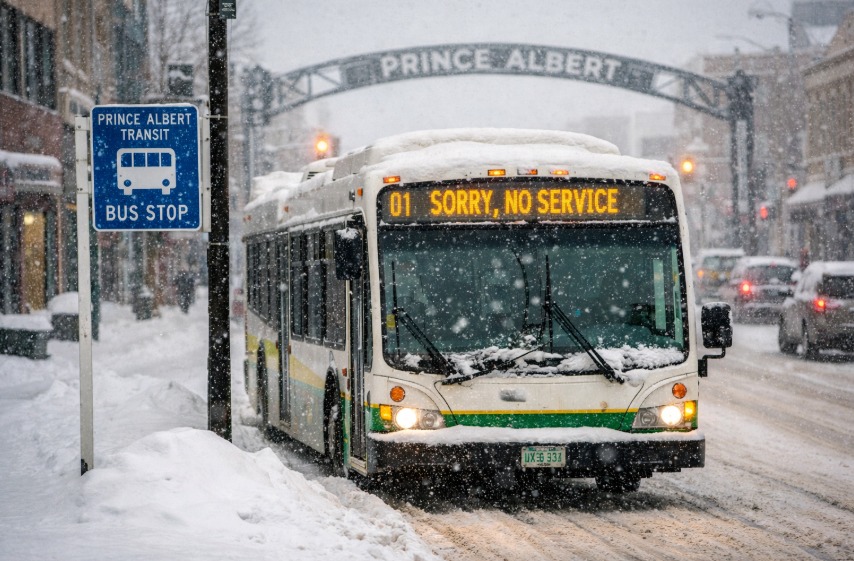
Public transit service in Prince Albert was suspended for the remainder of Wednesday after significant snowfall forced officials to halt bus operations, creating uncertainty for commuters and highlighting the operational challenges extreme winter weather poses for mid-sized Canadian municipalities.
In a service update issued Feb. 18, the City of Prince Albert said, “Transit service is cancelled for the remainder of the day, Wednesday, due to significant snowfall.”
The disruption affects the city’s entire bus network, which is operated by Prince Albert Transit and provides essential transportation for residents commuting to work, school, medical appointments and retail destinations. The shutdown underscores how winter storms can ripple through local economies, affecting employee attendance, business operations and access to services.
City officials said the timeline for restoring service remains uncertain as crews continue to assess road conditions and snowfall accumulation.
“At this time, the duration of the disruption is unknown and it is unclear when all routes will return to regular operation,” the city said in its notice.
Prince Albert, located about 140 kilometres northeast of Saskatoon, regularly experiences harsh winter weather, but significant snowfall events can still overwhelm municipal snow removal capacity and make it unsafe for buses to operate. Transit vehicles, particularly those running fixed routes and schedules, face heightened risks when roads are snow-covered, visibility is reduced, and stopping distances increase.
Municipal transit systems in smaller Canadian cities play a critical role in supporting local labour markets, especially for workers without access to personal vehicles. Service disruptions can affect staffing levels at hospitals, retail businesses, manufacturing facilities and government offices, potentially slowing economic activity for the day.
Local businesses often see immediate impacts when transit shuts down, particularly in downtown areas that rely on transit-dependent customers and employees. Weather-related closures can also result in lost productivity and reduced retail traffic, especially if disruptions extend beyond a single day.
City officials urged residents to seek updates directly from official sources as conditions evolve.
“Residents are encouraged to monitor the official City of Prince Albert Transit page for the most up-to-date information on route schedules and any further service changes,” the city said.
Municipalities across the Prairie provinces routinely build winter contingency planning into their operations, budgeting for snow removal, equipment maintenance and service disruptions. However, sudden and heavy snowfall can still force immediate service suspensions, particularly when safety becomes a concern.
Transit shutdown decisions typically involve coordination between public works, transit managers and municipal leadership, with safety considerations for both passengers and drivers taking priority. Snow accumulation can affect not only road traction but also the ability of buses to safely pull into stops, navigate intersections and maintain schedules.
The city acknowledged the inconvenience caused by the disruption and emphasized its focus on restoring service when conditions permit.
“We appreciate the public’s patience and understanding during this weather event,” the city said.
The service notice also included a directive for residents seeking additional details, stating, “Read the full article on our website.”
Environment and weather conditions remain a key operational risk for municipal governments across Canada, particularly in regions like central Saskatchewan where winter storms can develop quickly and produce large snowfalls within a short period.
For Prince Albert, the transit suspension represents both a logistical and economic challenge, as officials work to restore mobility while ensuring safety. The timing and speed of service restoration will likely depend on snowfall totals, road clearing progress and improving weather conditions.
Until then, residents dependent on public transit will need to rely on alternative transportation arrangements or delay travel plans, illustrating the broader economic and social impacts severe winter weather can have on Canadian communities.