

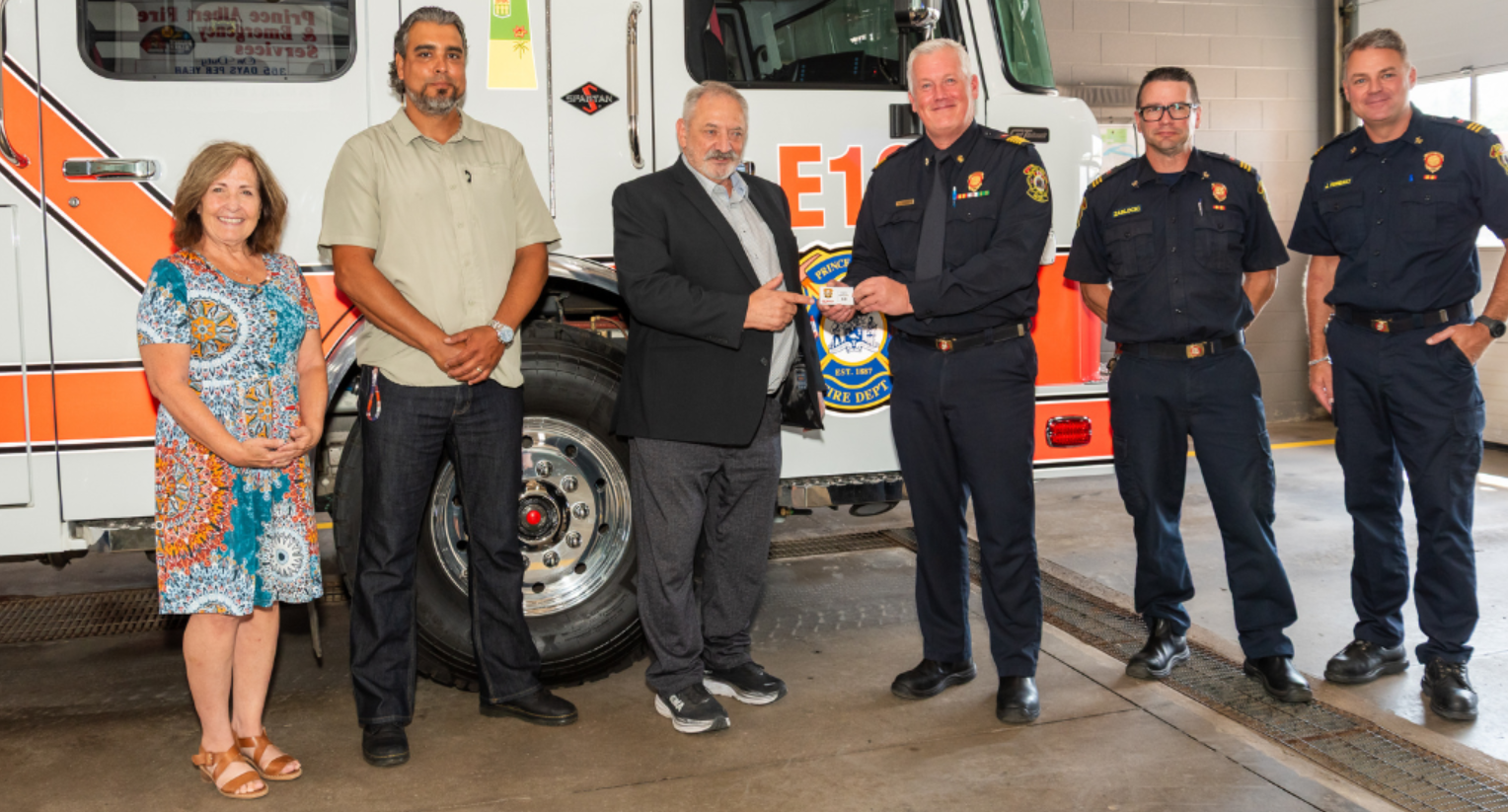
Prince Albert, SK — The Prince Albert Fire Department has strengthened its frontline emergency response capabilities with the arrival of a new, custom-built fire engine valued at approximately $1.3 million.
The new vehicle, designated Engine 13 (E13), replaces a 24-year-old engine that had reached the end of its operational service life. Officials say the acquisition represents a long-term investment in public safety, funded through the city’s capital reserves.
Fire Chief Kris Olsen said the decision to custom-build the unit was driven by the department’s unique operational requirements. “This new engine is a significant investment in the safety of our community,” Olsen said. “Having a custom-built unit like E13 allows us to meet the specific challenges we face in Prince Albert and ensures our firefighters have the tools they need to respond quickly and effectively.”
Cutting-edge technology for emergency response
Engine 13 is equipped with a state-of-the-art electronic pump control system, replacing traditional mechanical levers with a modern touchscreen interface. The system is designed to enhance firefighters’ accuracy, efficiency, and ease of use during high-pressure emergency situations.
For firefighting crews, the digital interface provides more precise water flow control and allows for faster adjustments in the field. Officials say the system will not only improve operational performance but also reduce the potential for mechanical failure over time.
The advanced technology also reflects a growing trend in Canadian fire services to adopt innovations that improve both safety and operational reliability. Municipal departments across the country are increasingly moving toward digital systems to streamline response efforts, a shift aimed at reducing human error in complex emergency scenarios.
Frontline deployment and expected service life
E13 has been assigned as the department’s first-arriving unit, meaning it will be the lead vehicle dispatched to most emergency calls in the city. This frontline position places the new engine at the heart of Prince Albert’s emergency response operations.
Officials estimate that E13 will remain in service for approximately 20 years, a typical lifespan for a frontline fire engine under regular maintenance schedules. Over its operational life, the vehicle will be tasked with responding to thousands of incidents, from structure fires and vehicle collisions to hazardous material calls and rescue operations.
A strategic upgrade for a growing city
The purchase is part of the City of Prince Albert’s ongoing commitment to ensuring its emergency services are equipped to meet evolving community needs. City officials say population growth, infrastructure expansion, and new building developments all contribute to the demand for reliable, modern firefighting equipment.
Replacing aging apparatus is a priority for municipalities, as older engines can become increasingly costly to maintain and less reliable in emergencies. The transition from the retired 24-year-old unit to E13 ensures that the department can maintain a high level of readiness without the risks associated with aging equipment.
Capital investment with long-term benefits
While the $1.3 million price tag is significant, officials emphasize that the purchase was funded through capital reserves rather than borrowing. This approach allows the city to manage large-scale equipment investments without adding to long-term debt obligations.
The investment also represents a cost-effective move when viewed over the vehicle’s anticipated two-decade lifespan. Spread over 20 years, the cost works out to about $65,000 annually — a figure city officials say is a reasonable price for ensuring frontline emergency readiness.
Enhancing firefighter safety and efficiency
Beyond the technological upgrades, E13 was built with firefighter safety in mind. The vehicle’s design includes ergonomic improvements to reduce strain during operations, enhanced lighting systems for nighttime visibility, and improved storage solutions for rapid access to gear.
For Chief Olsen and his team, these design elements are just as important as the advanced pump controls. “We need our firefighters to be able to do their jobs as safely and effectively as possible,” Olsen said. “Every detail, from the cab layout to the equipment compartments, was designed to support that goal.”
Community impact and future readiness
With E13 now operational, residents of Prince Albert can expect faster and more efficient emergency response times. The fire department’s ability to respond to a wide range of calls — from fires to rescue operations — is a cornerstone of public safety, and the addition of the new engine reinforces that capacity.
City officials also view the investment as part of a broader strategy to maintain and upgrade emergency services infrastructure. Future planning includes ongoing equipment replacement schedules, firefighter training programs, and the integration of emerging technologies.
As E13 begins its service, the retired engine will be decommissioned, marking the end of more than two decades of service to the city. In its place, the new fire engine represents a modern, highly capable resource that officials believe will serve Prince Albert well into the 2040s.
For residents, the message is clear: the city is investing in the tools and technology needed to keep the community safe — and Engine 13 is now leading that mission.