

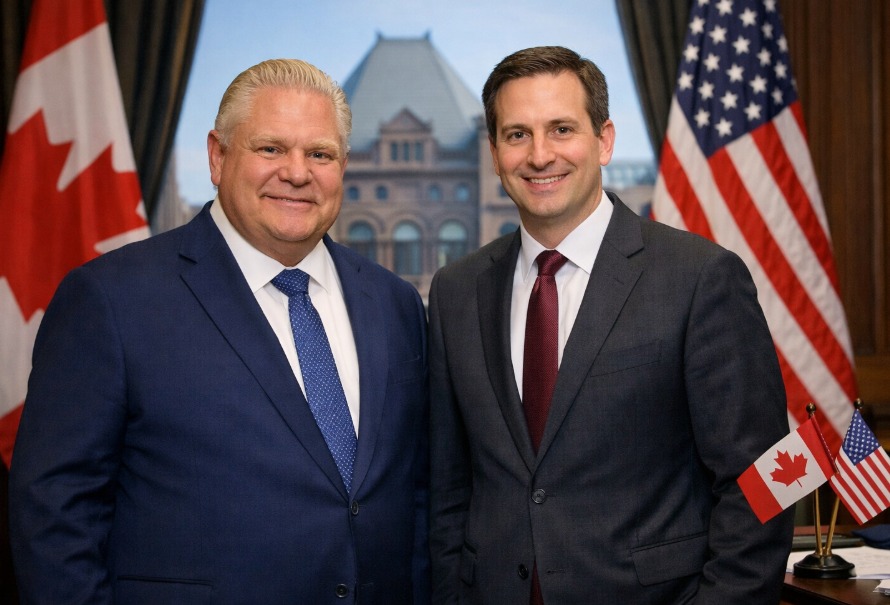
TORONTO — Premier Doug Ford has appointed Travis Kann as his new chief of staff, effective March 6, 2026, marking a senior leadership transition at Queen’s Park as Ontario navigates ongoing economic uncertainty and heightened trade tensions with the United States.
The appointment, announced Monday by the Premier’s Office, positions Kann — currently serving in dual roles as principal secretary and head of Ontario-U.S. engagement — at the centre of the government’s policy and political operations during a period defined by global economic volatility and tariff pressures from the United States.
“During his time in government, Travis has helped steer our government through some of Ontario and Canada’s most significant challenges, including our ongoing response to the economic threat posed by President Trump’s tariffs,” said Premier Ford. “As Ontario continues to navigate ongoing economic uncertainty, no one is better positioned to provide steady, disciplined leadership for our government.”
Kann will succeed Patrick Sackville, who has served as chief of staff for eight years. Sackville will remain with the government until March 6 to support the leadership transition, according to the release.
The leadership change comes as Ontario continues to focus on shielding its economy from U.S. protectionist measures and advancing domestic growth priorities. In his current portfolio, Kann has played a central role in executing the premier’s economic protection strategy.
As principal secretary and head of Ontario-U.S. engagement, Kann has worked across ministries to coordinate the implementation of key government initiatives aimed at bolstering Ontario’s economic resilience. These include the design of special economic zones intended to attract investment, efforts to dismantle internal trade barriers within Canada, and plans to accelerate infrastructure development — notably the construction of roads to the Ring of Fire, a mineral-rich region in northern Ontario considered critical to the province’s long-term resource and electric vehicle supply chain ambitions.
Kann has also overseen Ontario’s government-wide strategy to strengthen ties with U.S. lawmakers at both the federal and state levels. That work has included advocacy efforts in Washington during the lead-up to the review of the Canada-United States-Mexico Agreement, a cornerstone trade pact underpinning much of Ontario’s export-driven economy.
The province’s approach has been aimed at ensuring Ontario’s interests are represented amid shifting trade dynamics and political uncertainty in the United States. The review of the continental trade agreement has heightened the stakes for provinces heavily integrated into North American manufacturing and supply chains, particularly in the automotive, steel and critical minerals sectors.
Ford’s government has framed its economic agenda around protecting jobs, maintaining competitiveness and accelerating major infrastructure and development projects. The decision to elevate Kann signals continuity in that strategy, particularly as Ontario continues to face external pressures tied to tariffs and cross-border trade policy.
The premier also used the announcement to commend Sackville’s tenure as chief of staff, crediting him with helping guide the government through nearly a decade of political and economic challenges.
“I am immensely proud of the enormous contributions that Patrick has made to our government, to our province and to our country,” said Premier Ford. “After eight years of dedicated service to our government and province, Patrick is leaving behind a legacy few people can match and Ontario’s future is brighter because of his time as chief of staff. I am so thankful for Patrick’s leadership and service. There are amazing things ahead for him.”
Sackville’s time in the role spanned multiple provincial budgets, the COVID-19 pandemic, and periods of trade friction with the United States. His departure marks a significant shift within the premier’s inner circle, though the transition timeline suggests an effort to maintain operational stability.
Chief of staff appointments are among the most consequential staffing decisions for any premier, with the role responsible for overseeing political strategy, managing senior staff and coordinating policy priorities across government. As Ontario prepares for continued economic headwinds and major capital projects, Kann will assume a position that sits at the intersection of policy execution and political direction.
The Premier’s Office did not indicate whether additional senior staffing changes would accompany the transition.