

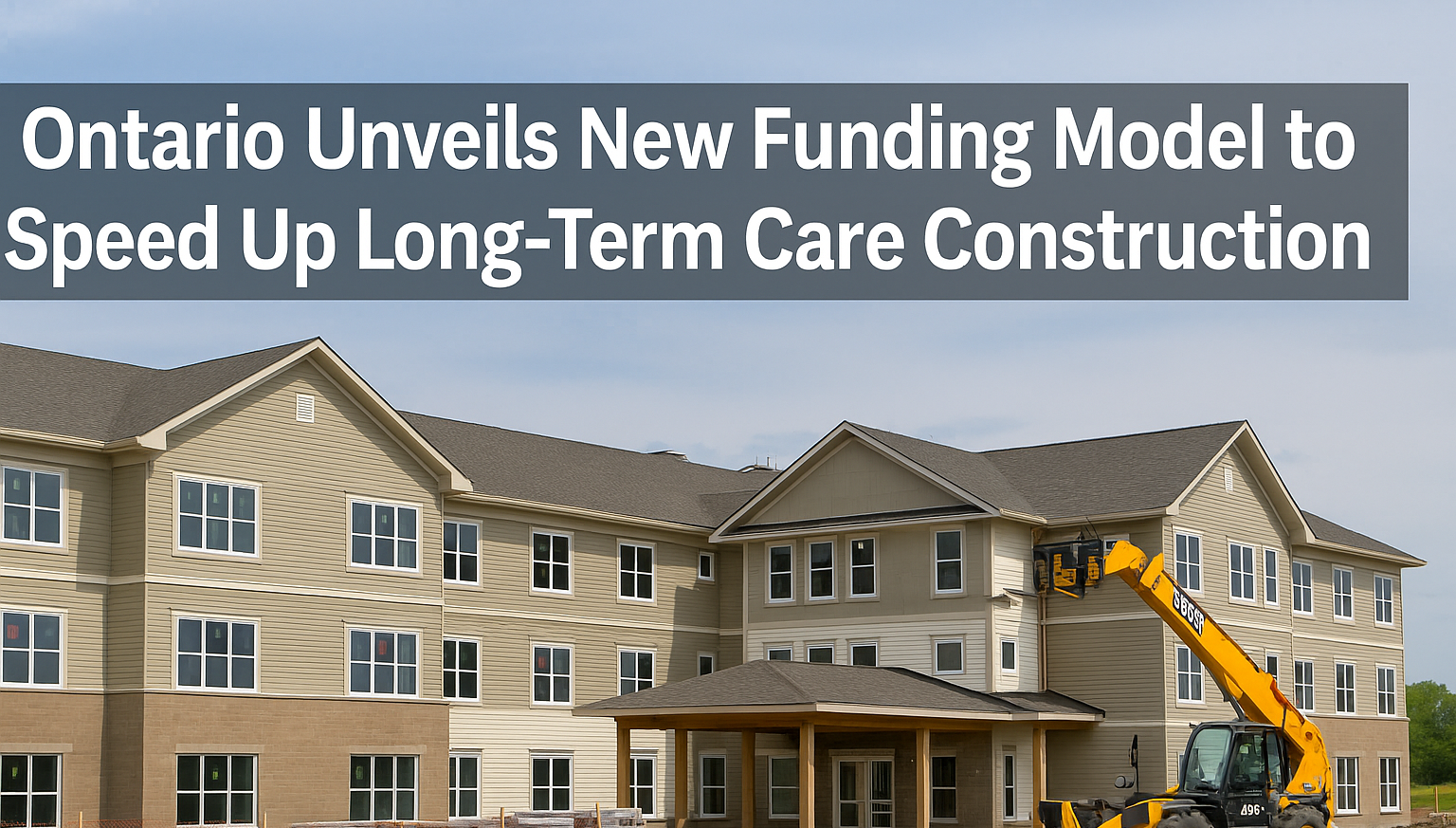
MAXVILLE, Ont. — The Ontario government is rolling out a new funding program aimed at making it easier and faster to build long-term care homes across the province, as demand for seniors’ care continues to grow.
The new Capital Funding Program (CFP), announced Tuesday, introduces a more flexible funding model designed to address labour shortages, rising construction costs and regional challenges that have slowed development in areas such as the Greater Toronto and Hamilton Area (GTHA) and northern Ontario.
“As Ontario ages, we need to protect our province by building long-term care homes faster, smarter and in the places that need them most,” said Natalia Kusendova-Bashta, Minister of Long-Term Care. “The success we’re already seeing at sites like Maxville Manor shows our new capital funding program will help us meet our ambitious construction targets and ensure Ontario families can receive world-class care close to home, for generations to come.”
A Shift in Funding Approach
Under the new framework, the province will move away from its previous fixed, cost-per-bed subsidy and instead cover up to 85 per cent of eligible construction costs, with funding caps tailored to four different market segments across Ontario.
The new model also changes how money flows to operators. Not-for-profit homes will be able to access a larger share of provincial funding earlier in the construction process, while eligible hospital and Indigenous operators may receive their entire allocation during the build phase. Government officials say the change is intended to give projects more financial certainty and help developers break ground sooner.
These reforms build on Ontario’s broader effort to expand and modernize the sector. Last year, the province met its target of providing nearly four hours of direct daily care to every resident, a benchmark introduced under the Fixing Long-Term Care Act, 2021.
Maxville Manor Redevelopment Kicks Off
The announcement comes as Maxville Manor, a not-for-profit home in eastern Ontario, begins work on a major redevelopment supported by the new program.
The project will upgrade the facility’s existing 122 beds and add 38 more, bringing the home’s total capacity to 160 residents. Renovations and two new buildings will bring updated amenities including a dining hall, spa, multipurpose room, adult day program suite and redesigned outdoor spaces. The phased redevelopment is scheduled to welcome its first residents in 2027.
“As the MPP for Glengarry—Prescott—Russell, I am very pleased to see this funding come to our riding,” said Stéphane Sarrazin, MPP for Glengarry—Prescott—Russell. “The redevelopment of Maxville Manor represents an important investment in the health and well-being of our seniors. This project will give residents and staff the modern spaces and amenities they deserve while strengthening long-term care in our community for years to come.”
Martin Lang, Warden of the United Counties of Stormont, Dundas and Glengarry, said the project reflects a growing regional need. “The demand for long-term care is real and growing. Families across SDG Counties rely on Maxville Manor – not just for a safe place, but for a home filled with compassion and community. That’s what this ground-breaking represents: a promise to meet that need, now and into the future,” he said.
Amy Porteous, CEO of Maxville Manor, called the provincial funding “critical” to moving the project forward. “We are not just upgrading a facility; we are building a future where residents, families and staff can thrive in a space that truly reflects the values of respect, safety and community,” she said.
Meeting Ambitious Targets
The CFP is part of a broader construction push outlined in the 2025 Ontario Budget: A Plan to Protect Ontario. The government has committed to creating 58,000 new and upgraded long-term care beds province-wide.
According to ministry figures, as of July 2025, 148 projects representing 24,101 beds were either completed, under construction or had secured ministry approval. The province says the CFP builds on record-level investments and replaces a temporary top-up introduced in 2022 that led to the highest volume of long-term care projects launched in a single year.
Provincial officials argue that the revamped model will provide the flexibility needed to address Ontario’s varied construction markets while ensuring seniors’ homes are built with modern safety and comfort standards.
“Together, we are building more than bricks and mortar,” said Lang. “We are building peace of mind, for today and for generations to come.”
