

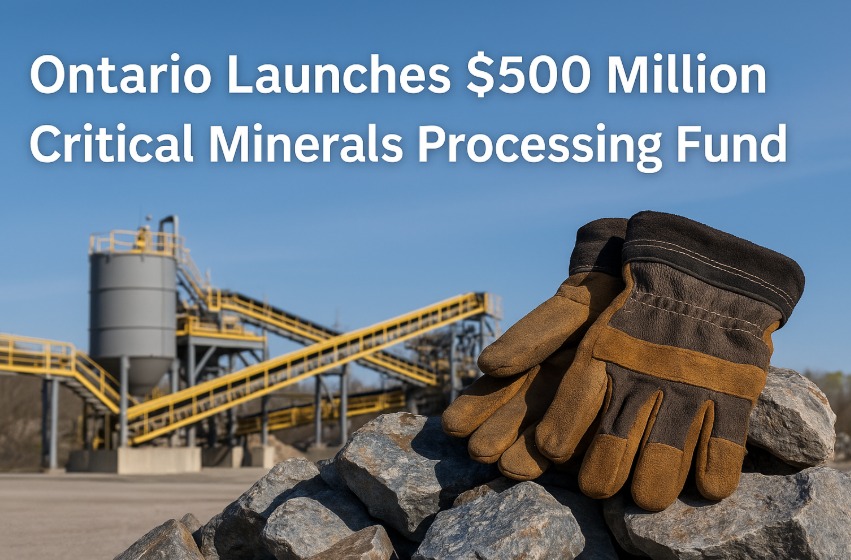
The Ontario government has launched a new $500-million fund aimed at boosting the province’s capacity to process critical minerals, positioning Northern Ontario as a cornerstone of Canada’s clean energy and advanced manufacturing economy. Announced Thursday in Sudbury, the Critical Minerals Processing Fund (CMPF) is designed to accelerate domestic refining, reduce reliance on foreign suppliers and support job creation across key industrial sectors.
The fund, first outlined in the 2025 provincial budget, marks one of Ontario’s largest targeted investments in mineral processing. It arrives at a time when global competition for secure supplies of nickel, graphite, copper, cobalt and lithium continues to intensify — minerals essential to electric vehicles, battery production, aerospace systems and defence technologies.
“As global demand for critical minerals rises across leading industries, our government is meeting the moment by increasing Ontario’s domestic processing capacity,” said Vic Fedeli, Minister of Economic Development, Job Creation and Trade. “Through the Critical Minerals Processing Fund, we are building a complete, made-in-Ontario critical minerals supply chain that will create good-paying jobs for workers, strengthen the economy and reinforce our province’s position as a global leader in this critical sector.”
A Push to Build Domestic Capacity
The CMPF will be administered through Invest Ontario, the province’s investment attraction agency, and will provide financial support to both new projects and expansions of existing facilities. The initiative aligns with the government’s broader strategy to advance resource development in Northern Ontario and the Ring of Fire — a 5,000-square-kilometre mineral-rich region northeast of Thunder Bay that is considered central to Canada’s long-term EV and battery ecosystem.
Government officials say the fund is intended not only to stimulate economic development but to prevent the export of unprocessed raw materials, a long-standing concern in the Canadian mining sector.
“We are finally ending the ripping and shipping of Canada’s vast resources by stepping up with a plan to build mines faster and expand domestic processing,” said Stephen Lecce, Minister of Energy and Mines. “This is about protecting Ontario workers by ensuring ‘Made in Canada’ is stamped on the minerals we process, creating thousands of good-paying jobs right here at home. We will continue to lead the clean energy economy by unapologetically opening new markets for the most ethically sourced resources on Earth.”
Economic and Strategic Rationale
Ontario ranks among the world’s top 10 jurisdictions for mineral exploration, and provincial officials argue that expanding refining capacity will further cement its competitive edge. By increasing domestic production of critical minerals, the government aims to help Ontario manufacturers weather global supply chain disruptions and respond to U.S. tariffs affecting key sectors, including autos and clean technology.
Local industry leaders and northern communities have long pushed for value-added processing to remain in the province. The government says the CMPF will help manufacturers and technology companies access more reliable and responsibly sourced inputs, a critical factor for firms navigating complex geopolitical pressures.
The fund also builds on a series of pro-business measures introduced by the province in recent years, including lower taxes, reduced regulatory burdens and expedited permitting for major industrial projects. Together with new legislative tools — such as the Protect Ontario by Unleashing Our Economy Act and the Special Economic Zones Act — the government says it is working to ensure Ontario is the most competitive investment destination in the G7.
Local and Industry Response
Political and industry leaders in Northern Ontario welcomed the announcement, emphasizing its potential to stimulate innovation and support long-term regional growth.
“As global demand for critical minerals continues to rise, the Critical Minerals Processing Fund will help Ontario deliver as a trusted supplier. By building supply chains here at home, with Ontario workers, we are creating good jobs, strengthening communities, and reinforcing our province’s reputation as a top destination for investment and growth,” said Bill Rosenberg, MPP for Algoma—Manitoulin.
Greater Sudbury — home to one of the world’s most established mining clusters — is expected to play a significant role in attracting projects supported by the CMPF.
“This investment reinforces what we have long known in Greater Sudbury: Ontario’s economic future runs through the North. The Critical Minerals Processing Fund will help ensure more value-added processing happens here at home, strengthening our mining ecosystem. It will accelerate innovation, grow our local economy, and create high-value jobs that support families across our community. I want to thank the Government of Ontario for recognizing the essential role that mining and Greater Sudbury plays in building a stronger, more self-reliant economy,” said Mayor Paul Lefebvre.
Invest Ontario CEO Khawar Nasim said the agency is prepared to help evaluate and support projects that advance provincial priorities. “A strong and reliable critical minerals supply chain is essential to building a more resilient economy. The Critical Minerals Processing Fund will enable us to support high-impact projects that deliver meaningful strategic and economic benefits for Ontario. We appreciate the government for entrusting us with the administration of the fund.”
Broader Impact
Since its creation, Invest Ontario has attracted more than $12.4 billion in business investments, resulting in over 11,300 new jobs. The province is also allocating nearly $3.1 billion in loans, guarantees, grants and scholarships to strengthen Indigenous participation and partnership in the critical minerals sector.
With global demand for clean technology and energy transition metals expected to surge in the coming decade, the government says the CMPF will play a central role in securing Ontario’s place in international supply chains — while anchoring high-value economic activity in the province’s north.
