

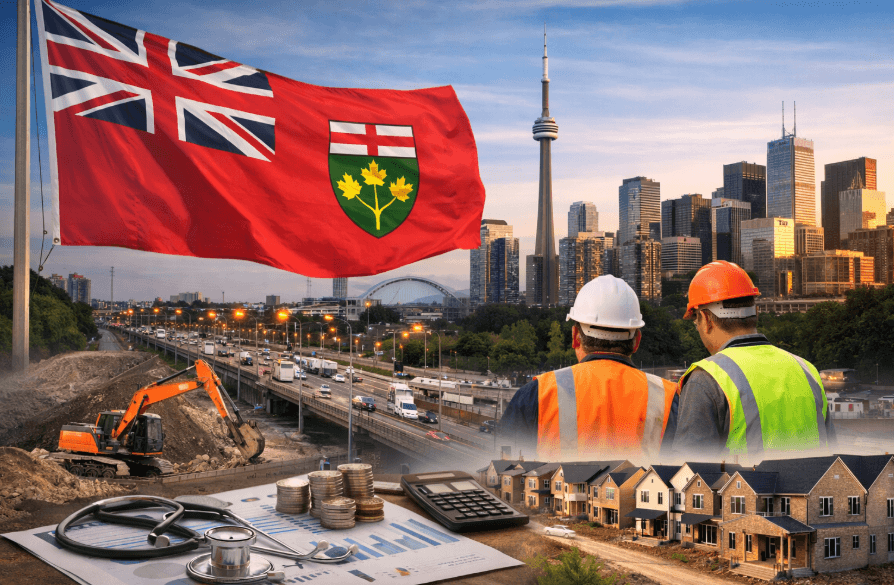
Government Positions Plan as Shield Against Economic Uncertainty
TORONTO — The Ontario government has released its 2026 budget, outlining a strategy aimed at strengthening economic resilience, boosting investment and easing financial pressures on households and businesses amid ongoing global uncertainty.
Finance Minister Peter Bethlenfalvy tabled the fiscal plan Thursday, framing it as a pragmatic response to external pressures such as tariffs and slowing economic growth. The budget, titled A Plan to Protect Ontario, emphasizes tax relief, infrastructure investment and targeted spending in key sectors.
“Ontario is navigating economic challenges with a pragmatic and prudent fiscal plan,” said Minister Bethlenfalvy. “To help the province navigate these times and come out stronger, we are investing in strategic priorities such as energy, critical minerals, key infrastructure and critical technologies that will make our economy stronger, while cutting red tape and creating the conditions for businesses to grow, supporting workers and strengthening Ontario’s economy.”
Tax Cuts and Housing Relief Take Centre Stage
A major pillar of the budget is the next phase of Ontario’s Tax Action Plan, designed to enhance competitiveness while lowering costs.
Among the headline measures is a proposal to remove the full 13 per cent Harmonized Sales Tax (HST) on new homes valued up to $1 million, offering eligible buyers up to $130,000 in relief. The rebate would be maintained for homes valued up to $1.5 million. The province noted that the federal government has agreed to cost-share the initiative, pending legislative approval, contributing to an estimated $2.2 billion in combined housing tax relief.
Small businesses are also set to benefit from a reduction in the corporate income tax rate, which the government proposes to cut from 3.2 per cent to 2.2 per cent effective July 1, 2026. The measure is expected to deliver $1.1 billion in tax relief over three years to more than 375,000 businesses.
The province is also planning to allow accelerated depreciation for capital investments, aligning with anticipated federal changes, in a move intended to lower investment costs and encourage business expansion.
Major Investments Target Growth Sectors and Infrastructure
The budget introduces a new Protect Ontario Account Investment Fund, with up to $4 billion earmarked to attract pension and private capital into strategic sectors tied to long-term economic priorities.
Infrastructure spending remains a central focus. The government is committing to what it describes as the largest capital plan in Canadian history, with more than $210 billion in planned investments over 10 years, including $37 billion in 2026–27. Projects will include highways, transit systems, hospitals and community infrastructure.
Additional targeted investments include:
- Nearly $1 billion annually for the Ontario Autism Program
- An expanded $3.4 billion Primary Care Action Plan through 2029
- $300 million over six years for community sport and recreation infrastructure
- $66 million annually for a new Classroom Supplies Fund for elementary school teachers
- A two-year extension of the Ontario One Fare Program, saving frequent transit users up to $1,600 per year
Fiscal Outlook Shows Gradual Path to Balance
Despite increased spending, the government maintains it is on track toward fiscal balance.
Ontario’s deficit for 2025–26 is projected at $12.3 billion, an improvement of $2.3 billion compared to earlier forecasts. The province anticipates deficits of $13.8 billion in 2026–27 and $6.1 billion in 2027–28, before returning to a projected surplus of $0.6 billion in 2028–29.
The government emphasized that its approach avoids tax increases and service cuts, distinguishing Ontario from other jurisdictions facing tighter fiscal conditions.
Economic growth is expected to remain modest in the near term, with real GDP projected to rise by 1.0 per cent in 2026 before gradually accelerating to 2.0 per cent by 2029.
Meanwhile, Ontario’s net debt-to-GDP ratio is forecast at 36.8 per cent for 2025–26, improving from earlier projections and remaining below the government’s 40 per cent target over the medium term.
Balancing Affordability and Competitiveness
The 2026 budget reflects a balancing act between supporting households and maintaining a competitive business environment. By combining tax relief with large-scale public investment, the province is positioning itself to weather external economic pressures while laying groundwork for long-term growth.
Officials argue that sustained investment in infrastructure, health care and education — alongside measures to reduce costs — will help attract investment and strengthen Ontario’s economic position within the G7.
As global uncertainty continues, the province’s fiscal strategy signals a commitment to stability while pursuing growth through targeted policy measures and capital spending.