

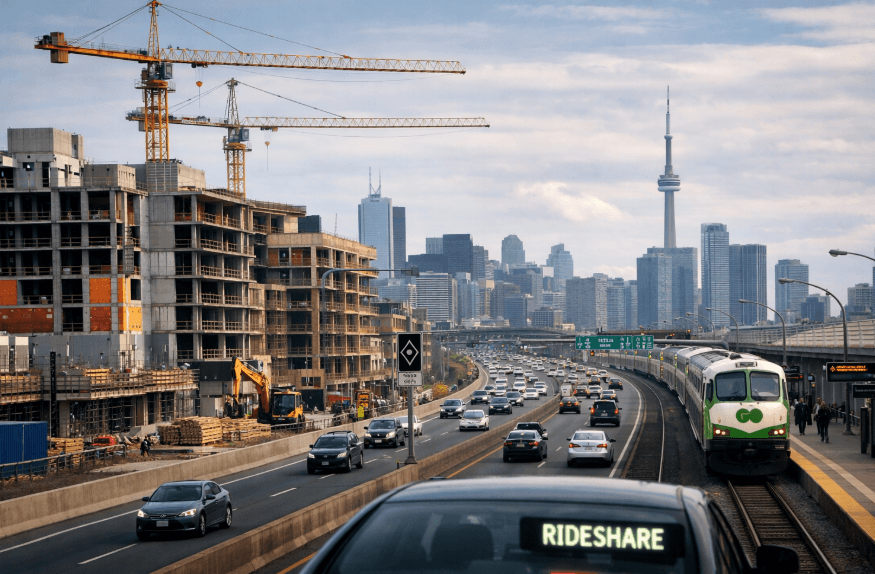
Proposed law targets transit efficiency, housing approvals, and development costs
Government says reforms will boost affordability and economic stability
TORONTO — The Government of Ontario has introduced new legislation aimed at tackling two of the province’s most persistent economic challenges: housing supply and transportation congestion.
The proposed Building Homes and Improving Transportation Infrastructure Act, tabled Monday, seeks to streamline home construction approvals, reduce development costs and improve mobility across urban and rural regions. Officials say the measures are intended to support economic growth while easing affordability pressures for residents.
“The Building Homes and Improving Transportation Infrastructure Act is the latest step our government is taking to tackle red tape, reduce unnecessary costs, and streamline approvals,” said Rob Flack, Ontario Minister of Municipal Affairs and Housing. “Along with our recent announcements to expand HST relief to all new-home buyers and recognize municipalities that cut their development charges, we’re making it easier for more people in Ontario to afford a home.”
Focus on reducing congestion and improving transit access
A central component of the legislation is improving transportation efficiency, particularly in congested corridors and underserved northern communities.
The bill proposes simplifying fare systems, expanding access to high-occupancy vehicle (HOV) lanes, and enabling rideshare services along the Northlander corridor. It would also allow single-occupant vehicles to use HOV lanes during off-peak hours, a move intended to maximize existing highway capacity.
“Our government is taking action to reduce gridlock and keep drivers moving across the province as we continue our work to protect Ontario,” said Prabmeet Sarkaria, Minister of Transportation. “The legislation we’re tabling today would improve transportation options in northern communities, support the future expansion of the One Fare program and make better use of existing highway capacity so people can spend less time in traffic.”
The province also plans to require on-road experience before prospective commercial drivers can obtain a Class A licence, a measure aimed at enhancing road safety.
Streamlining planning and reducing barriers to housing development
Beyond transportation, the legislation places heavy emphasis on accelerating housing construction by reducing administrative hurdles.
Proposed changes include standardizing municipal official plans to make them easier to navigate and limiting overly complex land-use designations. The government says these plans have become inconsistent and overly restrictive, contributing to delays in development.
The province will also launch a comprehensive review of Ontario’s Building Code through an expert advisory body made up of engineering, construction and regulatory specialists. The review aims to eliminate duplication and modernize requirements to better reflect current building practices.
Another key measure would restrict municipalities from imposing enhanced development standards through site plan control processes when those standards exceed health and safety requirements. The government argues that such practices have increased costs and slowed approvals.
Industry estimates cited by the province suggest Ontario’s site plan approval process costs roughly $3.5 billion annually in inefficiencies and missed opportunities, with timelines often exceeding the mandated 60-day review period.
Measures to improve transparency and expand housing options
The legislation also includes provisions to increase transparency for homebuyers by consulting on the disclosure of municipal development charges and additional fees in purchase agreements.
To support affordability for seniors, the province plans to eliminate development charges on non-profit retirement homes. It is also introducing a framework to enable communal water and wastewater systems in remote and rural areas, where traditional infrastructure can be cost-prohibitive.
Additionally, the bill reinforces that a new public corporation overseeing water and wastewater services in Peel Region will remain publicly owned. The measure clarifies employee and contractual transitions to ensure continuity of service.
Building on prior housing and infrastructure initiatives
The new legislation builds on earlier reforms, including the Protect Ontario by Building Faster and Smarter Act, 2025 and the Fighting Delays, Building Faster Act, 2025. Together, these initiatives form part of a broader strategy to address housing shortages and infrastructure constraints.
Recent policy moves also include extending the One Fare transit program—allowing commuters in the Greater Toronto and Hamilton Area to save up to $1,600 annually—and investing more than $100 million in the return of Northlander passenger rail service.
In its 2026 budget, the province announced expanded HST relief for new homes valued up to $1 million, offering rebates of up to $130,000.
Economic and social implications
The government positions the legislation as a key step toward long-term economic resilience, arguing that faster housing construction and improved transportation networks are critical to supporting labour mobility and investment.
If passed, the Building Homes and Improving Transportation Infrastructure Act is expected to reduce approval timelines, lower development costs and improve commuting efficiency—factors that could have a material impact on both housing affordability and business productivity.
Officials say the combined measures aim to “get shovels in the ground faster” while improving quality of life for Ontario residents, though the legislation will likely face scrutiny from municipalities, developers and transit stakeholders as it moves through the legislative process.