

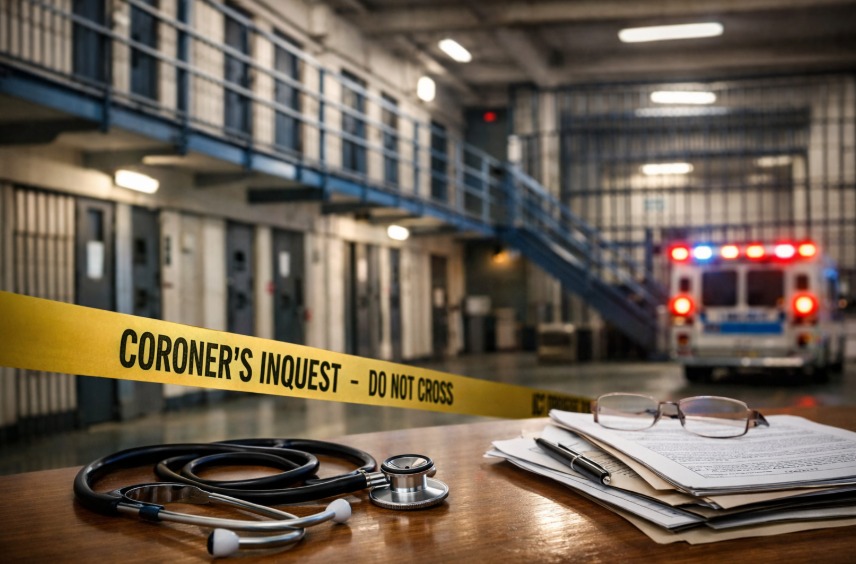
Ontario’s Office of the Chief Coroner has scheduled a single inquest to examine the deaths of five men who died while in custody or after being transferred to hospital from Collins Bay Institution in Kingston, a development that underscores ongoing scrutiny of correctional health care and institutional oversight in the province.
Dr. Armita Rahmani, Regional Supervising Coroner for the East Region at the Kingston Office, announced that the inquest will begin at 9:30 a.m. on Monday, January 26, 2026. The proceedings will be led by presiding officer Bonnie Goldberg, with Kristin Smith and Erin Winocur serving as inquest counsel.
The inquest will examine the deaths of Shimon Abrahams, Quinn Borde, Shane Gammie, Christopher Sipes, and Qin Long (Qinlong) Xue. According to the Ministry of the Solicitor General, Mr. Abrahams, 41, died on June 13, 2022; Mr. Borde, 39, died on April 2, 2022; Mr. Gammie, 35, died on November 24, 2018; Mr. Sipes, 51, died on November 21, 2019; and Mr. Xue, 26, died on November 13, 2020. All five men died while in custody or after transfer to hospital from Collins Bay Institution.
Under Ontario’s Coroners Act, inquests are mandatory when deaths occur in custody, reflecting the province’s legal requirement for public examination in cases involving state care or supervision. The Act is designed to ensure transparency, establish the circumstances surrounding a death, and identify potential systemic issues. While an inquest does not assign criminal or civil liability, its findings can carry significant policy implications.
The scope of the upcoming proceedings will focus on the circumstances surrounding each death. A jury will hear evidence and may make recommendations aimed at preventing similar deaths in the future. Such recommendations, while non-binding, are often closely watched by government ministries, correctional services, health-care providers, and advocacy groups, as they can influence operational practices and resource allocation.
The inquest is expected to last approximately 10 days and will hear from about 10 witnesses. Witness testimony typically includes medical professionals, correctional staff, and experts who can provide insight into institutional procedures, medical responses, and risk management practices. The relatively streamlined witness list suggests a focused examination, though the breadth of issues may span several years given the range of dates involved.
In a move that reflects broader changes in public-sector proceedings since the pandemic, the inquest will be conducted by video conference. Members of the public will be able to view the proceedings live through an online link provided by the Office of the Chief Coroner. Remote access has become an increasingly common feature of inquests and hearings, improving accessibility while also reducing logistical costs associated with in-person attendance.
For Ontario’s correctional system, the inquest comes amid continued public and policy debate over inmate health care, mental health supports, and emergency response protocols within institutions. From a business and governance perspective, such proceedings can have downstream effects on government spending priorities, procurement decisions related to health services, and risk management strategies across the public sector.
The Ministry of the Solicitor General noted that the jury’s role will be limited to fact-finding and recommendations. Any suggested changes emerging from the inquest may later be reviewed by provincial ministries, including those responsible for corrections and health, as well as by federal partners where applicable.
Members of the public seeking to observe the inquest can do so via the live-stream link hosted by First Class Facilitation on behalf of the Office of the Chief Coroner. Additional information about the inquest process, including the role of juries and the implementation of recommendations, is available through the Government of Ontario’s website.
As the January 2026 start date approaches, the inquest is expected to draw attention from legal observers, public-sector unions, and policy analysts monitoring accountability and operational standards within Ontario’s correctional facilities.
