

Provincially funded project adds 122 beds and supports broader seniors’ care strategy
Toronto development integrates housing, health care and community services
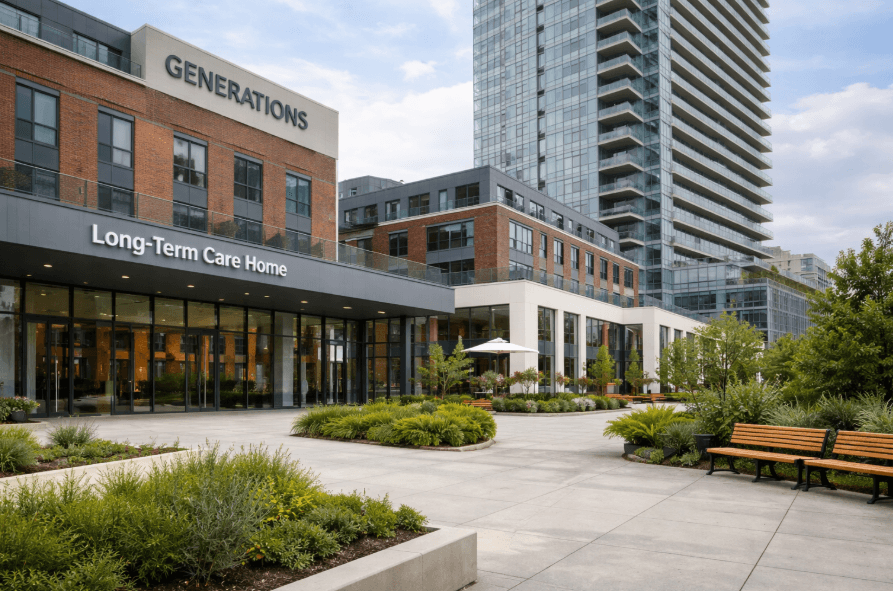
The Ontario government has marked the completion of a new long-term care home in Toronto, adding 122 beds as part of the broader Generations Toronto Campus, a multi-use development aimed at improving health and social outcomes for seniors.
The project, inaugurated on March 30 by Aga Khan, is situated within a 60-acre campus that combines long-term care with affordable housing, child care, and community services. The development is part of a wider provincial effort to expand long-term care capacity and modernize facilities across Ontario.
“After breaking ground on Generations Toronto Campus with Prince Amyn Aga Khan in 2022, our government is proud to see the completion of the 122-bed long-term care home to support Toronto’s Ismaili community,” said Doug Ford. “As part of a campus with 390 affordable homes, on-site health care, child care and community programming, Generations Toronto is a place where families can thrive together, alongside relatives who need more care.”
Part of broader provincial infrastructure push
The new facility has been supported through Ontario’s construction funding subsidy top-up and aligns with the province’s long-term care expansion strategy, which aims to deliver 58,000 new and upgraded beds.
Officials say the initiative is designed not only to increase capacity but also to enhance quality of care and living standards for residents.
“The inauguration of the new Generations Toronto long-term care home marks a major milestone in our government’s plan to protect residents and increase access to world-class health care across the province,” said Natalia Kusendova-Bashta. “With construction coming to completion, 122 residents will soon have a safe and modern place to call home.”
The facility occupies two floors within a 27-storey building and includes shared amenities such as program areas and community spaces. It is expected to create approximately 125 jobs, including roles in nursing, personal support, nutrition services, and administration.
Community-focused care model
The home will primarily serve the Shia Ismaili Muslim community, offering culturally appropriate services while remaining inclusive of residents from diverse backgrounds. The broader campus model reflects a growing trend toward integrated, multi-generational living environments.
“In the Islamic tradition, care for the elderly is not a social policy,” said Aga Khan. “It is a duty. Reverence for those who came before us, solidarity across generations, responsibility to the places where we live – these are the ethical commitments that guide the Ismaili Muslim community.”
Municipal leaders also highlighted the role of public investment in advancing the project. The City of Toronto contributed more than $17.5 million in incentives, alongside funding from other levels of government.
“Today’s opening of the Generations Toronto Campus, inaugurated by His Highness the Aga Khan, is a major step forward in delivering complete, caring communities to Torontonians,” said Olivia Chow. “This important project will serve the Ismaili community in Toronto while also supporting the diverse needs of all residents. The City of Toronto is proud to support this project with more than $17.5 million in incentives, along with additional funding from other levels of government, helping bring this vision to life and ensuring more residents have access to safe, modern care.”
Sector-wide implications
The Generations Toronto project is operated by Multi-Generational Housing and Community Centres Toronto, a not-for-profit organization, and forms part of a broader provincial pipeline of long-term care developments.
As of January 2026, the province reports that 164 projects—representing nearly 25,900 new and redeveloped beds—are completed, under construction, or approved to proceed.
Ontario has also introduced a revised Long-Term Care Home Capital Funding Policy, replacing earlier subsidy programs to better reflect regional cost differences and sector needs. The updated framework is intended to accelerate construction while ensuring financial sustainability for operators.
In addition to funding reforms, the province is pursuing strategies such as repurposing unused public land and leveraging hospital-owned properties to fast-track development, particularly in urban centres where demand remains high.
The Generations Toronto Campus illustrates how integrated infrastructure projects are increasingly central to Ontario’s long-term care strategy—combining housing, health services, and community supports in a single location to address the complex needs of an aging population.