

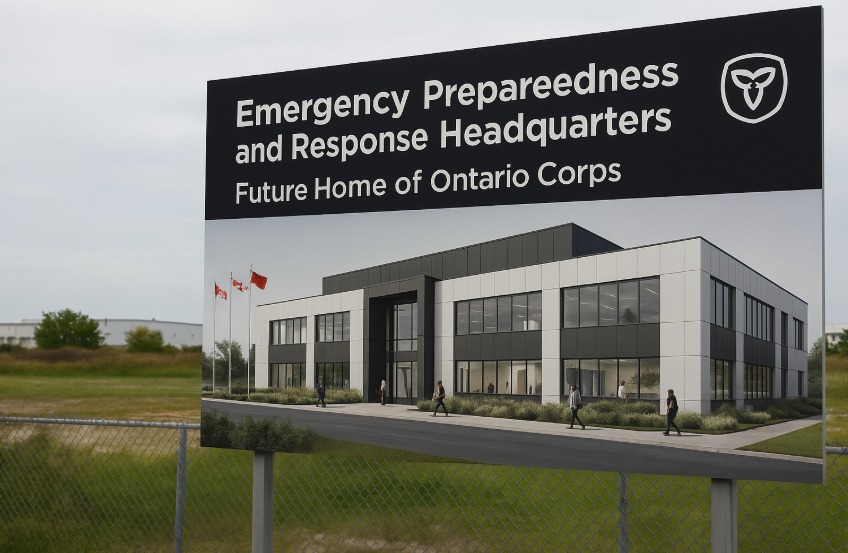
The Ontario government is advancing plans for a new Emergency Preparedness and Response Headquarters in Toronto, awarding a key contract that brings the project closer to construction. The province says the purpose-built complex will strengthen its ability to coordinate rapid, provincewide responses to floods, wildfires and other emergencies—demands that have grown sharply in recent years.
Announced Monday, the headquarters will be built on a 17-acre site at 111 Disco Road in Etobicoke, strategically located near Toronto Pearson Airport and major 400-series highways. The facility will also become the future home of Ontario Corps, the volunteer unit that supports emergency operations across the province.
“This new command centre will help us protect communities across Ontario with faster, more coordinated responses whenever emergencies happen, ensuring help gets to the people who need it most,” said Premier Doug Ford. “With a modern home for Ontario Corps, we’re making sure these volunteers and everyday heroes have the tools they need to carry out their critical operations and keep people safe.”
The province awarded the functional programming contract—an early planning stage that defines the building’s activities, technology needs and operational requirements—to WZMH Architects. Work is expected to wrap up in 2026 before the design and construction phases begin.
In outlining the project, the government emphasized the expanding workload of emergency responders and volunteers. Ontario Corps volunteers logged more than 6,000 hours in 2025 carrying out tasks that included wildfire evacuation support, flood barrier installation, wellness checks and community meal services. Emergency field officers were deployed for a combined 1,068 days so far this year. Meanwhile, Ontario coordinated the evacuation of more than 6,000 people from First Nations communities threatened by wildland fires and hosted over 2,300 evacuees from Manitoba.
The province has also faced a sharp rise in local emergency declarations—42 to date this year, compared with 29 over the same period last year.
“We’re taking bold steps to build and renew our infrastructure and grow our economy, and that’s why Ontario needs a strong emergency management system to stay protected, resilient and ready,” said Jill Dunlop, Minister of Emergency Preparedness and Response. “That means investing in a modern headquarters designed for future challenges and enabling more effective, coordinated and enhanced emergency response.”
The headquarters is part of Ontario’s more than $220-billion capital plan to expand critical infrastructure, which the government says represents the largest infrastructure build in Canadian history. Officials frame the investment as both an economic driver and a way to bolster provincial resilience in the face of increasingly severe natural disasters.
Support for the project has come from across the emergency management and community relief sectors. Todd McCarthy, Acting Minister of Infrastructure, said, “Ontario’s new Emergency Preparedness and Response Headquarters will be a state-of-the-art complex designed to keep our communities supported and protected during natural disasters and other emergencies. Under the leadership of Premier Ford, our government is delivering on our more than $220 billion capital plan to build the critical infrastructure our province needs to keep workers on the job, drive economic growth and protect Ontario.”
Dan Millar of The Salvation Army added that, “The Salvation Army is proud to be an Ontario Corps member and grateful for our partnership with our colleagues and the Ontario government. With the province’s new state-of-the-art Emergency Preparedness and Response Headquarters underway, Ontario Corps will be even better equipped to protect communities 24/7. Together, we’re stronger in supporting Ontarians in times of need.”
Several emergency and humanitarian organizations highlighted how modern infrastructure could improve coordination and shorten response times. Mischa Kaplan of Team Rubicon Canada said, “Ontario’s investment in a modern, purpose-built Emergency Preparedness and Response Headquarters is an important step toward strengthening the province’s overall emergency management system. As a disaster response organization operating across Ontario, Team Rubicon Canada sees firsthand how modern infrastructure, unified coordination and rapid information flow translate into faster, safer and more effective support for communities.”
Rahul Singh of GlobalMedic echoed the importance of unified operations, saying, “As part of Ontario Corps, we see firsthand the importance of collaboration, information and resource sharing when responding to emergencies here in Ontario. Steps like the creation of this new facility will only help increase the speed and efficiency of future responses. We are proud to be a part of this innovation and look forward to seeing the impacts it will create.”
Indigenous organizations also underscored the importance of improved systems for communities disproportionately affected by wildfires and evacuations. Chief Chris Skead of Kenora Chiefs Advisory noted, “Strong, coordinated systems are essential to supporting First Nation communities, and ensuring we have these systems in place allows the opportunity to try and navigate these emergencies before they grow.”
Construction timelines for the headquarters have not yet been released, but the province says the facility will be designed to “withstand all hazards” and serve as a 24/7 command hub with advanced communications and operational capacity.
If you’d like this article adapted for a different audience or condensed for a briefing note, I can prepare that as well.
