

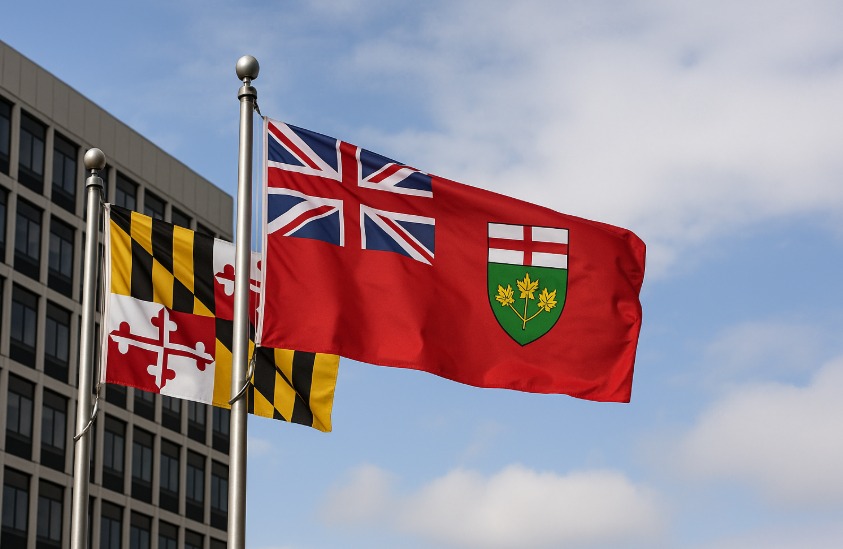
Ontario is moving to tighten its economic relationship with the State of Maryland through an expanded Memorandum of Understanding aimed at boosting collaboration in life sciences, information technology and clean energy—three sectors both governments say are key to long-term competitiveness. The agreement, announced Monday, marks a renewed push by the province to broaden its network of U.S. trade partners as it seeks to position itself as the most “resilient, self-reliant and competitive economy in the G7.”
The updated MOU builds on an earlier accord signed in 2020 and is structured to reduce trade barriers, encourage investment flows and support joint innovation initiatives. Ontario officials framed the agreement as part of a broader strategy to strengthen North American supply chains and ensure companies on both sides of the border can expand despite global economic headwinds.
“Ontario and Maryland share a strong and growing partnership built on innovation, hard work and opportunity,” Premier Doug Ford said in a statement announcing the renewed pact. “By rejecting tariffs and trade barriers and building Fortress Am-Can — a renewed strategic alliance between the U.S. and Canada — we can support workers and businesses in Maryland and Ontario while attracting investment and exchanging cutting-edge innovations and technologies. We’re stronger when we work together, and our government is proud to work with Governor Moore and the State of Maryland to build our economies while helping to lower costs for workers and families.”
Maryland Governor Wes Moore emphasized the role the partnership has played in fostering cross-border investment, noting that expanding its scope aligns with both jurisdictions’ ambitions in high-growth industries. “Partnership produces progress across regions, economies and cultures,” Moore said. “We are proud to double down on Maryland’s friendship with Ontario, which has been a source of job creation and economic growth for years. And by expanding the terms of this collaborative partnership to include key sectors like life sciences and I.T., we are furthering Maryland’s leadership in industries of the future. Together, we are building greater shared prosperity.”
Ontario officials say deeper cooperation with U.S. states is essential as global markets become more fragmented and as companies seek stable, transparent environments for investment. The province has signed five economic cooperation agreements with Indiana, Michigan, Nevada, Illinois and New Jersey since 2023, signalling a sustained push into sub-national diplomacy to secure supply chains and open new export channels.
The MOU with Maryland comes at a time when governments across North America are competing to attract investment in electric vehicles, biomanufacturing and emerging technologies. Ontario has repeatedly argued that reducing administrative burdens and interjurisdictional barriers is critical to maintaining its competitive advantage.
“While many jurisdictions around the globe are facing economic uncertainty, Ontario is focused on what keeps our economy open, competitive and ready for growth,” said Andrea Khanjin, Ontario’s Minister of Red Tape Reduction. “We need to keep trade moving, we need to cut red tape and reduce barriers that hold back investment, and we need to build strong economic ties with partners like Maryland that will help our workers and businesses succeed.”
Trade between the two jurisdictions has been steadily increasing. In 2024, goods exchanged between Ontario and Maryland reached CAD$2.7 billion. Approximately 40 Ontario-based companies operate in Maryland, while about 30 Maryland firms have an active presence in Ontario. Provincial officials say the updated MOU will support this commercial activity by improving coordination between economic development agencies and facilitating connections between businesses seeking cross-border opportunities.
For Maryland, the agreement aligns with its efforts to strengthen its role in technology-driven industries and climate-focused innovation. “From meeting the needs of a digital economy to addressing climate change, Maryland and Ontario are working towards several of the same economic development initiatives,” said Maryland Secretary of Commerce Harry Coker, Jr. “Encouraging these open lines of communication will strengthen ties between both regions as we support our growing North American communities.”
Ontario’s government maintains that enhancing U.S. partnerships is essential for job creation at home. Nearly one in five jobs in the province depends on trade, and more than 1.3 million positions are supported by exports—the highest proportion of export-reliant jobs in Canada. In 2024, Ontario-U.S. merchandise trade totalled more than $487 billion.
The expanded Ontario–Maryland agreement will take effect immediately, with both governments expected to convene working groups in the coming months to identify specific opportunities in the targeted sectors.
