

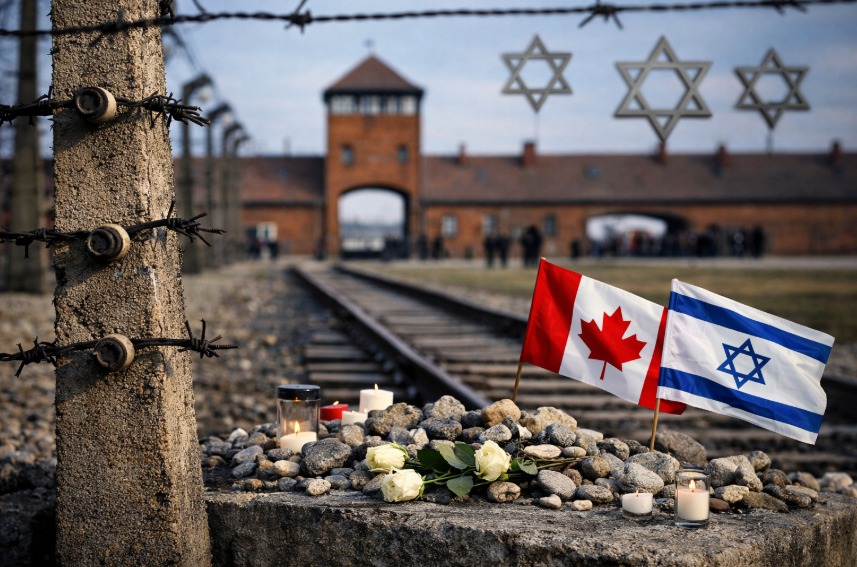
TORONTO — The Ontario government marked International Holocaust Remembrance Day on Monday with a renewed pledge to confront antisemitism and protect the rights of religious and cultural communities, as the province joined global commemorations recognizing the 81st anniversary of the liberation of Auschwitz-Birkenau.
In a statement issued January 27, Graham McGregor, Ontario’s Minister of Citizenship and Multiculturalism, paid tribute to the victims of the Holocaust and emphasized the continued relevance of remembrance amid rising incidents of hate in Canada and abroad.
“Today, on International Holocaust Remembrance Day, we honour and pay tribute to the memory of the six million Jews murdered during the Holocaust, alongside the millions of others who were persecuted by the genocidal Nazi regime,” McGregor said.
International Holocaust Remembrance Day, observed annually on January 27, coincides with the date in 1945 when Allied forces liberated Auschwitz-Birkenau in German-occupied Poland. The camp was the largest of the Nazi extermination and concentration camps and has become one of the most enduring symbols of the Holocaust.
“This year marks the 81st anniversary of the liberation of Auschwitz-Birkenau, the largest Nazi extermination and concentration camp,” McGregor said. “It stands as a powerful reminder of the devastating consequences of antisemitism and hatred, and of our responsibility to ensure these atrocities are never repeated.”
The commemoration comes at a time when governments, businesses, and community organizations across Canada are grappling with a documented increase in antisemitic incidents. According to data from advocacy groups and law enforcement agencies, reports of hate crimes and harassment targeting Jewish Canadians have risen in recent years, prompting calls for stronger public education, security measures, and enforcement.
“As we confront a rise in antisemitic incidents here in Canada and around the world, Ontario stands in solidarity with the Jewish community,” McGregor said.
For Ontario’s business and institutional sectors, the issue has taken on added significance. Employers and industry groups have increasingly been called upon to address workplace discrimination, ensure inclusive environments, and respond to hate incidents affecting employees and customers alike. Observances such as International Holocaust Remembrance Day are often viewed as an opportunity for organizations to reinforce commitments to diversity, equity, and inclusion, while educating staff and stakeholders about the economic and social consequences of intolerance.
The Ontario government has positioned remembrance and education as central pillars of its multiculturalism mandate. Through partnerships with community organizations, museums, and educational institutions, the province has supported initiatives aimed at preserving survivor testimony and promoting awareness of the Holocaust and other genocides.
McGregor’s statement underscored that remembrance is not solely about reflecting on history, but also about translating lessons from the past into present-day action.
“We honour the memory of those who were lost and we remain unwavering in our commitment to defend the right of every person to live safely, practice their faith freely and reaffirm ‘never again,’” he said.
International Holocaust Remembrance Day is recognized by the United Nations and observed in countries around the world. In Canada, commemorations typically include educational programming, memorial ceremonies, and statements from political leaders at all levels of government.
As the generation of Holocaust survivors continues to age, experts and community leaders have warned of the risks posed by historical denial, misinformation, and the normalization of hateful rhetoric. Governments and private-sector leaders alike have been urged to take a proactive role in countering these trends through education, policy, and leadership.
Ontario’s message on Monday aligned with that broader effort, reinforcing the province’s stated commitment to safeguarding human rights and fostering social cohesion in a diverse population.
While the statement focused on remembrance, it also reflected a forward-looking stance, linking historical accountability with contemporary challenges facing Canadian society. For the province’s political, business, and civic leaders, the day served as both a commemoration of profound loss and a reminder of the ongoing responsibility to confront hatred in all its forms.
