

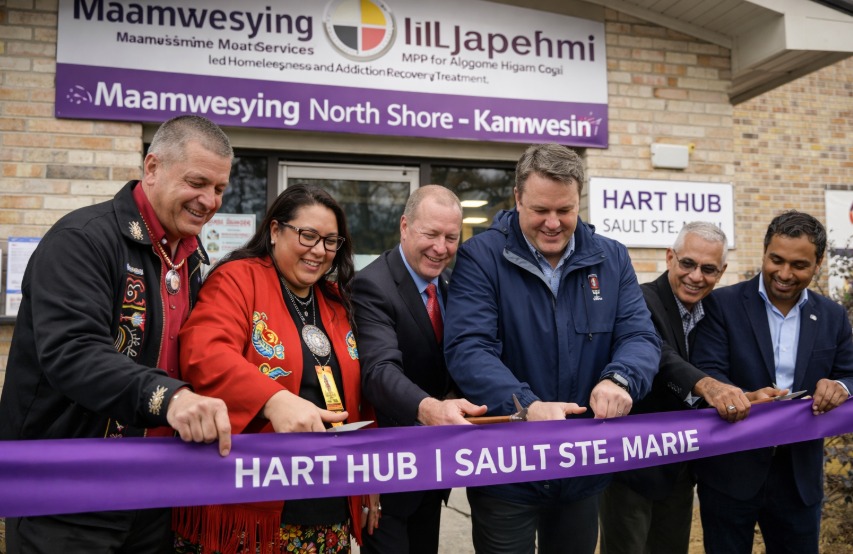
SAULT STE. MARIE — Ontario has opened a new Indigenous-led Homelessness and Addiction Recovery Treatment (HART) Hub in the Algoma region, expanding access to mental health, addictions and housing-related supports as the province rolls out a network of 28 hubs designed to prioritize treatment and recovery.
The new hub is operated by Maamwesying North Shore Community Health Services and will deliver services in Sault Ste. Marie, Blind River and Sagamok Anishnawbek, providing culturally relevant, community-based care for individuals experiencing housing instability, mental health challenges and substance use issues.
The launch is part of Ontario’s nearly $550 million investment to establish 28 HART Hubs across the province, a program the government says is aimed at protecting community safety while improving access to high-quality recovery and treatment services.
“We are building a stronger, more connected system of mental health and addictions care that better reflects the needs of communities and focuses on lasting recovery,” said Vijay Thanigasalam, Associate Minister for Mental Health and Addictions. “The opening of this new HART Hub will ensure that people struggling with mental health and addictions challenges in Sault Ste. Marie can get the care they need on their path to recovery while keeping the community safe.”
HART Hubs are intended to connect people to a range of integrated services, including primary care, mental health supports, addictions treatment, social services and employment assistance. Ontario says the model is designed to bring clinical and community-based supports together, allowing people to access care through a coordinated approach rather than navigating separate systems.
Operating from three locations, the Maamwesying-led hub is positioned as a regional resource that will deliver services tailored to local needs while strengthening culturally based programming for Indigenous clients. The province says the hub is built on partnerships across clinical, social service and care providers, with a focus on ensuring individuals can access the right supports when they need them.
The hub will provide a range of services, including mental health care, substance use treatment, case management, outreach, culturally based Indigenous supports, supportive housing services, and shelter and transitional programming. The government says these services are designed to address complex needs that often overlap, including homelessness, mental health concerns and addictions.
Ontario’s Minister of Indigenous Affairs and First Nations Economic Reconciliation Greg Rickford said the hub represents progress in building Indigenous-led service delivery in the region.
“Today’s announcement is another major milestone in providing Indigenous-led primary care, mental health services and social supports for community members throughout the region. These new Hubs will provide those facing housing instability, mental health and substance use challenges with culturally relevant care and support they need to get on the road to recovery.”
The announcement also comes as Ontario continues to transition former Consumption and Treatment Services sites into HART Hubs. As of April 1, 2025, the province says nine sites successfully transitioned, with additional hubs now opening across Ontario. The government has stated that, with a focus on treatment and recovery, HART Hubs will not offer safer supply, supervised drug consumption or needle exchange programs.
John Jordan, MPP for Lanark—Frontenac—Kingston, said the hub model is intended to break the cycle of addiction by connecting individuals with treatment options and immediate support.
“HART Hubs are a testament to this government’s commitment to addressing the mental health and addiction needs across the province. These Hubs are focused on connecting people to treatment and breaking the cycle of addiction, giving them the opportunity to reclaim their lives. HART Hubs provide a safe and welcoming space for those who need immediate support, so they can have positive long-term results.”
In the Algoma region, provincial officials say the Maamwesying hub will help expand access to services that are both clinically comprehensive and culturally grounded. Bill Rosenberg, MPP for Algoma—Manitoulin, highlighted the hub’s role in strengthening community-centered supports.
“Congratulations to Sagamok Anishnawbek First Nation on the grand opening of the Maamwesying Homeless and Addiction Recovery Treatment (HART) Hub. This remarkable milestone reflects a strong commitment to compassionate, community-centered healing. As part of a provincial initiative, the HART Hub will make a meaningful and lasting difference for individuals and families through its vital programs and services.”
Local leadership at Maamwesying said the hub’s approach is rooted in Indigenous-led health care delivery and partnerships with Indigenous organizations across the region.
“Our people and our communities need and deserve Indigenous-led health and social services to respond to the addictions and homelessness crisis. Maamwesying is proud to partner with Minister Sylvia Jones and the Ontario government on this HART Hub which engages local Indigenous organizations to support our people with a circle of multi-dimensional care for complex needs. Indigenous health in Indigenous hands works for our communities.”
Allan Moffatt, CEO of Mamaweswen, The North Shore Tribal Council, said the hub will help strengthen coordination across communities and improve access to integrated care for Indigenous people both on and off reserve.
“All communities in the North Shore Tribal Council are committed to this HART Hub that will help our families struggling with the opioid epidemic, building bridges between silos. This will support an established and trusted network to integrate care for our people both on and off reserve. Thank you to Premier Ford for continuing to recognize the leadership of Maamwesying and the importance of investing in Indigenous services as a recovery pathway.”
Ontario says the HART Hub rollout is part of broader provincial planning to improve access to integrated care, including through Your Health: A Plan for Connected and Convenient Care, building on the province’s Roadmap to Wellness strategy. Under the Roadmap to Wellness, Ontario is investing $3.8 billion over 10 years to expand and strengthen mental health and addictions services, while Budget 2025 includes $303 million over three years for community-led mental health programs.
The province also says HART Hubs will add close to 900 supportive housing units across Ontario, intended to help people transition to stable housing and support longer-term recovery outcomes. A second Indigenous-led hub in Kenora is also actively delivering services, further expanding access to culturally relevant care in Northern Ontario.
