

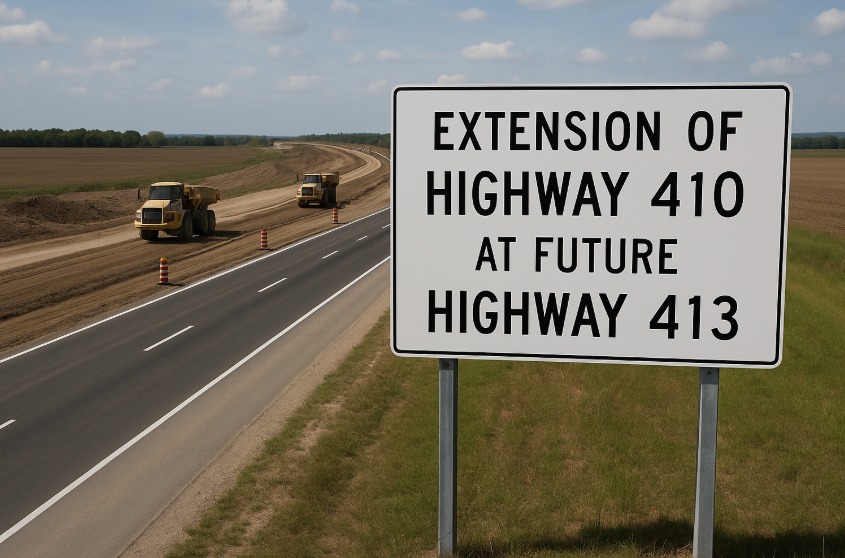
The Ontario government is moving ahead with a key link in its signature highway expansion program, issuing a Request for Proposals (RFP) to design a 9.1-kilometre extension of Highway 410 that will connect directly to the planned Highway 413 corridor. The step marks a significant milestone in the province’s multi-billion-dollar plan to relieve gridlock across the Greater Toronto Area and support long-term economic growth.
Announced Monday in Caledon, the proposed Highway 410 extension would run from Countryside Drive north to Highway 413, and from Highway 413 west to Highway 10. Once completed, it would provide drivers a direct connection between the two major routes and reduce pressure on increasingly congested regional roads. The Ford government estimates that travel times across the new corridor could be shortened by as much as 30 minutes per trip.
“Our government is making historic investments in highway infrastructure to get drivers in the GTA and Ontario out of gridlock,” said Prabmeet Sarkaria, Minister of Transportation. “Building Highway 413 will help protect Ontario against U.S. tariffs and global economic uncertainty by improving the movement of people and goods and keeping more than 6,000 workers on the job during construction.”
Highway 413 itself is planned to run from Highway 400 in the east to the Highway 401/407 interchange in the west. According to the Ministry of Transportation, construction on the future route is expected to support more than 6,000 jobs annually and contribute more than $1 billion to Ontario’s gross domestic product.
The new RFP follows several recent project milestones, including the award of the first two construction contracts for Highway 413 in August and the completion of upgrades to the Highway 401/407 interchange, which will serve as the highway’s western terminus.
The provincial government emphasized that the 410 extension is part of its broader $220-billion infrastructure plan—the largest in Canadian history. That strategy includes roughly $30 billion for roads, highways and bridges, among them the Bradford Bypass, the twinning of the Garden City Skyway in St. Catharines, and major widening projects on Highway 401 and the QEW.
Support for the announcement came from several industry and sector stakeholders, who framed the project as essential to economic competitiveness, construction supply chains and long-term regional planning.
“OSSGA welcomes today’s progress on Highway 413. Moving ahead with this critical corridor will strengthen Ontario’s economy, reduce gridlock, and support the close-to-market aggregate supply that makes every major infrastructure project possible,” said Sharon Armstrong, interim executive director of the Ontario Stone, Sand & Gravel Association.
Other industry voices drew attention to the role of infrastructure in supporting the province’s energy demands and population growth. “The GTA is the most congested region in North America, which is why it’s critical that we build new highways, subways, and transit to get people moving. As we build new infrastructure, we are also delivering the largest clean power expansion that keeps the GTA moving and Ontario’s economy strong,” said Stephen Lecce, Minister of Energy and Mines.
Local representatives also pointed to the implications for daily commuters. “As our government advances work on Highway 413, this milestone brings us one step closer to reducing gridlock and shortening commute times for residents of Dufferin-Caledon and beyond,” said Sylvia Jones, MPP for Dufferin-Caledon. “This progress builds on our government’s bold action to deliver the transportation network Ontario families will rely on for generations to come.”
Labour groups highlighted the project’s employment significance. “This latest step toward extending Highway 410 and connecting it with the future Highway 413 demonstrates real momentum in building the transportation network our growing region needs,” said Jack Oliveira, business manager for LiUNA Local 183. “Ontario’s continued progress on Highway 413 demonstrates a clear vision for growth and opportunity. It is a powerful reminder of the long-term investments needed to support our growing communities.”
Additional support came from construction associations. “RCCAO welcomes the Ontario’s Government’s RFP for Highway 410’s extension to support the future construction of Highway 413,” said Nadia Todorova, executive director of the Residential and Civil Construction Alliance of Ontario. “Today’s news caps off a year of progress on legislative, regulatory, and tendering preparatory work by the province to advance building Highway 413 and bring much needed critical infrastructure to one of the fastest growing regions of the province.”
Patrick McManus, executive director of the Ontario Sewer and Watermain Construction Association, added that “today’s announcement marks another significant project within the province’s multi-billion-dollar infrastructure and transportation plan, and a project that brings us another step closer to building Highway 413.”
The province also noted refinements to the Northwest GTA Transmission Corridor, which will share portions of the Highway 413 route and support Ontario’s long-term energy strategy. Lands deemed unnecessary for future transmission infrastructure will be released.
A draft Environmental Impact Assessment Report for Highway 413, required under the Highway 413 Act, 2024, is now available for public comment. The effort to accelerate the project follows last year’s passage of the Reducing Gridlock, Saving You Time Act.
Ontario continues to cite the high cost of congestion as a key motivation. According to the Canadian Centre for Economic Analysis, gridlock cost the province $56 billion last year and could rise to $108 billion by 2044 if no new measures are taken.
